

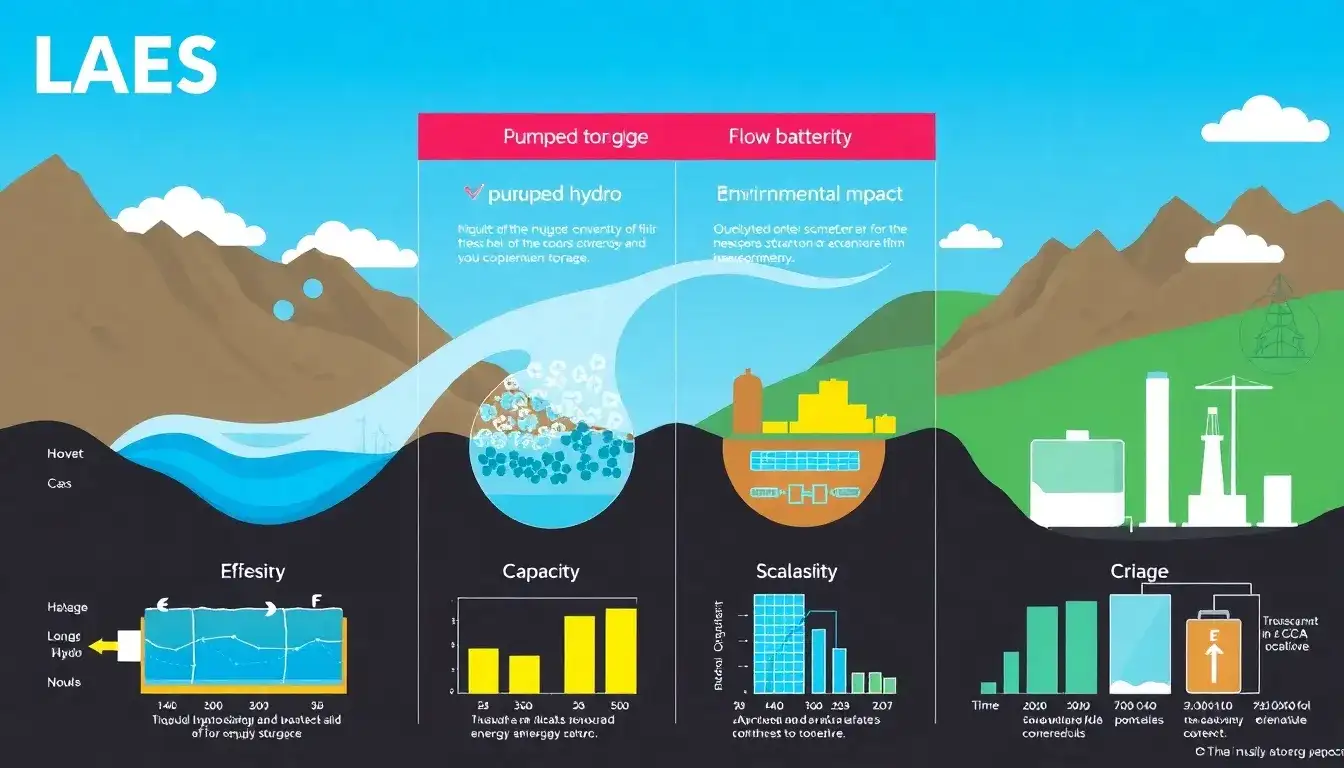
Liquid Air Energy Storage (LAES) is a promising technology for long-duration energy storage, particularly as the world shifts towards renewable energy sources. Here’s how it compares to other long-duration energy storage technologies:
Key Features of LAES
- Clean and Scalable: LAES systems are environmentally friendly and can be deployed on a large scale, offering medium to large-scale storage solutions.
- Efficiency and Cost: Standalone round-trip efficiency of LAES ranges from 50% to 60%, which is lower than some other technologies. However, LAES can achieve higher efficiencies by integrating waste heat or cold, potentially reaching over 70%.
- Cost-Effectiveness: The levelized cost of storage (LCOS) for LAES is competitive, around $60 per megawatt-hour, which is lower than lithium-ion batteries and pumped hydro storage.
- Flexibility: LAES can be built anywhere, which offers logistical advantages over technologies like compressed air energy storage (CAES), which requires specific geological formations.
Comparison with Other Technologies
| Technology | Efficiency (RTE) | Scale | Cost (LCOS) |
|---|---|---|---|
| LAES | 50% – 60% (standalone), potential for 70%+ with optimization | Medium to large scale, GW/GWh | Approximately $60/MWh |
| CAES | 55% – 65% | Large scale, dependent on geology | Generally more expensive than LAES |
| Pumped Hydro Storage (PHS) | 80% – 90% | Large scale, dependent on geography | Higher LCOS than LAES |
| Lithium-ion Batteries | 90% – 95% | Small to medium scale | Higher LCOS than LAES |
Advantages and Disadvantages of Each Technology
- LAES:
- Advantages: Scalable, flexible deployment, potentially cost-effective, high storage capacity.
- Disadvantages: Lower efficiency compared to some other technologies, complex process.
- CAES:
- Advantages: Well-established technology, reliable efficiency.
- Disadvantages: Requires specific geological sites.
- PHS:
- Advantages: High efficiency, proven technology.
- Disadvantages: Limited by geography, higher cost compared to LAES.
- Lithium-ion Batteries:
- Advantages: High efficiency, widely used.
- Disadvantages: Higher cost compared to LAES, limited scale for long-duration storage.
Overall, LAES offers a competitive cost profile and flexibility in deployment, making it a promising option for future energy grids, especially with financial incentives to improve its economic viability. However, it faces challenges in terms of efficiency compared to other technologies like PHS and lithium-ion batteries.
Original article by NenPower, If reposted, please credit the source: https://nenpower.com/blog/how-does-liquid-air-energy-storage-compare-to-other-long-duration-energy-storage-technologies/

