

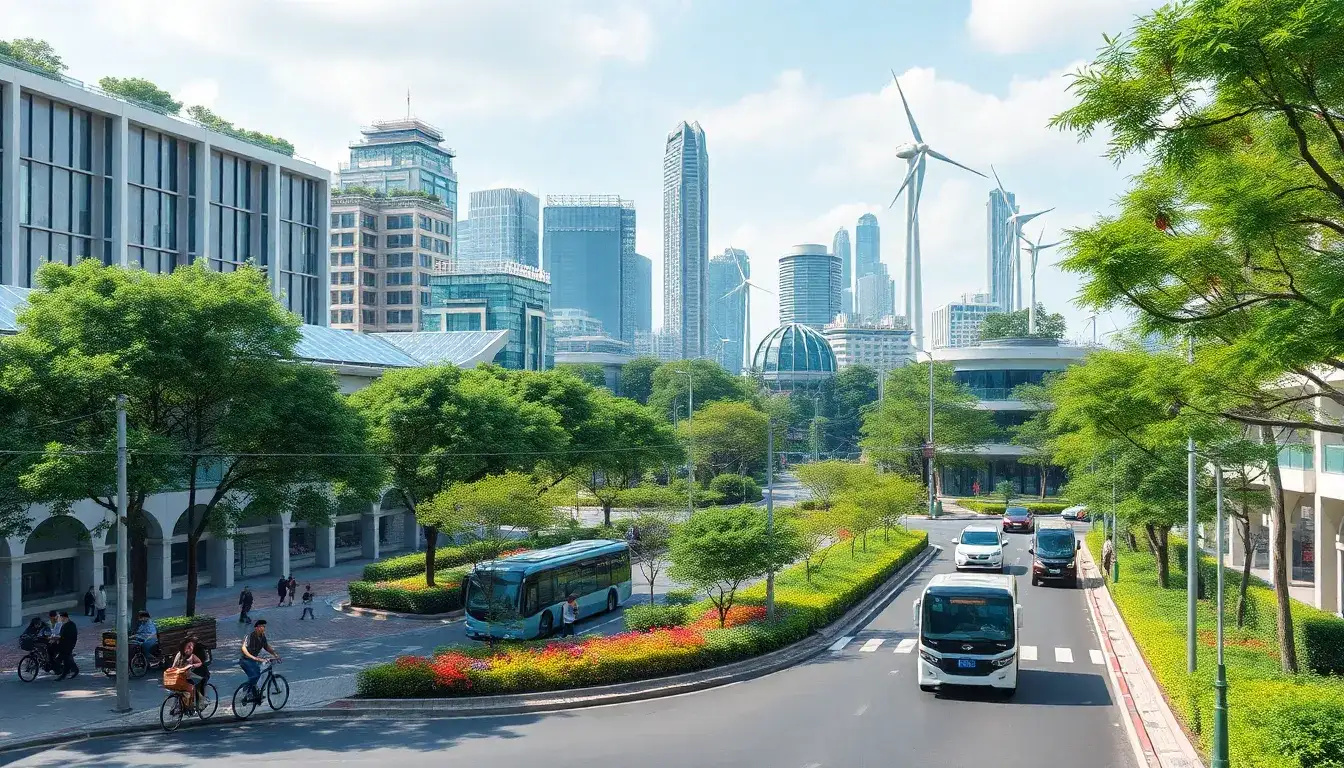
Guangzhou Accelerates the Development of a Green, Low-Carbon, and Beautiful City
As of now, Guangzhou has successfully put into operation 12,000 pure electric buses. The “Guangzhou Public Transport Electrification” project, led by the Guangzhou Public Transport Group, has made it to the finals of the “Earthshot Prize” in the “Clean Air” category. This achievement signifies Guangzhou’s leading position in the global transition to green transportation, showcasing a vibrant example of China’s dual carbon objectives on the world stage.
This year marks the 10th anniversary of the Paris Agreement, a pivotal moment in global climate governance. As a significant central city and the core engine of the Guangdong-Hong Kong-Macao Greater Bay Area, Guangzhou firmly anchors itself to the dual carbon goals, prioritizing ecological preservation and green development. The city is actively promoting the synergy between pollution reduction and carbon emission reduction, striving to balance high-quality development with high-level protection. It is exploring a comprehensive green and low-carbon transformation of urban life, accelerating the creation of a beautiful and sustainable city.
Building a Low-Carbon Network Across Multiple Scenarios
As a pioneer in reducing transportation emissions in mega cities, Guangzhou’s efforts began in 2017. Over the past eight years, the city has focused on “vehicle electrification, clean energy, intelligent operations, and battery recycling” to establish a comprehensive green public transport system. The central urban area has achieved 100% electrification of buses and taxis, with a cumulative deployment of 12,000 electric buses and nearly 10,000 electric taxis. Additionally, it has built 400 charging stations and 8,000 charging piles, creating a city-wide network for green travel.
The transformation’s success is evident in the data: since the project’s implementation, Guangzhou’s public transportation energy consumption has decreased by 50%, resulting in a reduction of nearly 1 million tons of carbon emissions and a 40% drop in PM2.5 concentration. Residents’ travel experiences have improved alongside enhanced urban air quality.
The breakthroughs in transportation are merely a glimpse of Guangzhou’s dual carbon practices. The city is integrating green concepts across all dimensions of urban development, including industry, energy, and public welfare. By the end of 2024, Guangzhou’s installed capacity for natural gas, biomass, and solar energy will reach 7.35 million kW, 930,000 kW, and 3.57 million kW, respectively, marking significant growth compared to the end of the 13th Five-Year Plan.
Guangzhou has established 82 national-level green factories, 1 green industrial park, and 18 green supply chain management enterprises, ranking among the top nationwide. Ultra-low energy consumption and nearly zero energy consumption building projects span 800,000 square meters, with the central district’s buses and all taxis fully electrified. The city’s delivery vehicles are now 100% new energy trucks, and it has built seven major circular economy industrial parks to achieve “zero landfill” for municipal solid waste, marking significant progress in green and low-carbon transformation across energy, industry, building, transportation, and waste management.
Carbon Inclusivity Initiatives Engage the Public
The green and low-carbon transformation is an irreversible trend that requires active participation from all sectors. As one of the first carbon inclusivity pilot cities in the country, Guangzhou has innovatively constructed a closed-loop ecosystem of “carbon inclusivity – carbon trading – carbon neutrality.” This system quantifies citizens’ green travel and waste sorting behaviors into “carbon assets,” converting them into market value through certification, issuance, and trading, thus achieving precise alignment between individual carbon reduction and corporate emissions cuts. This “shared construction and sharing” mechanism transforms low-carbon responsibility from the government to a societal consensus.
By July 2025, the Guangzhou carbon inclusivity platform will have created a multi-dimensional ecological operation system covering carbon inclusivity scenic spots, campuses, and communities. It will integrate over 10 public low-carbon data platforms, including WeChat Sports, Alipay ride codes, Hello Bike, and Sui Recycling, and establish a carbon inclusivity cooperation alliance with more than 30 participating companies. The city will launch a low-carbon city check-in map and over 10 low-carbon check-in routes, and will unveil the nation’s first carbon inclusivity demonstration children’s park. The platform has attracted 459,900 registered users, benefiting over 6 million people.
Creating a Carbon-Neutral Event for the National Games
The upcoming 15th National Games and the Special Olympics in November 2025 will showcase Guangzhou as a new window for low-carbon practices. On September 30, 2025, the “Guangzhou Sewage Treatment Plant Standardized Tail Water Reuse Carbon Inclusivity Methodology” was officially released. This is the first carbon inclusivity methodology linking “tail water reuse” and “carbon reduction” in the sewage industry. Guangzhou Water Investment Group has even pre-donated 6,051 tons of voluntary carbon reduction, setting a dual benchmark for low-carbon development in sports events and urban water management.
This event, grounded in the principles of “green, sharing, openness, and integrity,” aims to create the first carbon-neutral National Games in history, deeply integrating the dual carbon objectives throughout the entire event planning process. The Guangzhou competition area will employ a “1+1+1” model, featuring one zero-carbon building, one near-zero carbon building, and several green building star venues, implementing differentiated renovation strategies to revitalize old venues.
Guangzhou has also proposed to utilize a large-scale local carbon inclusivity system, integrate zero-carbon scene concepts, and advocate for the supply of zero-carbon products, all aimed at achieving carbon neutrality for the Guangzhou competition area. The city encourages citizen participation in carbon donations through the carbon inclusivity platform, supporting scenic spots, communities, and large commercial entities in building carbon inclusivity pilot zones.
From international breakthroughs in transportation electrification to multi-scenario low-carbon integration, and now to the first carbon-neutral National Games, Guangzhou is responding to the dual carbon era with systematic reforms, promoting carbon reduction, pollution reduction, greening, and growth, making green the most distinct hallmark of high-quality development in mega cities.
Global Recognition for Public Transport Electrification
On October 5, the Earthshot Prize Council announced in London that the “Guangzhou Public Transport Electrification” project, spearheaded by Guangzhou Public Transport Group, has been shortlisted for the 2025 Earthshot Prize in the “Clean Air” category. The Earthshot Prize, initiated by Prince William in 2020, is recognized as one of the world’s most prestigious and influential environmental awards. It aims to honor groundbreaking contributions to climate change solutions and environmental protection worldwide, with shortlisted projects representing the highest standards and forward-thinking concepts in global environmental governance.
This year’s awards featured nearly 2,500 submissions from 72 countries and regions, with 15 projects from cities such as Guangzhou, Bogotá, West Virginia, and Bristol making it to the finals. The final assessment and award ceremony will take place on November 5 in Rio de Janeiro, Brazil, where five winners will be determined.
Key Highlights:
- The “Guangzhou Public Transport Electrification” project has built a comprehensive green public transport system through innovative mechanisms, technological leadership, and infrastructure development, focusing on vehicle electrification, clean energy, intelligent operations, and battery recycling.
- Currently, Guangzhou Public Transport Group operates 12,000 pure electric buses, nearly 10,000 electric taxis, and 4 new energy ferries. The city has established 400 charging stations and approximately 8,000 charging piles, while also developing integrated low-carbon industrial parks for solar energy storage.
- Over the past eight years, the project has reduced carbon emissions by nearly 1 million tons, led to a 40% decrease in PM2.5 concentration, and cut public transport energy consumption by 50%, significantly improving urban air quality and residents’ travel experiences, while providing solid local practices for China’s dual carbon objectives.
Guangzhou’s Practices in Battery Recycling
Recently, the “Guangzhou Public Transport Electrification” project was shortlisted for the 2025 Earthshot Prize, highlighting Guangzhou’s vibrant practices of tackling resource challenges through “circular intelligence” and implementing ecological civilization via “refined governance.” The project has innovatively established a “retired battery – tiered utilization – resource regeneration” circular model, creating China’s first “battery hospital” demonstration base. This initiative successfully extends battery life, reduces overall life cycle costs, and plans to build a production line with an annual output of 15,000 tons for tiered utilization, achieving large-scale reuse of retired batteries in fields like solar energy storage and low-speed electric vehicles.
The first tiered battery energy storage station in the Guangdong-Hong Kong-Macao Greater Bay Area, resembling a container, has become the energy core of the industrial park. The Yanning energy storage project alone can save around 4 million yuan in electricity costs over its entire cycle. The key to this high efficiency lies in the lithium iron phosphate batteries retired from public transport. After undergoing comprehensive testing, qualified cells are reconfigured, and paired with a “black box” active balancing device, allowing stronger cells to exert more power while weaker cells consume less energy, granting them a “second life.”
The “battery hospital” in the Shima Industrial Park represents a deeper exploration of Guangzhou’s ecological management across the entire battery life cycle. Here, professionals conduct precise assessments and develop customized “revitalization plans” for batteries. Additionally, the “battery hospital” has independently developed a 24V starting lithium battery suitable for new energy buses, with a lifespan of 8-10 years, closely aligned with the vehicle’s entire life cycle.
Original article by NenPower, If reposted, please credit the source: https://nenpower.com/blog/guangzhou-accelerates-development-of-a-green-low-carbon-city/

