

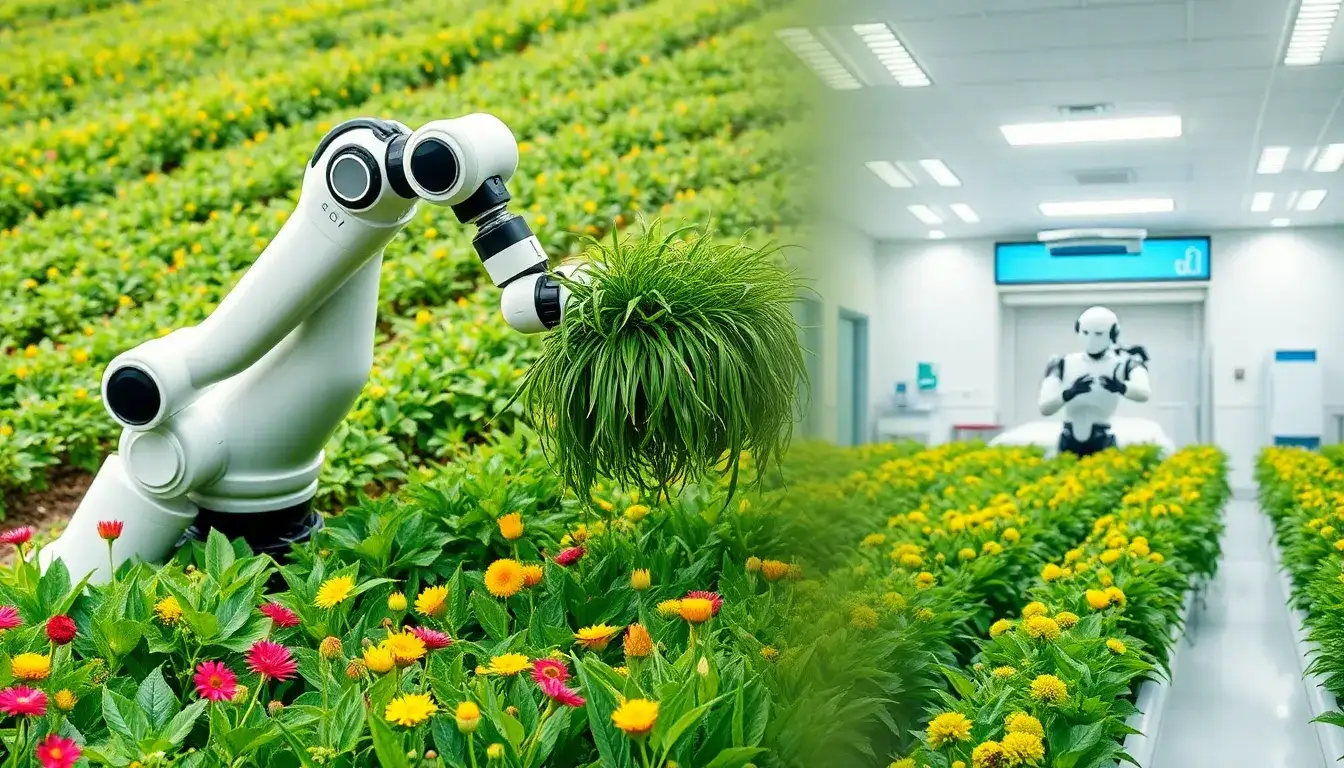
Fuzhou-made robots are showcasing their capabilities in various settings this spring. The impressive robot performances during this year’s Spring Festival Gala highlighted their versatility. In Fuzhou, these robots are no longer just stars on stage; they are actively involved in tasks such as inspecting chickens in poultry farms, harvesting navel oranges in orchards, and assisting doctors during surgeries. They have even made their way to international markets, being exported to countries like Malaysia and Japan. From industrial production lines to public services, and from healthcare to smart logistics, Fuzhou is rapidly developing a robot industry cluster characterized by its regional features through the three-pronged approach of expanding application scenarios, executing key projects, and fostering an innovative ecosystem.
At the Fuzhou Guangyang Egg Industry’s Yuxi chicken farm, a robot named Mu Jilang 6 autonomously patrols a chicken house housing 50,000 hens. Utilizing the world’s first deep learning model for the poultry industry, and integrating visual and voiceprint multimodal analysis technologies, it achieves a 99% accuracy rate in identifying dead chickens and a 90% accuracy rate for weak or non-productive hens. This innovation addresses the challenges of low efficiency and high error rates in traditional manual inspections. According to Liao Xinwei, the head of the development team for Mu Jilang, “The egg-laying industry is highly standardized and automated, but human factors remain the primary risk variable. Issues such as an aging workforce and labor shortages also hamper industry development.” Currently, over 220 Mu Jilang robots are serving more than 100 egg-laying companies across the country. In February 2025, this Fuzhou-made robot was exported to Malaysia, marking a significant breakthrough in the international market for China’s original poultry farming robots. Subsequently, the product was also exported to Japan, with plans to enter the European and American markets.
Robotic applications in Fuzhou continue to expand. In Fuzhou, the agricultural robotics team from Fujian Agricultural and Forestry University is testing a new generation of smart harvesting robots designed for picking navel oranges. This robot features a modular design and an autonomous navigation system, enabling it to operate stably in challenging environments such as muddy and steep terrains. In the medical field, the world’s first intercontinental surgical assistance using a 5G remote-controlled robot was successfully completed in Fuzhou. Additionally, Fuzhou Human-Machine Intelligent Technology has launched the world’s first BCI (brain-computer interface) lower limb exoskeleton rehabilitation robot, marking a shift in rehabilitation medicine from “mechanical assistance” to “neural-machine collaboration.”
On March 11, Fuzhou High-tech Zone welcomed a significant new project—the groundbreaking of the Aidekang Robot Intelligent Manufacturing Industrial Park. This high-end equipment manufacturing project has a total investment of approximately 500 million yuan and covers an area of 22.26 acres. Upon completion, it will create a complete industrial chain that includes the integrated application of intelligent robotic equipment, electrical automation system design, high-precision core component manufacturing, and the development of specialized plastic welding robots. “Once fully operational, the project is expected to generate an annual output value of 1 billion yuan, contribute 46 million yuan in annual taxes, and provide over 900 jobs,” stated a project representative. The establishment of this industrial park is poised to facilitate the collaborative development of the regional robot industry chain and inject strong “intelligent” momentum into building a more resilient modern industrial ecosystem in Fuzhou High-tech Zone.
Local robot companies in Fuzhou are also experiencing rapid growth. Founded in 2019 in Cangshan, Fujian Hanteyun Intelligent Technology Co., Ltd. has developed a core technology system encompassing hardware platforms, software systems, and algorithm models, holding over 110 invention patents. The company’s self-developed C61 smart cleaning robot is specifically designed for cleanroom environments, integrating vacuuming, wiping, and high-efficiency filtration to meet the cleanliness requirements of semiconductor manufacturing and biomedicine cleanrooms. Xie Geng, deputy director of the Electrical and Software Department of Fuzhou’s Industry and Information Technology Bureau, highlighted that Fuzhou focuses on key project construction as a vital driver for robot industry development, aiming to attract quality projects, enhance the industry chain, and promote cluster-based and refined development.
The innovation ecosystem is rapidly taking shape, promoting deep integration of production, education, research, and application. The Fujian Intelligent Robot Industry Alliance was established in Fuzhou at the end of September 2025, including over 60 key companies, universities, research institutions, and financial entities across the industry chain. To address the shortage of application-oriented talent in the service robot sector, Hanteyun has collaborated with Fujian Technician College since April 2025 to establish a training base that integrates industry and education. This initiative employs a training model that combines real-life scenarios, enterprise mentorship, and project-based learning to align talent supply with industrial demand. Fujian Kunhua Intelligent Equipment Co., Ltd. has also partnered with Fuzhou University and Fujian Normal University to establish an Artificial Intelligence Research Institute, with its fully automated production line capable of producing humanoid robots. Concurrently, the construction of industry standards and quality safety systems is advancing. The first “Intelligent Service Robot Product Quality Safety Risk Monitoring Station,” built by a company in the region, has filled a gap in industry monitoring.
On March 6, a series of events themed “Quality Safety and the Healthy Development of the Robot Industry” took place in Fuzhou, alongside the inaugural conference on robot inspection, testing, and standard certification. Agreements for the transformation of research achievements were signed by 21 companies, and a national special robot standard testing and certification alliance was simultaneously established. Additionally, Huaron Group has led a collaborative agreement with nine industry-leading companies, including Jiushi Intelligent, Post, Shunfeng, Zhongtong, YTO, Shentong, Yunda, and JD.com, to construct a complete ecosystem for driverless delivery robots in Fuzhou. According to the plan, the focus will be on creating three main business scenarios: in the government service sector, a “government + unmanned delivery” model will be developed to ensure precise delivery of legal documents, approval materials, and social security documents; in the public service sector, the goal is to enhance the “last mile” for fresh foods, over-the-counter medications, and campus and park material circulation; and in special scenarios, innovative business operations will be expanded in areas such as security, emergency material delivery, and hotel supply delivery.
As policies reinforce the future, the industrial layout will continue to expand. To further boost the robot industry, Fuzhou has implemented the Action Plan for Promoting the Innovation and Development of the Artificial Intelligence Industry in Fuzhou (2024-2026). This plan actively promotes the development of “humanoid robots + AI,” encourages enterprises to develop humanoid robots based on AI large models, strengthens human-machine collaboration capabilities, and advocates for the “service leasing + system integration” business model to promote large-scale applications of humanoid robots. The Fuzhou Development and Reform Commission has announced that the application for the Provincial Engineering Research Center in 2026 has prioritized support for future industries, including humanoid robots and brain-computer interfaces. Hong Hui, general manager of China Science and Technology Intelligence (Fujian) Co., Ltd., stated that the current product line of Fuzhou’s robots spans multiple fields, including service robots, industrial robots, and special robots, widely applied in industries such as firefighting, petrochemicals, electricity, public security, counter-terrorism, transportation, and municipal services.
From the international success of the Mu Jilang robots to the groundbreaking of industrial parks, from ultra-remote surgeries to the launch of a complete ecosystem for driverless delivery robots, Fuzhou is leveraging deep integration of production, education, research, and application to accelerate the construction of an innovation ecosystem led by enterprises, supported by universities, guided by the government, and driven by the market. This manufacturing hub on the southeastern coast is using the robot industry as a new engine to continuously inject “intelligent” momentum into high-quality regional economic development.
Original article by NenPower, If reposted, please credit the source: https://nenpower.com/blog/fuzhous-innovative-robots-revolutionize-agriculture-and-healthcare-industries/

