

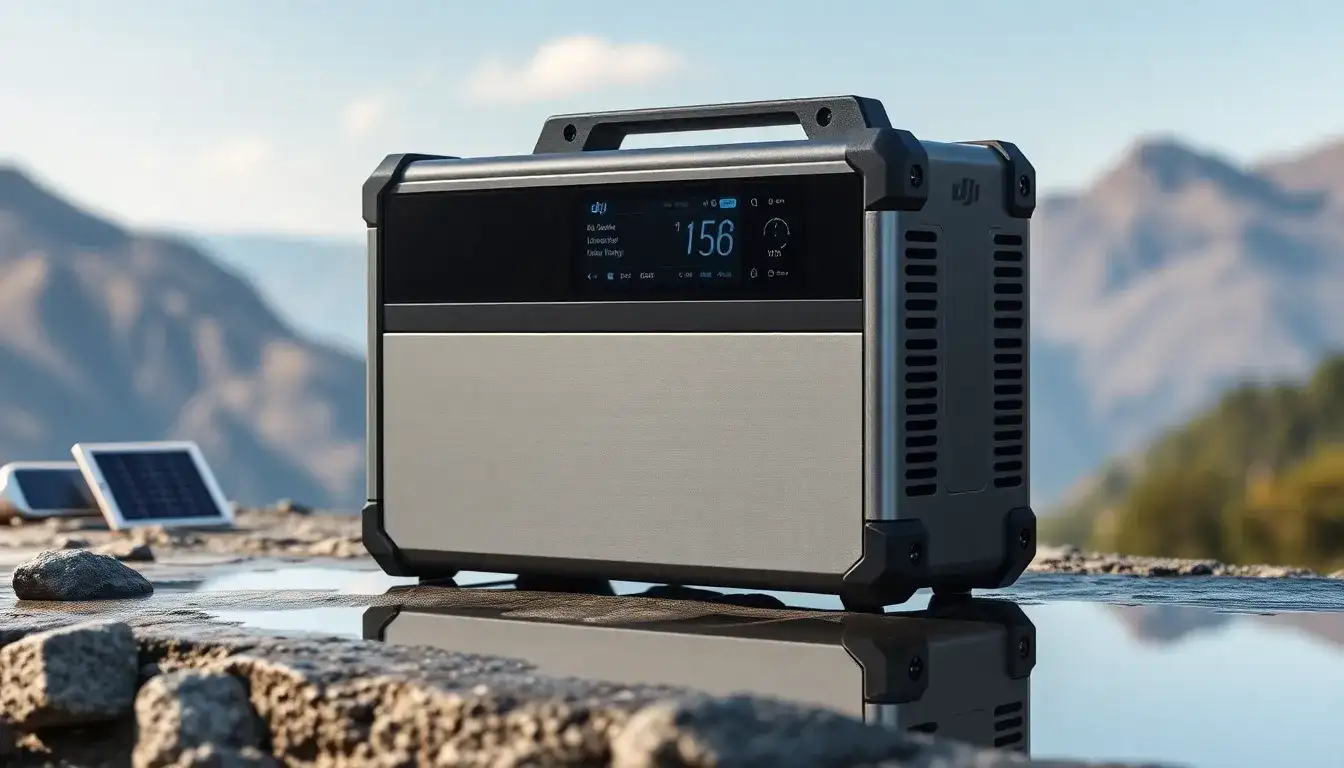
The ambitions of DJI are becoming increasingly clear as they aim to challenge Anker with their Power series. The outdoor power supply market has evolved significantly in recent years, transforming from a niche area dominated by small players into a competitive battleground for major tech firms. Last Friday, May 9, DJI officially launched its second-generation outdoor power supply—DJI Power 1000 V2—marking the company’s third outdoor power product. This model boasts a capacity of 1024Wh and a remarkable high-power output of 2600W, supporting a 0.01-second UPS mode switch and can be fully charged in as little as 56 minutes.
The launch of this product was not unexpected. As portable energy storage becomes an essential part of outdoor camping, road trips, and home backup scenarios, DJI clearly recognizes this as a significant opportunity in the hardware market. More importantly, DJI has an ecological advantage—it can power not only smartphones, cameras, and laptops, but also provide super-fast charging directly to batteries of drones like the Mavic and Inspire, offering a closed-loop experience for aerial photography users.
However, challenges arise as the outdoor power supply market is currently dominated by three major Chinese brands: Jackery, EcoFlow, and Anker. Anker has been in the outdoor power market since 2021, leveraging its robust consumer electronics channels and charging technology to secure a long-standing presence on global e-commerce platforms. In contrast, DJI only released its first outdoor power supply at the end of 2023, indicating significant gaps in brand recognition, accessory ecosystem, and user community compared to its competitors.
With the Power 1000 V2, how does DJI stack up in the mainstream portable energy storage segment? In a highly competitive market, can DJI emerge as a significant player? The 1000Wh range has become one of the most active and intensely contested segments of the market. This capacity is typically seen as the optimal balance between portability and endurance, appealing to both novice users and lightweight enthusiasts. Notably, following Jackery’s release of the 1000 Pro 2 last year, EcoFlow launched its DELTA 3 series in January, followed by DJI’s recent Power 1000 V2 introduction. Meanwhile, Anker’s latest 1000Wh outdoor power supply, the SOLIX C1000, is already three years old despite still being a best-seller.
At face value, these products are all 1000Wh lithium iron phosphate battery storage units, supporting fast charging via grid power and solar expansion, with prices generally ranging from 3000 to 5000 yuan. However, the differences between them are what give each its competitive edge.
From a performance perspective, the DJI Power 1000 V2 is positioned at the upper echelon of this capacity range with 1024Wh of energy and a maximum stable output power of 2600W, peaking at 4400W. This exceeds EcoFlow’s 1800W and Jackery’s 1500W. In practical terms, this means the product can handle virtually all household appliances, including high-demand devices like induction cookers and hair dryers.
DJI has also taken an aggressive stance on fast charging, achieving full charge in just 56 minutes, comparable to EcoFlow’s flagship X-Stream technology, and significantly faster than Jackery’s 1.8-hour charging time. Importantly, the Power 1000 V2 supports various charging modes, including grid, solar, and car fast charging. It features dual USB-A ports, four AC ports, one SDC port, one SDC Lite port, and two 1/4 inch threaded ports, making it the only model in its price range to support dual 140W USB-C (PD 3.1) fast charging, catering to high-power digital devices.
Conversely, EcoFlow’s strengths lie in its ecosystem and comprehensive functionality. Noted for its systematic approach, the DELTA 3 supports connections to additional batteries, solar panels, and smart generators, all controllable via the EcoFlow App. Its capabilities in UPS mode (uninterruptible power supply), device identification, and intelligent distribution have matured over years of refinement. For multi-device users or those needing integration with home energy systems, EcoFlow’s completeness remains an irreplaceable advantage.
While Jackery may seem conservative in specifications, it maintains a solid place in terms of portability and design. The 1000 Pro 2 continues its traditional design style, featuring a well-distributed interface and good solar charging capability, making it ideal for mid-range users seeking stability and reliability.
Returning to the DJI Power 1000 V2, it indeed offers an impressive configuration, especially in power output, interface capability, and charging time—all ranking at the industry’s top level. However, its accessory ecosystem appears limited, lacking the expansion capabilities of EcoFlow and the user base established by Jackery over the years. While DJI has created a powerful outdoor power supply, there remains considerable space for improvement in terms of marketability, usability, and sustainable evolution.
Next, it will be crucial to observe how DJI addresses these gaps. The Power 1000 V2 stands out not only for its leading specifications but also for its vision of becoming an intelligent mobile energy platform—an early glimpse of the “DJI product ecosystem.” Before achieving this, however, enhancing the fast charging experience is paramount. In grid fast charging mode, the Power 1000 V2 can reach 80% in just 37 minutes and fully charge in 56 minutes, placing it among the top tier of outdoor power supplies available today.
Additionally, it comes standard with dual USB-C ports, supporting the latest PD 3.1 protocol with a maximum power output of 140W per port. In actual usage, it can simultaneously fast-charge two high-performance laptops or drone batteries at full speed, leveraging DJI’s ecological advantages. For users of Mavic 3, Air 3, and Inspire 3 drones, the Power 1000 V2, paired with the appropriate fast-charging cable, can have drones ready for takeoff in as little as half an hour, far exceeding alternative outdoor power supply solutions.
Moreover, the Power 1000 V2’s expansion capability is noteworthy, allowing for the connection of up to five additional power packs, increasing the total capacity to 11kWh for household backup and emergency scenarios. In terms of intelligent experience, the Power 1000 V2 inherits DJI’s mature design in hardware-software integration. Through the DJI Home App, users can remotely monitor battery level, temperature, output power, switch output modes, or enable silent mode, and even upgrade firmware online. Compared to other outdoor power supplies that do not emphasize app experience, the Power 1000 V2 approaches a “remotely controllable digital energy device.”
These details add significant value in real-world scenarios. For instance, users can adjust parameters and check power status without needing to approach the power supply unit while in their vehicle, tent, or from a distance at a photography site; any device anomalies can also be promptly addressed through the app. For professional users who prioritize efficiency, this control is something many competing products fail to deliver.
Additionally, DJI has made efforts to optimize the noise performance of the Power 1000 V2. Officially, the device operates at a noise level as low as 26 decibels during charging, making it nearly silent in nighttime camping or studio environments—a stark contrast to the more audible fan noise typically associated with mainstream outdoor power supplies under fast charging conditions.
Ultimately, the DJI Power 1000 V2’s appeal lies not just in its superior hardware specifications, but also in its integrated experience centered around professional-grade use cases, ecological synergy, fast charging efficiency, and intelligent management. While it stands out as a formidable option in the outdoor power supply market, it may serve as a unique energy hub for drone users and imaging professionals.
So, how far does DJI need to go to compete with established players like EcoFlow? The Power 1000 V2 is undoubtedly a highly competitive high-performance model. With its 2600W high-power output, fully fast-charging dual 140W USB-C ports, and 56-minute complete charging efficiency, combined with its fast-charging advantages tailored for drone users and detailed app control experience, this product showcases top-tier capabilities in its class.
However, the challenges extend beyond hardware. Compared to established brands like Jackery and EcoFlow, DJI is still building a complete accessory ecosystem, channel network, and user education framework. For many general users, it is not yet the first brand that comes to mind when considering outdoor power supplies. Whether DJI can replicate Anker’s success and become the next significant player in the outdoor power supply market will depend not solely on the product itself but on whether they commit to cultivating this as a long-term venture.
DJI’s rise in the drone sector was not achieved overnight but through a consistent product rhythm and ecological layout that established long-term trust. While DJI demonstrates the capability to create a quality power supply and hints at integrating it into their ecosystem, becoming recognized as a leading outdoor power supply brand will require time, strategy, and refinement of additional product lines.
Original article by NenPower, If reposted, please credit the source: https://nenpower.com/blog/dji-unveils-ambitious-power-1000-v2-to-compete-with-anker-and-ecoflow-in-outdoor-power-market/

