

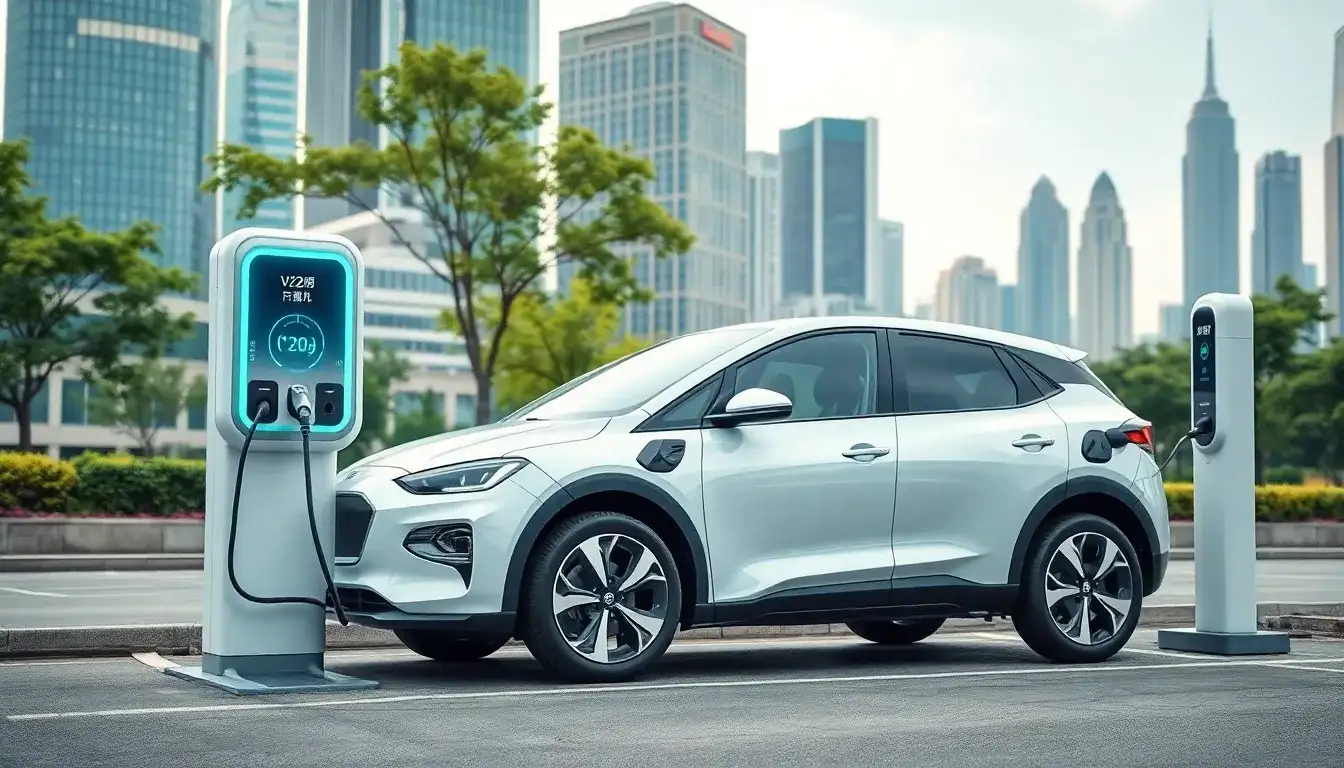
The “Charging Treasure” on Wheels is Coming!
In early April, the National Development and Reform Commission, the National Energy Administration, the Ministry of Industry and Information Technology, and the State Administration for Market Regulation announced the first batch of pilot projects for interactive vehicle-grid applications. Nine cities and thirty projects have been included in the pilot program.
Interactive vehicle-grid technology enables electric vehicles to function as “mobile charging treasures.” These vehicles can not only charge from the grid but also send energy back to it. This initiative benefits ordinary vehicle owners by providing them with financial gains and reducing their vehicle operating costs. Additionally, it ensures that the power grid has sufficient electricity, helping to manage peak and off-peak demand, and will further promote the development of the new energy vehicle industry.
Pilot Cities with Scale Application Advantages
The list of the first batch of pilot cities includes Shanghai, Changzhou, Hefei, Huaibei, Guangzhou, Shenzhen, Haikou, Chongqing, and Kunming, as well as thirty projects such as the “V2G Collaborative Regulation Pilot Project Based on New Energy Storage” in Beijing. According to Liu Bowen, the head of the Charging Business at the Electric Vehicle and Energy Storage Branch of the China Electric Power Enterprise Association, these cities have advantages in policy support, industrial infrastructure, and technological innovation.
Shanghai has constructed a total of 913,000 charging piles and 225 battery swap stations, achieving a vehicle-to-pile ratio of approximately 1.8:1. Shenzhen has built 100 interactive demonstration stations and 151 V2G stations. Kunming has over 2,200 charging stations and more than 120,000 charging piles, reaching an average of 1.8 charging stations per square kilometer in the main urban area. Chongqing boasts 381,200 new energy vehicle charging piles and 219 battery swap stations, with comprehensive coverage of ultra-fast and quick charging stations across the city and rural areas.
Broad Prospects for Electric Vehicles Participating in Vehicle-Grid Interaction
What can vehicle-grid interaction bring? By the end of 2024, the number of new energy vehicles in China is expected to reach 31.4 million, with a total of 12.818 million charging infrastructure units. The number of various charging operators has surpassed 10,000. For regular vehicle owners, using V2G technology to supply electricity to the grid can generate tangible financial benefits and lower operating costs. For instance, Mr. Li, a car owner in Guangzhou, learned that he could receive a subsidy of 3.5 yuan per kilowatt-hour for discharging to the grid, which he finds very attractive.
Moreover, regions participating in the pilot will implement time-of-use pricing for charging, aiming for over 60% of annual charging electricity to occur during off-peak hours. Residents charging from private piles will see over 80% of their usage concentrated during these low-demand periods, effectively widening the price gap between peak and off-peak rates and encouraging ordinary vehicle owners to charge during off-peak times.
Where does the electricity discharged by vehicles go? Charging stations are equipped with transformers that directly deliver the current to the city’s main grid. Liu Bowen stated that “vehicle-grid interaction can fully utilize the flexibility of power batteries as controllable loads and mobile energy storage, supporting the efficient and economical operation of new power systems, alleviating the burden of large-scale electric vehicle development on power systems, and helping to manage peak loads, integrate renewable energy, and stabilize load fluctuations.”
Key to a Complete Business Model
Since the release of China’s first top-level design document for vehicle-grid interaction at the end of 2023, various policies supporting the development of this industry have been introduced. With guidance from these policies, industry players are accelerating the establishment of large-scale pilot applications. Recently, the Southern Power Grid Company organized the country’s first inter-provincial vehicle-grid interaction project, covering 63 cities across five provinces, including Guangzhou, Shenzhen, Haikou, and Kunming, with interactive electricity volumes exceeding 500,000 kilowatt-hours and participation from over 100,000 electric vehicles, demonstrating the potential for large-scale application.
To aggregate a large number of dispersed electric vehicles and harness their scale effect, a complete business model is crucial. V2G technology requires specialized charging stations, with design costs approximately 1.2 times that of standard charging stations. By creating a robust business model that ensures profitability for operators, companies will be incentivized to switch to V2G charging stations. Currently, the market mechanism for vehicle-grid interaction is still in exploration.
Experts believe that despite numerous challenges, vehicle-grid interaction is poised to achieve a “win-win” outcome with continued technological advancements and the gradual improvement of supportive policies.
Original article by NenPower, If reposted, please credit the source: https://nenpower.com/blog/china-launches-pilot-program-for-vehicle-to-grid-technology-to-transform-electric-cars-into-mobile-power-sources/

