

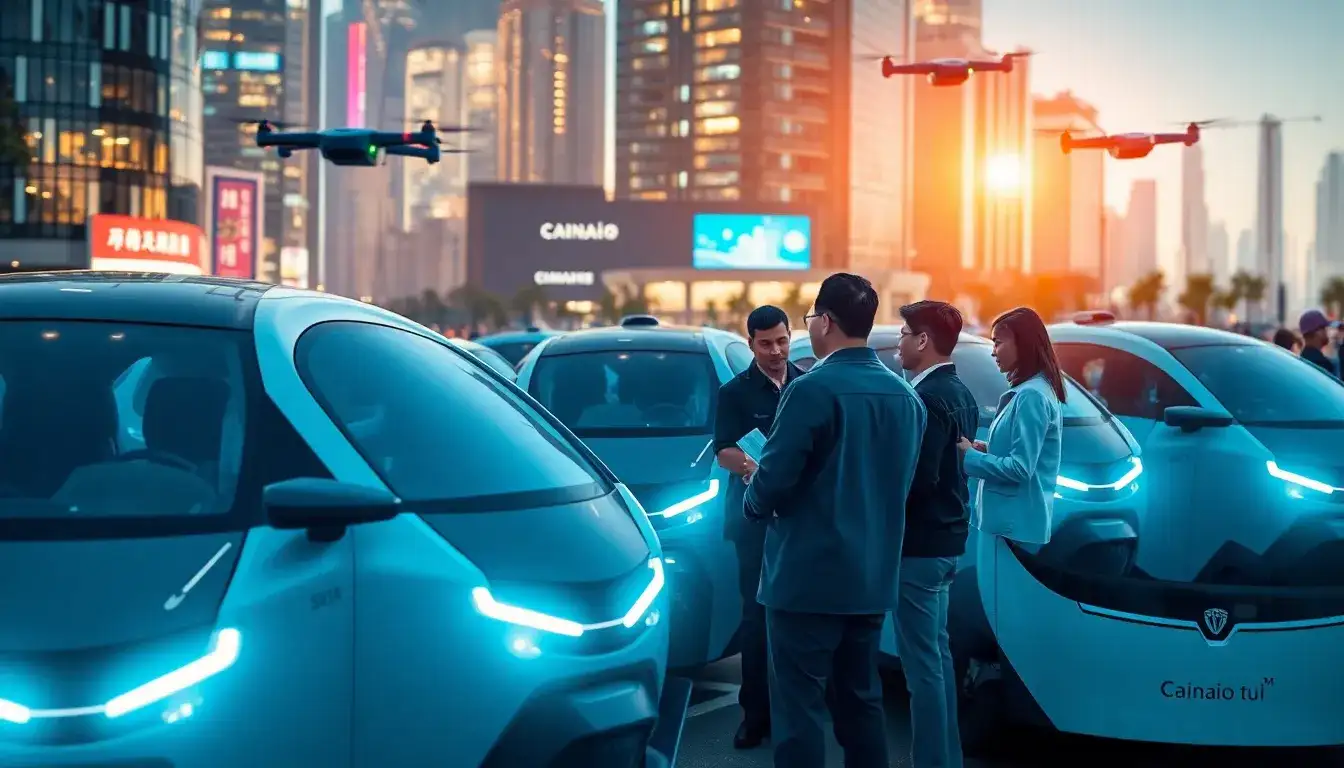
Recently, Cai Niao’s autonomous vehicles have merged with Jiu Shi Intelligent, creating the largest fleet of unmanned logistics vehicles in the world. On January 29, news emerged that Jiu Shi Intelligent and Cai Niao’s autonomous vehicle division have officially announced a strategic restructuring of their unmanned vehicle business. As part of this deal, Cai Niao has become a strategic shareholder in Jiu Shi Intelligent through business asset injections and cash investments.
Following the restructuring, the new entity will not only boast the largest Robovan (autonomous freight vehicle) fleet globally but will also signal a shift in the industry from isolated technological exploration to a more integrated approach combining “scenarios + technology.” Both companies have confirmed that they will maintain independent brand operations post-merger.
Capital Restructuring and Dual Brand Strategy
Both parties aim to become the “Toyota and Lexus” of the logistics sector. The central focus of this integration is resource reallocation. Following the restructuring, Cai Niao will undergo a role transformation, stepping away from direct involvement in unmanned vehicle hardware development and sales. Instead, it will focus on leveraging its global logistics network to promote the large-scale application of unmanned vehicles. Operationally, Jiu Shi Intelligent will receive the “Cai Niao Unmanned Vehicle” brand authorization, initiating a dual brand independent operation model. According to Zhou Qing, co-founder of Jiu Shi Intelligent, this strategy is comparable to the relationship between Toyota and Lexus.
The Jiu Shi brand will concentrate on delivering comprehensive smart transportation solutions, while the “Cai Niao Unmanned Vehicle” brand will leverage its logistics technology expertise to focus on specific scenarios and key accounts, offering in-depth services based on RoboVan technology. The two companies will share their technological foundations and supply chain systems to reduce R&D costs through economies of scale.
In contrast to Robotaxi, which faces stringent regulations and technological challenges, urban unmanned freight logistics has already established a commercial closed loop due to its low-speed, cargo-carrying, and urban distribution characteristics. Currently, the combined fleet of Jiu Shi and Cai Niao has surpassed 20,000 vehicles, covering over 500 cities. Zhou Qing shared in a recent media interview that customers utilizing unmanned vehicles have achieved an average cost reduction of over 50% compared to traditional models. Li Shangqing, General Manager of Cai Niao’s unmanned vehicle business division, noted that Cai Niao’s cross-border and local global businesses could integrate deeply with Jiu Shi’s RoboVan technology.
Achieving Technological Complementarity and Deepening Scenario-Based Operations
The restructuring has enabled both parties to complement each other technologically. Cai Niao’s unmanned vehicle team has long been a leader in visual language models (VLA) and world modeling, handling millions of packages daily, generating high-quality data across the entire supply chain and various scenarios. Jiu Shi Intelligent, on the other hand, possesses nearly a hundred million kilometers of real-world public road data, alongside L4-level engineering capabilities for vehicles with varying load capacities from 2 to 10 cubic meters.
With the management and technical leaders from Cai Niao officially joining Jiu Shi Intelligent, a complete chain will be established from foundational chassis development and algorithm iteration to large-scale operations. Wan Lin, CEO of Cai Niao Group, emphasized that both companies would maintain a close ecological partnership. Kong Qi, CEO of Jiu Shi Intelligent, believes that this collaboration represents a milestone in the automatic driving industry, moving from “point breakthroughs” to “system integration.” In practical applications, low-cost unmanned delivery will normalize services like same-day delivery for fresh produce and pharmaceuticals, while nighttime deliveries will help alleviate urban traffic congestion. Additionally, the new entity has established a logistics network covering urban, town, and county levels. In the future, based on a universal autonomous driving chassis, operations will also extend into specialized robotics fields such as sanitation inspections, municipal services, and agriculture.
The Booming Unmanned Delivery Business
The unmanned delivery business is currently thriving, and one of the entities involved in this merger, Jiu Shi Intelligent, has secured multiple rounds of financing, now entering its Series B round. As of now, the total amount raised in Jiu Shi Intelligent’s Series B financing has reached $400 million (approximately 2.848 billion RMB), making it one of the most significant financings among Chinese technology companies in 2025 and a crucial event in the global L4 autonomous driving sector. Public information from Qichacha indicates that the total financing for Jiu Shi Intelligent’s Series A and B rounds has accumulated to $500 million (approximately 3.56 billion RMB).
Conclusion
The collaboration between unmanned logistics vehicle players marks a significant shift in the industry. The integration of Jiu Shi and Cai Niao signifies that the development of unmanned logistics vehicles has evolved from a purely technological competition to a systematic competition that encompasses scale, data, and ecosystems. By leveraging each other’s strengths, both companies can avoid ineffective internal competition and rapidly capture significant market share in the blue ocean of unmanned logistics vehicles.
Original article by NenPower, If reposted, please credit the source: https://nenpower.com/blog/cainaio-and-jiushi-technology-merge-to-create-worlds-largest-autonomous-delivery-fleet/

