

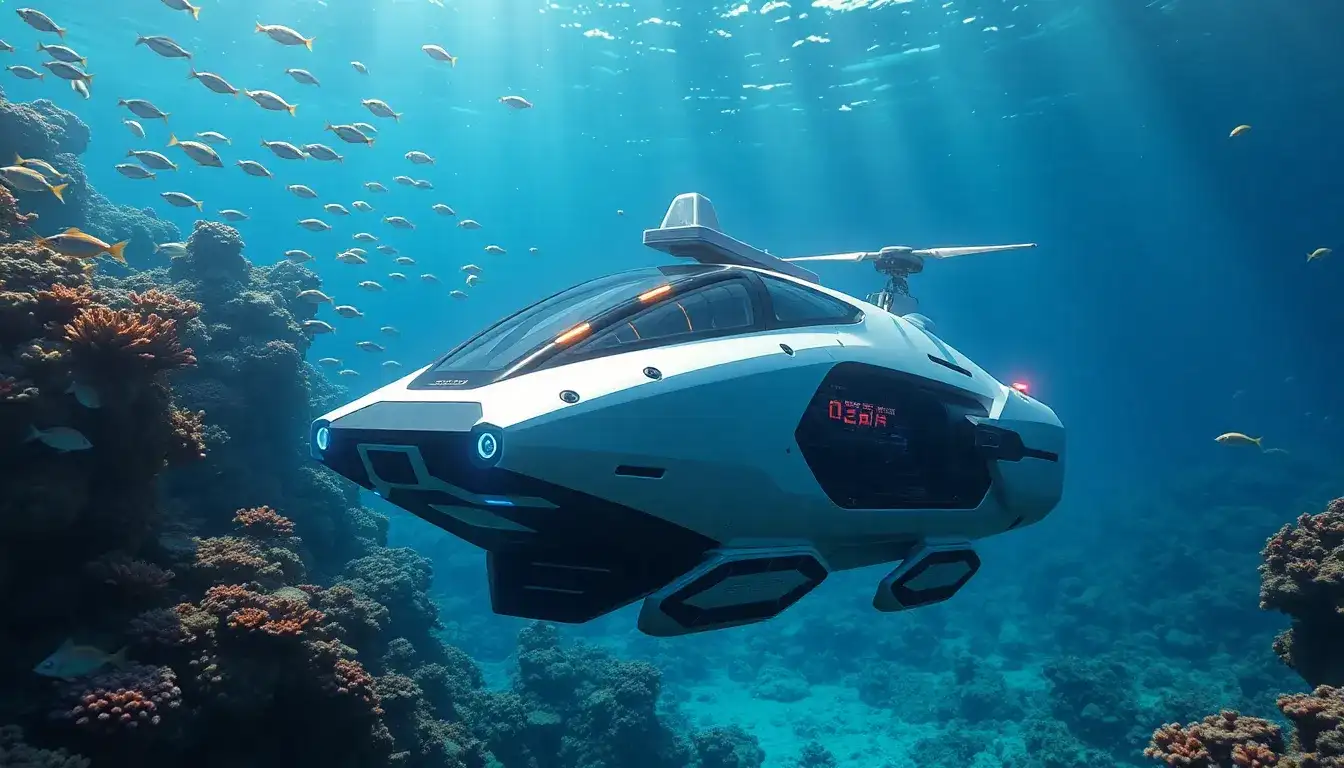
Breaking 30 Years of Western Monopoly: The Deep Blue Ambition of Deep Sea Intelligent People | March 19, 2026
Photosynthesis is the energy source for all growth, and it embodies the investment philosophy of Guanghe Venture Capital: not only a provider of resources but also a co-builder of an innovative ecosystem. As a leading fund deeply rooted in China’s tech sector, Guanghe Venture Capital is leveraging this “photosynthesis” to make technological innovation a significant driver of social progress. Chuangye Bang will continue to publish Guanghe’s investment column, “Guanghe Says”, sharing the stories behind their investments.
Ten years ago, Ma Yiming never anticipated that his R&D experience at a foreign company would become a turning point in his career. At that time, a major Chinese state-owned enterprise had just completed the acquisition of a well-known European deep-sea robotics company. As the first systematically trained professional in deep-sea robotics in China, Ma was sent to the UK for further education. Standing on the assembly line of deep-sea robots, he felt a starkly different product culture. The workshop was lined with heavy-duty deep-sea robots, resembling steel beasts, where engineers focused not on “overtaking in curves” but on intricate technical issues like “what should the safety factor be for a sealed electronic unit under high seawater pressure?” and “how do hydraulic oil’s viscosity and volume change at zero degrees?” Ma recalls the impact of that experience, realizing the vast gap in industrialization between China and the West, extending beyond a few technical parameters to a complete engineering system encompassing design standards, supply chain management, and project delivery.
Six years later, Ma founded Deep Sea Intelligent People (Guangzhou) Technology Co., Ltd. in Guangzhou, aiming to bridge this gap with Chinese strength. In just three years, this “new face” of the industry defeated established competitors from the UK and the Netherlands in the UAE, securing a key order worth over a hundred million yuan from a UAE telecom company, thus breaking nearly 30 years of overseas monopoly in this field. Currently, Deep Sea Intelligent People is the first and only company in China to successfully achieve the commercial export of deep-sea robots.
Last November, Guanghe Venture Capital led the Series A funding round for Deep Sea Intelligent People and has recently increased its investment. Guanghe’s partner Cai Wei stated, “Deep Sea Intelligent People is an important investment in the marine sector for us, with vast market potential in the thousands of meters deep sea. The team has rapidly grown into a leader in China’s high-end marine intelligent equipment, thanks to their foresight in the industrial intelligent transformation and crucial strategic decisions in building a complete engineering system from scratch.”
01 Bridging the Gap from Prototypes to Industrial Products
At depths of thousands of meters, static water pressure can reach hundreds of atmospheres, akin to thousands of elephants stepping on a soda can simultaneously. Temperatures hover between 2-4 degrees Celsius, with potential exposure to extreme heat from underwater volcanoes. Here, in perpetual darkness, optical observation is nearly impossible, and electrochemical corrosion from high-salinity seawater is pervasive. Additionally, GPS signals are absent, leading to navigation reliant on inertial systems and underwater acoustics, with communication delays and bandwidth limitations.
A working-class ROV (Remotely Operated Vehicle) must adeptly handle hundreds of specialized tools in such extreme operational environments—whether turning valves worth millions of dollars, precisely laying and repairing underwater pipelines, or connecting and disconnecting optical cable joints. Each action requires a guaranteed success rate, as a single failure can incur costs in the millions and extend project timelines by weeks.
“We can build the largest hull in the world and weld the strongest steel structures, but the ‘hand’ that actually works underwater—the deep-sea operation robot—has long relied on imports,” Ma lamented. He noticed that market clients were heavily dependent on Western brands, harboring inherent doubts about Chinese products. “They not only care about technical parameters but also require a thorough review of your design specifications, supply chain management, and project processes. This is why we invested significant effort upfront to make our R&D and manufacturing processes as transparent and standardized as possible to gain their trust.”
To this end, he and his team systematically integrated international engineering standards with the realities of Chinese industry, drafting over 300 internal documents on design, manufacturing, processes, testing, and supply chain management. These standards were detailed, covering everything from anti-corrosion treatment and tightening torque specifications for specialized screws to compatibility and lifespan prediction models for over 30 types of metals and 40 types of non-metals under high-pressure corrosive conditions. They also included guidelines for structural strength and fatigue analysis based on international standards from organizations such as the Norwegian Ship Classification Society and the American Petroleum Institute. This comprehensive set of specifications later became Deep Sea Intelligent People’s most compelling “certificate of trust” when facing the rigorous scrutiny of top international clients.
02 Defeating Giants to Secure Overseas Orders
Deep Sea Intelligent People assembled an interdisciplinary R&D team covering mechanical, hydraulic, electrical, software, and communication engineering to build a foundational technology platform. They independently developed a unified operating system for robots, a control algorithm library, and a simulation testing platform, while tackling the design and process control of critical components like propeller servo modules. Simultaneously, they formed deep partnerships with core suppliers to enhance their supply chain. Ma acknowledged that developing the entire chain internally is a high-investment, long-term endeavor, but he firmly believes it is the only way to build the company’s long-term core competitiveness.
He views the successful acquisition of a contract from the global telecom infrastructure giant UAE Telecom Group last year as the ultimate validation of the reliability of their products and engineering capabilities, marking Deep Sea Intelligent People’s “debut battle.” “From concept design to the completion of assembly and debugging, we only took about six months, cutting the delivery cycle by two-thirds compared to our Western counterparts.” Ma remains excited recalling this experience. The Middle East market has traditionally been the “backyard” for Western equipment, with energy and telecom giants imposing stringent quality and safety standards. Previously, there was no sight of Chinese deep-sea robots.
Facing formidable competitors from the UK, the Netherlands, and Norway, who had decades of brand presence and operational experience, Deep Sea Intelligent People was merely a new player with just over two years of operation. At that time, UAE Telecom Group was bidding for a new generation of submarine cable laying robots for its Indian Ocean submarine cable network and found Deep Sea Intelligent People through the company’s official website. Ma promptly led a team to the UAE, bringing some core components, leaving a lasting impression on the client. Soon after, the UAE Telecom team flew to Guangzhou for a deep audit lasting several days, not only reviewing the entire process of technical documentation but also conducting random visits to core suppliers and engaging in marathon-style technical defenses with Deep Sea Intelligent People’s various technical teams. Ultimately, Deep Sea Intelligent People successfully tackled this challenging task.
Ma believes that the standardized design processes, meticulous documentation management, and quality system control exhibited during the supply chain audit convinced the client of the industrial capability of Chinese companies to continuously deliver highly reliable equipment. “The decisive factor was our complete engineering system and the resilience of our supply chain,” Ma stated. Clients were ordering not just a visible steel machine but also the complete engineering capability ensuring its flawless operation in the deep sea thousands of miles away.
After this success, the company quickly won additional ROV orders from UAE Telecom, including the direct purchase of a complete machine and granting Deep Sea Intelligent People priority rights to supply the same model, totaling over 120 million yuan. Reports indicate that the company has recently formed a partnership with a major Dutch offshore service contractor, marking the first entry of Chinese-developed deep-sea robot technology into the mainstream European offshore equipment market. Additionally, the deep-sea ROVs signed with domestic clients have been successfully delivered.
03 Seeking Embodied Intelligence in the Deep Sea
Currently, less than 1% of global marine resources are developed, yet the total output of the global marine economy is nearing $30 trillion, showcasing tremendous potential for growth. Furthermore, by 2025, the deep-sea economy has been incorporated into government work reports and this year into the “14th Five-Year Plan,” propelling related industries into a fast development track. Guanghe Venture Capital has been exploring opportunities in the deep-sea sector for over a year. “I believe the marine sector is a potential goldmine waiting to be tapped, both strategically and commercially,” stated Zhai Haowei, Vice President of Guanghe Venture Capital.
Elon Musk’s business ventures span from aerospace to land and even underground transportation; Zhai imagines if further exploration could open opportunities in the ocean, particularly in the deep sea—a realm where human understanding is less than 1%, yet holds vast potential. Based on initial assessments, a team was quickly formed internally, comprising partners Cai Wei, Sun Jian, and vice presidents Zhai Haowei and Zhang Yuqi, to study the sector and identify valuable investment directions. Simultaneously, they engaged with industry experts for insights. During a casual conversation with peers, Deep Sea Intelligent People caught their attention.
However, they did not immediately open the doors to capital. The determined quartet launched a series of “bombardments”: team members took turns visiting the company to discuss their understanding of the industry from an investor’s perspective with Ma. They also provided strategizing help on aspects like overseas client referrals, future development plans, product iterations, engineering systems, and technology routes. “Our sincerity in visiting three times ultimately won the company over,” Cai Wei recalled with a smile.
Ma also felt a strong connection to this experience. He recalls Cai Wei posing a thought-provoking question during one discussion: “If we don’t see deep-sea robots as cold, mechanical equipment but as intelligent agents with bodies and perceptions, what changes would occur in this industry?” This question struck Ma as a lightning bolt, opening a new avenue of thought: traditional deep-sea robots were like “puppets on strings,” while the highly complex deep-sea operational scenarios that Deep Sea Intelligent People focuses on should require embodied intelligence underwater.
04 An Era Belonging to Deep Sea Intelligent People
According to Ma, traditional deep-sea robots, constrained by the extreme oceanic environment, typically operate through remote control, connected to surface work platforms via optical-electrical composite umbilicals. Human operators on boats send signals through optical cables to underwater robots, creating a closed-loop operational cycle. Currently, Deep Sea Intelligent People has upgraded the equipment development process from a physical trial-and-error model to a digital twin verification method through the introduction of virtual simulation systems. This allows for high-fidelity simulations of ocean environments in the digital realm, covering the fluid dynamics, structural strength, control systems, underwater perception, and the entire operational workflow of the robots. This enables the identification of most potential issues before the machines are formed, shortening the iteration cycle from years to months, reducing research and development risks and costs while simultaneously enhancing reliability and efficiency.
However, he candidly stated that due to the complex and ever-changing structure of the marine ecological environment, achieving autonomous operations for robots in the future will require improvements in their real-time environmental awareness and decision-making capabilities, along with enhanced task planning and handling of exceptional situations. “What we aim to create isn’t just a better hammer but an intelligent agent that can find nails and build houses,” Ma emphasized. The name Deep Sea Intelligent People embodies the company’s goal—embodied intelligence in the deep sea.
Currently, Deep Sea Intelligent People is advancing into a more cutting-edge battlefield—deep-sea mining. The founding team was involved nine years ago in the world’s first and only set of commercially used deep-sea mining robots, priced at an astounding 1.5 billion yuan. With the explosion of the electric vehicle industry, the polymetallic nodules on the seabed (rich in copper, nickel, cobalt, manganese, rare earths, etc.) have become a hotly contested territory. This requires stronger and smarter mining robots. Deep Sea Intelligent People, relying on its technological accumulation in deep-sea heavy-load operation robots, is positioning itself ahead in this trillion-dollar potential market.
“We see even greater opportunities in the future, not just in existing oil and gas development or subsea communications, but deep-sea mining which relies heavily on robots and will be exponentially larger. Deep Sea Intelligent People has already opened markets in China and the Middle East, with collaborations with European clients underway. I believe that in 3-5 years, they will occupy a significant position in the mainstream market,” Cai Wei expressed with confidence.
Zhai Haowei still vividly remembers the first visit to Deep Sea Intelligent People, standing before a massive mural of deep-sea scenes where Ma pointed out every opportunity area and corresponding robot products, discussing the company’s future prospects. “At that moment, I felt their ambition extends far beyond the present; they possess the potential to become a marine technology platform company,” Zhai firmly believes.
In March 2012, Hollywood director James Cameron piloted his single-person submersible, the Deepsea Challenger, to the bottom of the Mariana Trench, the deepest part of the ocean. He spent six hours there, capturing the wonders of the deep ocean with a high-definition 3D camera. A year later, the 3D documentary Deepsea Challenge was completed. As a long-time deep-diving enthusiast and certified PADI Rescue Diver, Cai Wei was deeply impressed by this film. “In the deep sea, there is no light, and exploring the unknown in total darkness is inherently cool. Deep Sea Intelligent People is the key to unlocking the new world of the deep sea,” Cai Wei remarked. The era belonging to Deep Sea Intelligent People has just begun.
Original article by NenPower, If reposted, please credit the source: https://nenpower.com/blog/breaking-the-30-year-monopoly-deep-sea-intelligences-ambitions-in-ocean-technology/

