

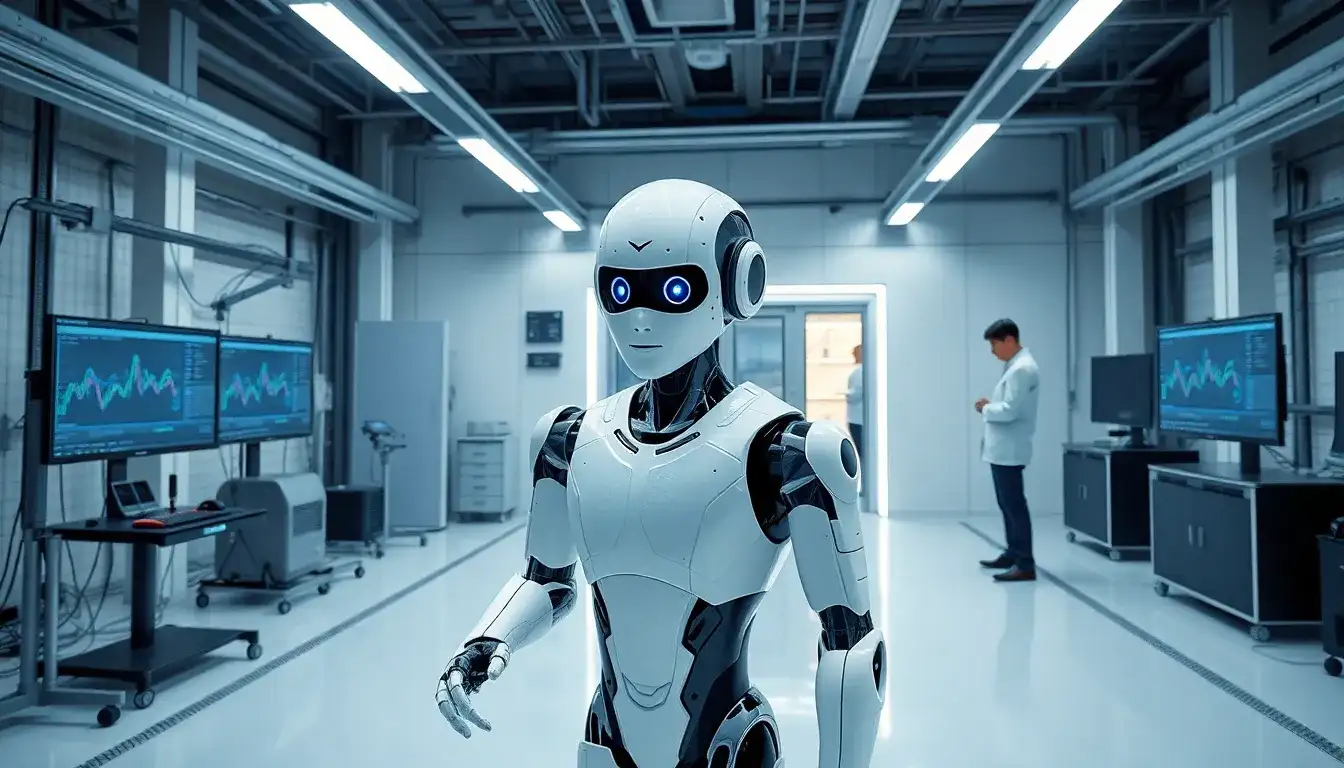
The humanoid robot industry is currently facing a significant challenge: while laboratory prototypes are being developed at a rapid pace, there are bottlenecks in large-scale delivery. On January 29, the Beijing Humanoid Robot Innovation Center officially launched its pilot validation platform, marking the production of its 1,000th customer-customized model. This platform spans 9,700 square meters and includes four key functional areas: a complete machine production demonstration line, a joint production line, a small batch trial production line, and a specialized testing laboratory. It offers a one-stop service for industry enterprises and research institutions, covering trial production, performance and process validation, process optimization, functional module assembly, complete machine assembly, and testing verification.
The launch of this platform signifies a crucial bridge in China’s cutting-edge humanoid robot sector, facilitating the transition from technology research and development to product conversion, and from small batch trial production to preparation for mass production.
Addressing Four Critical Pain Points to Aid Industry Progress
How can the flexible “genius” from the laboratory become a reliable “worker” in real-world scenarios? This is a question every enterprise in the humanoid robot industry must confront. In recent years, robotic technology has rapidly evolved, and market expectations have surged exponentially. However, delivery capabilities have become a bottleneck for many companies. Liu Yizhang, head of the Beijing humanoid pilot base, admitted, “Orders are coming in, but we can’t deliver the products.” This situation reflects the so-called “valley of death” in industrialization. While laboratory prototypes focus on achieving functionality and technological breakthroughs, products intended for mass production require consistency, reliability, and controlled costs.
Liu emphasized four prominent pain points in the industry: first, the lack of specialized pilot testing services, leading research institutions and startups to establish small trial production lines with high costs, low efficiency, and insufficient expertise; second, a lack of standardized production capabilities that hinders the assurance of product consistency and reliability, thus limiting mass delivery; third, an incomplete testing system across the entire supply chain, which does not adequately validate performance, processes, and reliability, increasing market application risks; and fourth, a lack of data accumulation throughout the product lifecycle, preventing the formation of an iterative closed loop from research and development to pilot testing to mass production.
Recent policies from the Ministry of Industry and Information Technology have called for a focus on future industries, including humanoid robots, to accelerate the construction of pilot validation platforms and improve inspection, testing, and result conversion systems. Against this backdrop, the launch of the Beijing Humanoid Robot Innovation Center’s pilot platform aims to directly address these four pain points.
An Integrated Platform for Production, Trial, and Testing
Unlike traditional factories, this 9,700 square meter pilot platform serves as a highly flexible, digital, and modular hub for production and validation. The platform consists of four functional areas: a demonstration line for embodied intelligent robot production, a joint production demonstration line, a small batch trial production line, and a specialized testing laboratory. The first floor houses a smart warehouse, functioning as the logistics center of the entire platform. With shelves six meters high, it can accommodate over 5,000 material boxes in a 300-square-meter area, storing four times more than a conventional warehouse. The receiving workstation assigns a unique code to each component using visual recognition and barcode systems, while the outgoing system automatically matches the optimal picking path based on orders.
On the fifth floor, the joint production demonstration line is in operation, where robot joint modules are continually flowing along the production line. The production line manager noted that approximately 300 joints can be produced in a single shift each day. This line has achieved high precision and stability in flexible production, catering to various joint production requirements.
The third floor features the production demonstration line, which showcases modular assembly concepts. The robot’s head, torso, and limbs are assembled on separate lines, with each module undergoing independent testing before being integrated into the complete machine. The site manager revealed that they are testing the “embodied intelligent” humanoid robot’s ability to autonomously transport material boxes, with the future goal of enabling robots to assemble robots.
The small batch trial production line on the fourth floor is designed as a shared platform for universities, research institutions, and startups, primarily responsible for the trial production, assembly, and validation of complete robots and key modules. The testing and verification system is similarly well-developed, capable of simulating various operating conditions that humanoid robots may encounter in real-world applications, from precision, torque, and temperature testing at the component level to performance, temperature extremes, and endurance testing at the complete machine level. This testing platform is also open to industry service.
Reportedly, the pilot platform is equipped with 500 sets of trial production and testing equipment, with an annual production capacity of 5,000 units for embodied intelligent robots. The value of constructing an open ecological pilot platform goes beyond the equipment and production lines; it lies in its public attributes, open ecosystem, and ability to define standards. Li Chunzh, Chief Operating Officer of Beijing Humanoid, stated that the platform will assist all parties in the supply chain in exploring advanced production processes, developing high-end equipment, and establishing industry standards to efficiently convert research outcomes and enhance mass production and high-quality delivery capabilities.
During the platform’s launch ceremony, the Beijing Humanoid Robot Innovation Center signed strategic cooperation agreements with Lingyi Manufacturing, Haohai Starry Sky, Yuanluo Technology, and Zhenjiang Technology, covering key areas such as core component research and development, scene adaptation validation, and collaborative formulation of industry standards. The platform is becoming a significant practice in establishing industry standards.
In the emerging field of humanoid robotics, many testing standards have yet to be unified, and performance assessments lack authoritative basis. Through extensive practical production testing, the platform has accumulated substantial data and experience. Liu Yizhang shared insights on the exploration of testing standards: “We have learned during the production process which reliability tests must be conducted after assembling the robots, and how long and how far they need to run to ensure stability.” These practical experiences are being distilled into reusable and shareable industry knowledge, providing references for subsequent enterprises and helping them avoid making the same mistakes.
Original article by NenPower, If reposted, please credit the source: https://nenpower.com/blog/beijings-new-testing-platform-tackles-challenges-in-humanoid-robot-reliability-and-consistency/

