

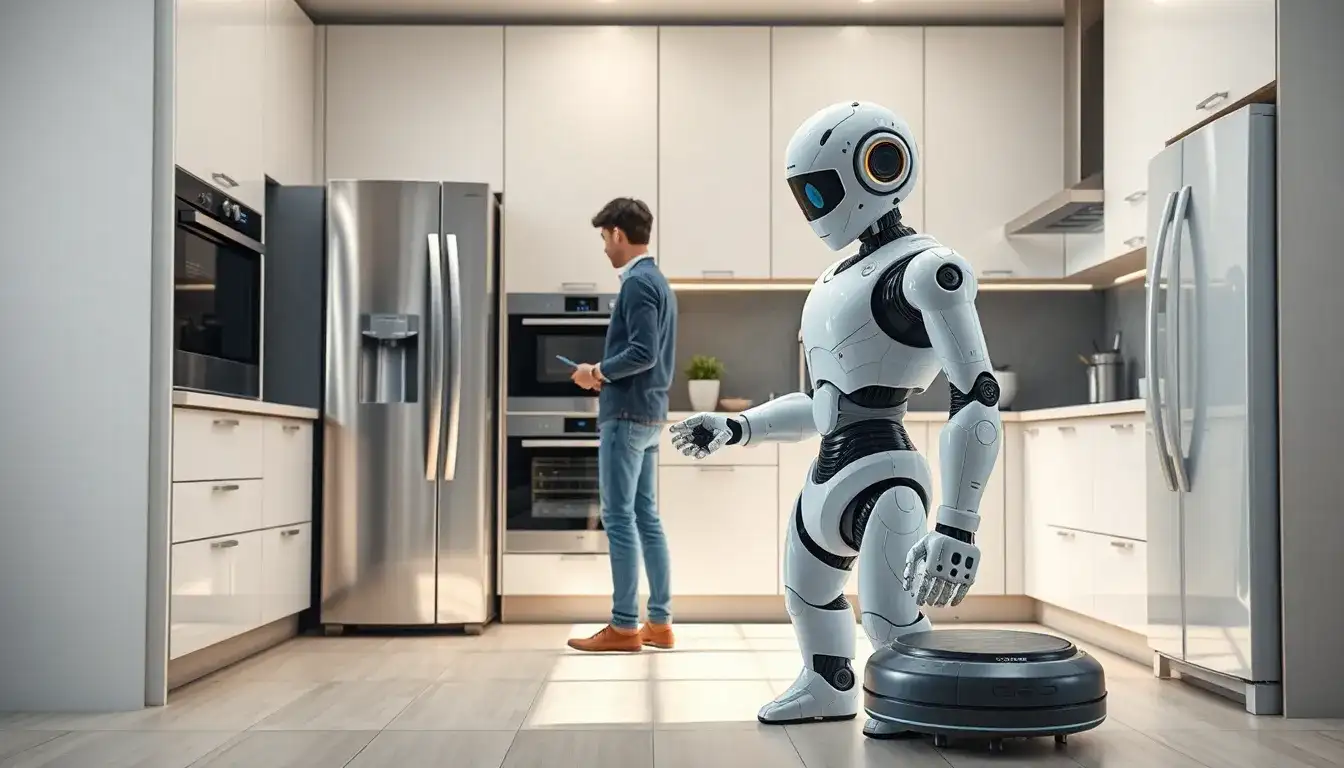
AWE 2026: Humanoid Robots Enter Homes, Appliances Transform into “Human-like” Devices
The 2026 China Appliances and Consumer Electronics Expo (AWE) recently concluded its three-and-a-half-day event, but discussions surrounding the expo continue. Over the past year, artificial intelligence and intelligent agents have become hot topics in the global tech community. At AWE, numerous companies showcased their AI-integrated products, with some consumer electronics firms even exploring new concepts inspired by the trending “OpenClaw” AI agents.
A notable highlight of AWE 2026 was the dedicated robotics innovation exhibition area, which prominently featured humanoid robots. Tesla showcased its latest humanoid robot, the Optimus Gen3, while several Chinese manufacturers, including Yushu and Zhiyuan, also made their presence felt.
As general-purpose robots were on display, advancements in smart technology and AI applications led to a rapid transformation of exhibited products into “robotic” forms. The boundaries between home appliances and robots are increasingly blurring, with intelligent home devices equipped with sensing, decision-making, and collaborative abilities capturing market attention in new ways.
The robotics innovation exhibition area featured dozens of representative companies from both domestic and international backgrounds. In the humanoid robot field, Tesla presented the revamped Optimus Gen3, although it remained encased in a glass chamber, similar to previous exhibitions in Shanghai. This robot is slated for large-scale production this year, although initial quantities are expected to be limited. In contrast, Chinese manufacturers appeared well-prepared and confident after a successful year.
Yushu Technology, a frequent participant in major events, showcased its mature G1 humanoid robot performing boxing demonstrations. This time, they also introduced the newly launched Go2 quadruped robot, featuring dynamic display capabilities. Another performer, Magic Atom, presented its general-purpose humanoid robot MagicBot Gen1, the highly agile bipedal robot Z1, and the “robotic panda” that previously appeared at major events, highlighting their product delivery capabilities.
Zhiyuan Robotics exhibited its entire product lineup, showcasing various functions. For instance, the A2 full-sized humanoid robot emphasized dexterous hand functions and general intelligence, performing tasks such as writing the characters “福” and “禄,” showcasing rhythmic performances, and engaging in interactive dialogues. The Lingxi X2 series primarily targeted lightweight applications like performances. Additionally, Zhiyuan introduced the G2 industrial-grade interactive embodied robot, aiming to demonstrate the potential for general-purpose robots in traditional industrial settings.
Similar to Zhiyuan, many firms focused their presentations on the industrial applications of robots. For example, Yunshe Technology showcased the “Jueying” series of quadruped robots designed for industrial inspections in harsh environments like mines and chemical plants. Fourier Intelligence unveiled a medical rehabilitation robot equipped with an AI rehabilitation assessment system targeting specific scenarios. Meanwhile, Zhongqing Technology presented a cost-effective industrial humanoid robot priced below 100,000 yuan, targeting assembly tasks in 3C electronics and automotive parts.
Overall, leading humanoid robot companies are shifting their focus from merely showcasing motion performance to emphasizing control capabilities and adaptability to specific scenarios. On the technical front, these companies demonstrated the latest breakthroughs in AI integration, motion control, and perceptual decision-making, targeting clear commercialization scenarios across various fields, from industrial manufacturing to home services.
Beyond the humanoid robot exhibits, robots have increasingly entered households through smart appliances. At the Chasing Appliances booth, a flagship refrigerator was equipped with robotic arms to automate tasks such as stacking, retrieving, and intelligently organizing food and beverages based on user preferences. Additionally, Chasing demonstrated robotic arms integrated into washing machines for folding clothes and precise air conditioning control.
Robotic arms are also being installed in various appliances. For instance, Chasing’s first embodied smart lawn mower, APEX, has upgraded its capabilities to become a multifunctional yard assistant, performing tasks such as leaf collection, trash gathering, tool organization, and supporting tasks like automatic watering and fruit picking.
Some manufacturers are also exploring equipping large appliances with wheeled mobile bases to expand beyond the limitations of two-dimensional space. For example, Stone Technology showcased its first sweeping robot featuring a dual-wheel leg structure, capable of autonomously navigating stairs and demonstrating dynamic capabilities in simulated home environments, making it suitable for complex layouts such as duplexes and villas.
Throughout these examples, it is evident that as general-purpose robots rapidly develop, the supply chain and machine intelligence have matured solutions for smaller-scale applications, which are increasingly being integrated into traditional appliances to enhance the user experience and meet complex scenario demands.
As general-purpose humanoid robot manufacturers eye the home service appliance market, home appliance manufacturers are also actively responding. At AWE, several appliance companies showcased their home service robot prototypes, engaging directly with users to gauge market acceptance of robots in households. For example, Haier introduced a trio of humanoid robots for household chores, cleaning, and companionship, covering various scenarios such as kitchen tasks, laundry, cleaning, and home alerts. Hisense Group also unveiled companion robots and showcased its self-developed general-purpose humanoid robot, Harley.
According to Chen Chunyu, co-founder and CTO of Magic Atom, “AI interactions in home environments are undergoing a profound paradigm shift. In terms of perception, AI is evolving from a deterministic understanding of environmental information to an active interpretation of the environment; in terms of interaction methods, it is transitioning from passive responses to actively providing services.” As enthusiasm for robots in the end-user market remains strong, the commercialization of robots seems to be on the horizon. For instance, JD.com announced its “Smart Robot Industry Acceleration Plan 2.0” at AWE, pledging to invest billions in resources, offer large model support, standard battery solutions, open up diverse operational scenarios, and provide significant procurement orders to help robot companies accelerate their path to market.
Original article by NenPower, If reposted, please credit the source: https://nenpower.com/blog/awe2026-the-rise-of-humanoid-robots-and-the-transformation-of-home-appliances-into-intelligent-assistants/

