

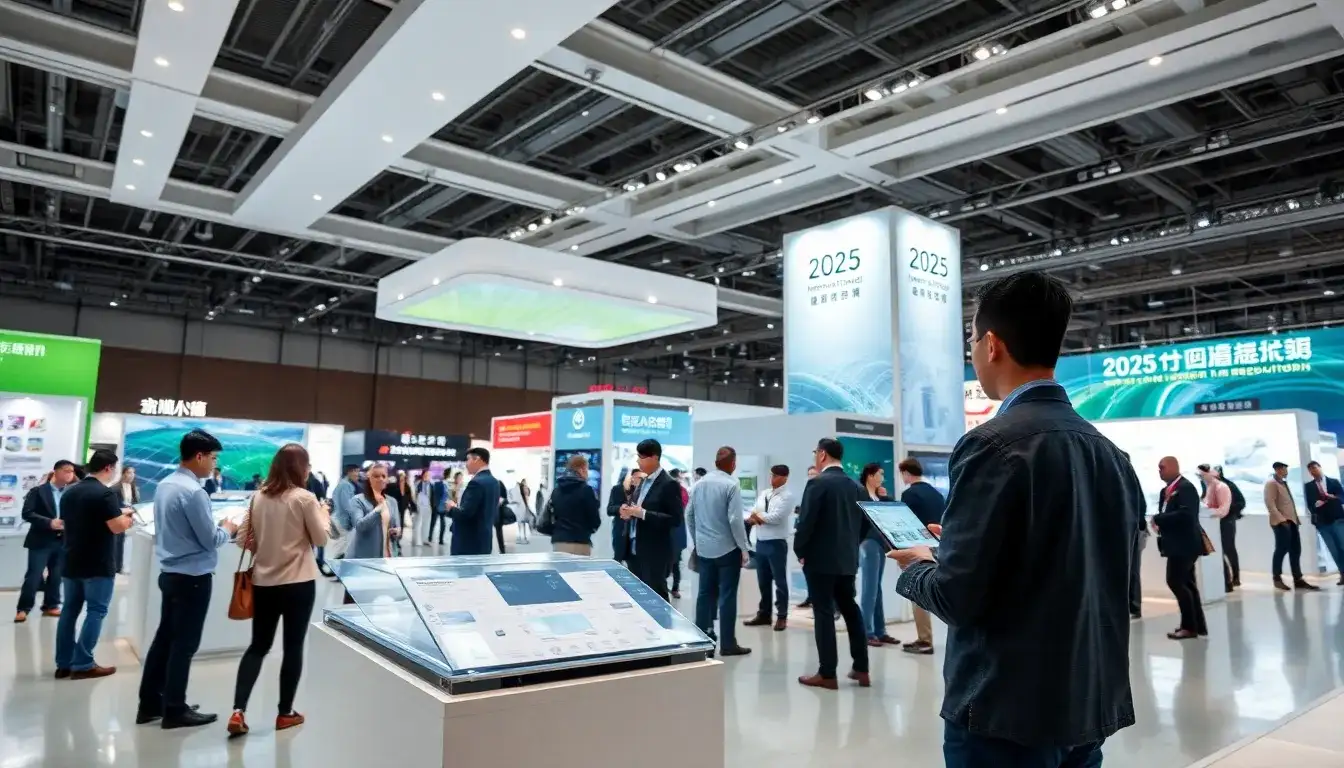
The 2025 International Digital Energy Exhibition concluded successfully at the Shenzhen Convention and Exhibition Center after four days of insightful events. The exhibition, themed “Deep AI Energy, Creating the Future,” brought together over 2,000 companies from more than 50 countries to showcase over 300 cutting-edge technologies. It offered a 50,000 square meter innovative ecological platform that covered the entire energy chain from source to grid, load, and storage. According to preliminary statistics, the event attracted over 30,000 professional visitors from both domestic and international backgrounds, achieving a transaction value exceeding 100 million RMB and anticipated order amounts surpassing 480 million RMB.
During the exhibition, a range of activities unfolded, including an opening ceremony, a main forum, seven thematic exhibition areas, a business matchmaking area, and a heavy truck zone. These events not only highlighted technological breakthroughs and application results in the digital energy field but also facilitated deep cooperation among global energy companies, underscoring Shenzhen’s role as a leading global digital energy city.
The exhibition was characterized by a “full-chain coverage and multi-entity participation” approach, creating a complete closed loop of “technology showcase – idea exchange – pathway discussion” in the digital energy sector. At the opening ceremony, the 2025 Shenzhen Digital Energy White Paper was released, outlining a systematic approach to establish a global digital energy pioneer city. The focus is on six directions: source, grid, load, storage, data, and carbon. This initiative aims to create the world’s first supercharging city 2.0, a unified network for electric power charging and storage, and a virtual power plant management cloud platform. By establishing four major centers, nurturing top 100 leading enterprises, and providing ten key solutions, Shenzhen aims to advance its digital energy technologies, products, and models to achieve a three-tier leap from demonstration to national and then global levels.
According to Yang Kun, Secretary of the Party Committee and Executive Vice Chairman of the China Electric Power Enterprise Federation, the deep integration of digital technologies and the energy revolution is becoming a new engine for global economic growth. The Chinese electric power industry is making substantial digital investments and building a standard system to support the development of a new type of power system.
The main forum held on the afternoon of September 18, titled “Digital Transformation Driving High-Quality Energy Development,” gathered authoritative experts and business leaders from the global energy sector. Shenzhen is currently pioneering the integration of cloud computing, the Internet of Things, and artificial intelligence with various energy sectors, providing practical examples for urban energy transformation worldwide. Zhao Tianshou, Director of the Carbon Neutral Energy Research Institute at Southern University of Science and Technology, proposed solutions to the challenges of wind and solar energy wastage by combining all-vanadium flow batteries and AI technology to overcome cost barriers. International guests such as Csaba Novak, President of the Hungarian Renewable Energy Association, and Felipe Santos Costa, former President of the Portuguese Trade and Investment Promotion Agency, shared experiences from Europe’s energy transition and expressed an urgent need for collaboration with Chinese enterprises. They emphasized that smart technology is the core driver for addressing the energy “impossible triangle,” calling for enhanced standard collaboration, data sharing, and financial innovation.
During the roundtable discussion, representatives from enterprises such as China General Nuclear Power Group, China Resources Power, Shenzhen Energy, and Siemens Energy reached a consensus on the opportunities and challenges of digital energy in the global energy transition. The exhibition also featured seven parallel forums, each showcasing various topics including the construction of digital energy industry ecosystems, innovations in the energy internet, core component R&D, new energy storage technologies, AI-enabled smart energy solutions, vehicle-grid integration, and the resilience of urban power systems. Companies like Huawei, BYD, Sunwoda, and Kosen Technology presented their latest technological advancements at these forums, offering replicable and feasible solutions for the industry.
The seven thematic exhibition areas presented comprehensive results of the digital energy industry chain from the perspective of “source, grid, load, and storage.” In the AI Empowerment area, Huawei and Sunwoda showcased algorithms for energy forecasting and operation optimization, enhancing energy management efficiency. The Clean and Low-Carbon area displayed CCUS technologies and carbon asset management tools, providing technological pathways for carbon neutrality. The International Enterprises area gathered global energy technology giants, serving as a platform for cutting-edge technology exchange.
As a key section of the exhibition, the Heavy Truck zone highlighted breakthroughs in new energy heavy trucks concerning lightweight design, safety, intelligence, and all-scenario services. This section provided “Shenzhen solutions” for the green transformation of logistics, attracting seven key companies including BYD, Skyworth, and Dawei Hongde, showcasing nearly ten new energy heavy trucks. BYD presented its T31 series new energy heavy trucks, launched at the end of August, which includes models for dump trucks and mixers. The series features a drive motor with a maximum power of 390 kW and a lithium iron phosphate battery of 444.36 kWh, achieving a range of 270 km under standard conditions, meeting daily operational needs with a rapid DC charging time of just two hours. The trucks also passed rigorous tests for waterproofing, wading depth, and climbing ability, making them suitable for complex construction scenarios. The vehicle’s luxurious interior and smart configurations enhance operational convenience, establishing it as a benchmark product in the urban construction vehicle sector.
Skyworth focused on regulatory and cost challenges by exhibiting a lightweight urban construction vehicle that complies with national overload regulations. Its version with a 350-degree electric power swap system weighs only 16.5 tons, at least 1 ton lighter than similar products in the industry. The innovative “vehicle-battery separation” sales model allows users to purchase only the non-powered chassis and rent the battery, significantly reducing initial financial burdens. The battery swapping model enables concentrated night charging and daytime use, saving time and space costs, with plans to expand to overseas markets in Indonesia, Africa, and Europe. Dawei Hongde showcased its revolutionary technology by unveiling an “intelligent mobile charging and storage vehicle,” the first of its kind listed by the Ministry of Industry and Information Technology. This vehicle can supply between 500 kWh and 2 MW of power, supporting a maximum discharge power of 500 kW and capable of charging four to eight electric vehicles simultaneously. With a 500 kWh capacity, it can meet the energy needs of several passenger cars. A company representative stated, “Our goal is for each mobile charging and storage vehicle to become an ‘urban energy node,’ integrating with fixed supercharging stations and home energy storage to form a ‘ubiquitous power IoT’.”
The International Business Matchmaking Area achieved fruitful results, establishing a long-term mechanism for global energy cooperation. Transitioning from “product display” to “transaction implementation,” and from “experience sharing” to “eco-construction,” this area became the core hub for global energy collaboration. It attracted over 200 international professional buyers from 50 countries and regions, filling all four matchmaking sessions. Through precise data matching and face-to-face negotiations, the platform facilitated technology imports, product exports, project cooperation, and talent exchanges, achieving practical outcomes that transformed exhibitors into partners and products into goods. Preliminary statistics indicate multiple cooperation intentions covering technology exports, equipment procurement, and project co-construction. For example, the Indian company GM JNNOUAHON LTD plans to purchase $12 million worth of BESS from LEOCH; the Italian company Green VEHICCES SRL intends to procure products from BYD and ZTE, with a total intended purchase amount of $11 million; and a Bangladeshi enterprise, Fast Cyben Network, seeks 16 solar strong charge solutions with an expected procurement amount of $2 million, having reached preliminary cooperation with Shandong Electric Engineering to visit its factory in the next phase.
In terms of experience exchange, international thematic forums were also held concurrently, where guests from both China and abroad explored transformation pathways. Giuseppe D’Alessandro, Director of the International Energy Department of Italy’s EEMAXX, shared European decarbonization practices, mentioning Italy’s efforts to build dedicated data centers that integrate renewable energy and green hydrogen data to promote decarbonization in refining plants, while looking forward to technological collaboration with Chinese companies. Maria Kukushkina, Chief Technology Officer of Digital Energy at Siemens Energy, expressed a desire to establish a joint “technology breakthrough – eco-co-building” consortium with Chinese enterprises to address global issues such as grid stability and energy storage efficiency. Chinese enterprises are accelerating their transition from “technology followers” to “rule makers,” with Huawei’s “digital energy full-stack solution” and Yuantong Energy’s European project experience recognized by multiple countries as “replicable Chinese solutions.” Importantly, the exhibition facilitated a shift in global energy cooperation from “short-term interaction” to “regular ecological collaboration.”
On September 20, during the promotional event for the 2025 International Digital Energy Exhibition in Shenzhen, the organizers proposed the establishment of an “International Digital Energy Industry Alliance” in 2026, with each region selecting a core partner. This initiative received responses from multiple countries, including Hungary, Portugal, and the Democratic Republic of the Congo. Former European Parliament member and former Deputy Speaker of the Hungarian National Assembly, Istvan Ujhelyi, stated that “the alliance will prevent ‘exhibition closure and cooperation stagnation,’ making cooperation between China and Hungary, and Central and Eastern Europe more stable and deeper.” On the same day, a matchmaking meeting with a Hungarian business delegation in Shenzhen facilitated deep exchanges between Shenzhen enterprises like Skyworth Solar, Ground Iron, and Yuantong Energy with Hungarian government and business representatives. During the promotional event, the Arab Renewable Energy Commission, the Central African Republic Chamber of Commerce, and the Chamber of Commerce of the Democratic Republic of the Congo signed strategic cooperation agreements with the Shenzhen Business Association, clarifying specific pathways for resource connection, technology exchange, and project implementation.
The exhibition showcased Shenzhen’s leadership and injected “Chinese momentum” into the global energy transition. As the world’s first megacity to achieve full electrification of public transportation, Shenzhen has developed a new energy infrastructure pattern where the number of supercharging stations exceeds traditional gas stations. The Virtual Power Plant 3.0 platform improves the efficiency of clean energy utilization through AI scheduling, achieving industry-leading performance. These practices provide a “Shenzhen model” for energy transformation in densely populated cities globally. The successful hosting of this exhibition further solidified Shenzhen’s position as a global digital energy pioneer city, highlighting China’s leading role in the global energy transformation.
The event attracted significant attention from numerous authoritative media outlets, with over one hundred media organizations, including industry outlets, online media, and new media, providing comprehensive coverage and generating widespread interest from both domestic and international audiences. From technological innovation to industrial collaboration, and from urban practices to global cooperation, the 2025 International Digital Energy Exhibition stands not only as an industry event but also as a “thought origin” and “cooperation incubator” for promoting global energy transition. Moving forward, Shenzhen will continue to advance initiatives like “Supercharging City 2.0” and “Unified Network for Electric Power Charging and Storage” in accordance with the 2025 Shenzhen Digital Energy White Paper. Chinese digital energy enterprises will deeply engage in global energy governance, collaborating with countries worldwide to drive technological innovation, industrial cooperation, and ecological construction, ultimately contributing to building a community with a shared future for mankind and achieving sustainable global development.
Original article by NenPower, If reposted, please credit the source: https://nenpower.com/blog/2025-international-digital-energy-exhibition-concludes-successfully-in-shenzhen/

