 Nenpower
Engineering
How real machines are made and moved — CNC, motion, control, robots and factory automation, animated.
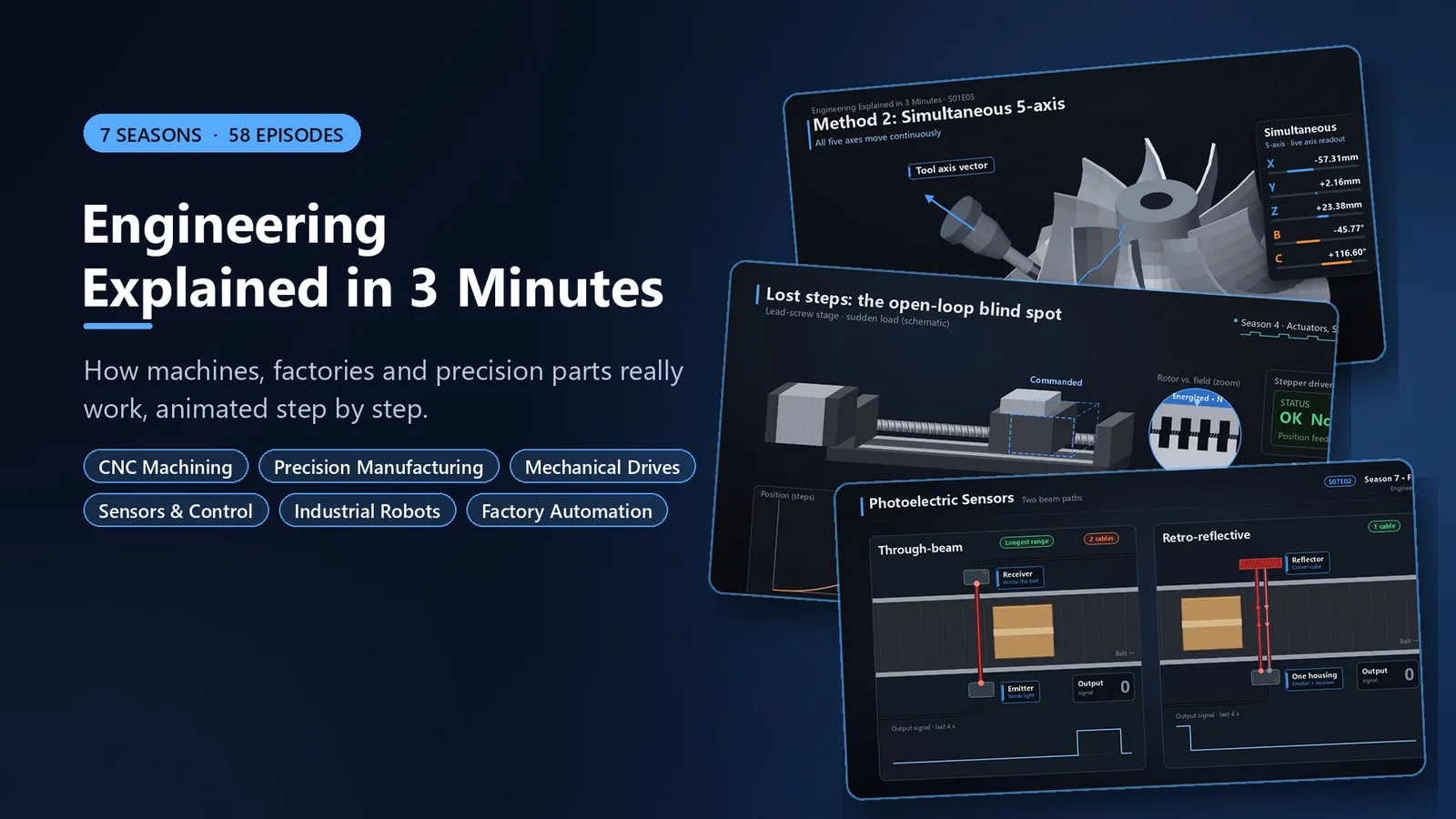
Short animated explainers on the engineering behind modern manufacturing. Start with how CNC machines cut metal, then go beyond milling to EDM, gear hobbing and metal 3D printing; open up ball screws, harmonic drives and linear guides; learn how motors, encoders and PID loops make motion precise; and finish with industrial robots, humanoids and the automated factory floor.
CNC Machining Fundamentals.
 FREE
2:50
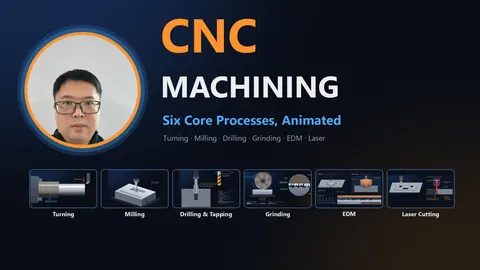
How Does CNC Machining Actually Work? 6 Core Processes Animated
How does CNC machining turn a block of metal into a precision part? This episode animates six core processes: turning, milling, drilling and tapping, grinding, EDM, and laser cutting. Cross-sections, close-ups, and motion paths show how each one removes material, and a six-panel comparison wraps it all up.
 FREE
3:06
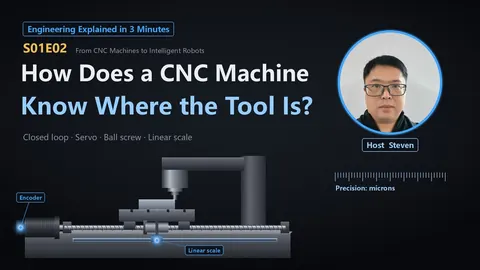
How Does a CNC Machine Know Where the Tool Is? Closed-Loop Control Explained
A cutting tool moves several meters per minute, then stops within a few microns of its target. This episode animates how a CNC machine actually knows where the tool is: how G-code is interpolated into axis targets, how the position, velocity, and current loops of a servo work together, how a ball screw turns rotation into linear motion, and why linear scales close the loop on the real table position. We finish by comparing open-loop steppers, semi-closed-loop servos, full closed loop, and linear motors.
 FREE
3:04
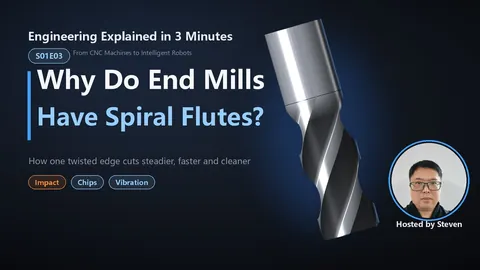
Why Do End Mills Have Spiral Flutes? Helix Angle, Flutes & Climb Milling
Why aren't the cutting edges of an end mill straight? This episode animates the three jobs of the spiral: smoothing out the cutting force, carrying chips up and out of the flutes, and fighting vibration. We also cover the flute-count trade-off, show climb versus conventional milling in slow motion, explain how variable-helix tools suppress chatter, and compare tool choices for aluminum, steel, and composites.
 lock
2:57
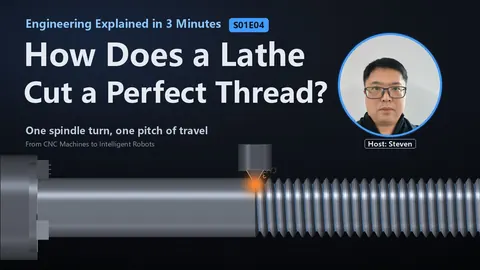
How Does a Lathe Cut a Perfect Thread? Spindle Sync Explained
A thread takes several passes, so how does every pass land in exactly the same groove? This episode animates the heart of thread turning: one pitch of travel per spindle revolution, how the spindle encoder makes the Z axis follow the spindle, how the index pulse keeps every pass in phase, why threads are cut in multiple passes with flank infeed, plus lead-in distance, multi-start threads, and alternatives like thread rolling, thread milling, tapping, and grinding.
 lock
2:45
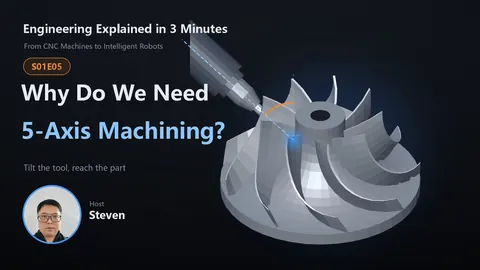
Why Do We Need 5-Axis Machining? 3+2, Simultaneous & RTCP
A 3-axis tool can only point straight down, and parts like turbine impellers are out of reach. This episode animates 5-axis machining: the limits of 3-axis, trunnion, swivel-head, and hybrid layouts, 3+2 positioning versus simultaneous 5-axis, how RTCP keeps the tool tip on path while the rotary axes move, the benefits of shorter tools and tilted ball-end mills, and the real costs of going 5-axis.
 lock
2:47
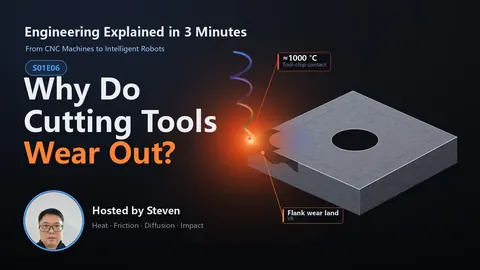
Why Do Cutting Tools Wear Out? Heat, Diffusion & Coatings
Carbide is harder than hardened steel, so how does steel wear it out? This episode animates tool wear: where cutting heat comes from, how flank wear, crater wear, built-up edge, and thermal cracks form, why Taylor's tool life equation makes speed so critical, and how coatings and cooling extend tool life.
 lock
2:57
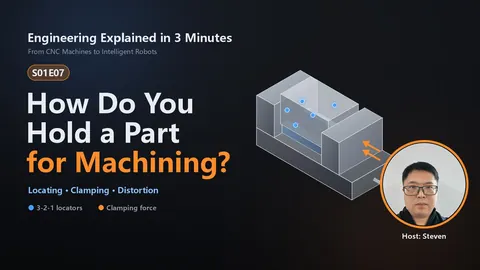
How Do You Hold a Part for Machining? Workholding Explained
A thin ring is turned perfectly round, then comes off the chuck slightly triangular. The culprit is workholding. This episode animates six degrees of freedom and the 3-2-1 locating principle, the difference between locating and clamping, vises and soft jaws, three-jaw and four-jaw chucks and collets, clamping distortion in thin-walled parts, vacuum chucks, and zero-point clamping systems.
 lock
2:45
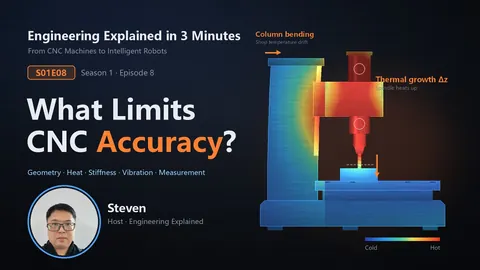
What Limits CNC Accuracy? Geometry, Heat, Stiffness & Chatter
A machine rated for a few microns can still make parts that are tens of microns off. In this Season 1 finale, we animate the error budget: six errors per linear axis and twenty-one geometric errors for a 3-axis machine, spindle thermal growth and the 20 °C reference temperature, why tool deflection grows with the cube of overhang, stability lobe diagrams, and how on-machine probes and ballbars measure and correct error.
Beyond Milling: Advanced Manufacturing Processes.
 lock
2:28
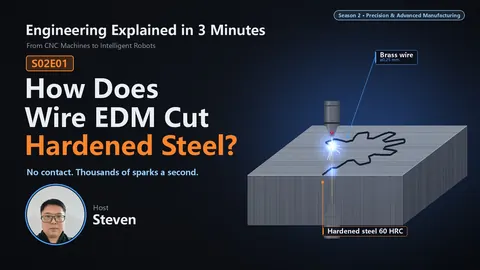
How Does Wire EDM Cut Hardened Steel? Spark Erosion Explained
Season 2 begins. A brass wire barely thicker than a hair can cut hardened steel without touching it. In this episode we animate wire EDM: how pulsed sparks melt and erode metal, what the deionized water does, why the wire is used only once, how the servo controls the gap by voltage, rough and skim cuts, and taper cutting with a threaded start hole.
 lock
2:47
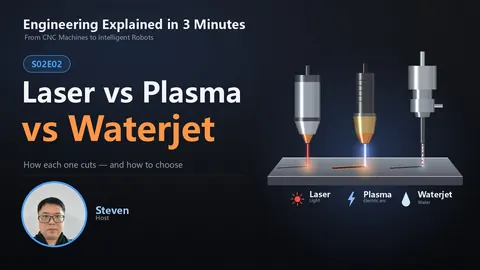
Laser vs Plasma vs Waterjet: How Each Cuts & Which to Choose
Laser uses light, plasma uses an electric arc, and waterjet uses water. In this episode we animate all three: how a laser is focused and why oxygen and nitrogen assist gases give different edges, how a plasma arc is constricted into a jet and why it only cuts conductive metals, and how abrasive waterjet cuts almost anything cold. Then we compare kerf, bevel, and heat-affected zone, and finish with a simple rule of thumb for choosing.
 lock
2:30
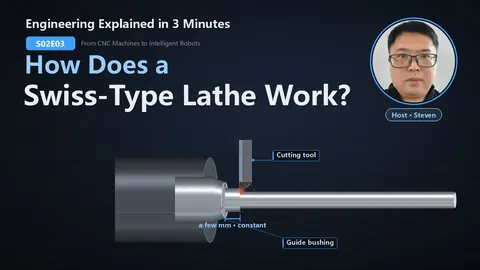
How Does a Swiss-Type Lathe Work? The Guide Bushing Explained
Why are long, slender precision parts so hard to turn on a regular lathe? In this episode we animate the Swiss-type lathe: a sliding headstock moves the bar while the tools stay put, and a guide bushing keeps support just millimeters from the cut. We also cover gang tools, live tooling, sub-spindle back-working, bar feeders, and the machine's roots in Swiss watchmaking.
 lock
2:34
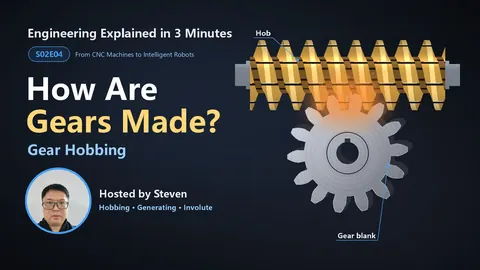
How Are Gears Made? Gear Hobbing & the Involute Explained
A gear tooth follows a precise curve called an involute. In this episode we animate how an involute is drawn and why it keeps the speed ratio constant, why form cutting tooth by tooth is limited, how a hob is really a rotating rack, and how synchronized rotation of hob and blank generates the involute. We also cover helical gears, gear shaping for internal gears, and gear grinding after heat treatment.
 lock
2:24
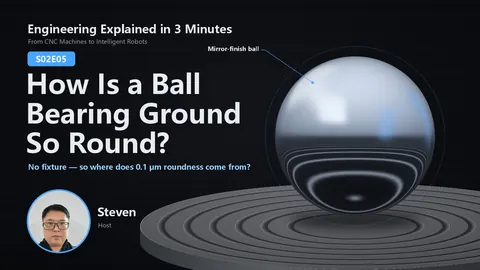
How Is a Ball Bearing Ground So Round? Lapping & Centerless Grinding
Precision bearing balls are round to about a tenth of a micron, yet nothing can clamp a sphere. In this episode we animate how balls are made: cold heading, flashing, hardening, grinding, lapping, and sorting, and how two grooved plates make the balls tumble randomly so errors average out. We also look at centerless grinding for rollers and rings, and why the part must sit slightly above the wheel centers.
 lock
2:41
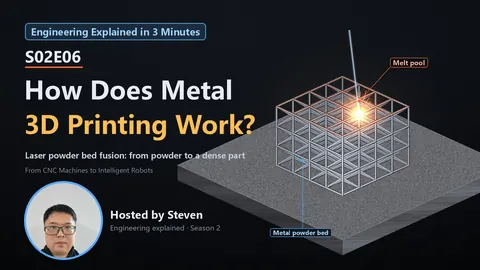
How Does Metal 3D Printing Work? Laser Powder Bed Fusion Explained
A part with curved internal cooling channels can't be drilled, but a metal 3D printer can grow it layer by layer. In this episode we animate laser powder bed fusion: slicing, powder spreading, galvo scanning, melt pools, and inert gas shielding; why overhangs need supports and how residual stress warps parts; and the post-processing that follows, from stress relief and wire EDM removal to HIP and machining.
 lock
2:28
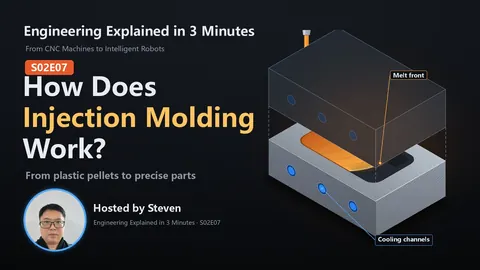
How Does Injection Molding Work? Melt, Fill, Pack & Cool
Plastic parts come out every few seconds, nearly identical every time. In this episode we animate the full injection molding cycle: how the screw melts and meters the plastic, how melt fills the cavity with fountain flow, why packing compensates for shrinkage, why cooling time scales with wall thickness squared, ejection, draft angles, clamping force, and common defects like short shots, flash, sink marks, warpage, and weld lines.
 lock
2:51
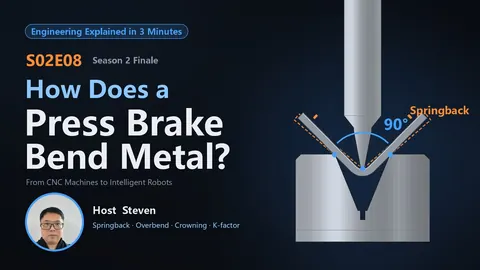
How Does a Press Brake Bend Metal? Springback & Compensation
Press a sheet to 90 degrees, and it springs back a degree or two. In the Season 2 finale we animate the press brake: three-point air bending where punch depth sets the angle, where springback comes from and how it varies by material, how overbending, material databases, and laser angle measurement get it right first time, why ram and bed deflection opens the angle in the middle and how crowning fixes it, plus the neutral axis, K-factor, and bend sequencing.
Precision Motion Components.
 lock
3:02
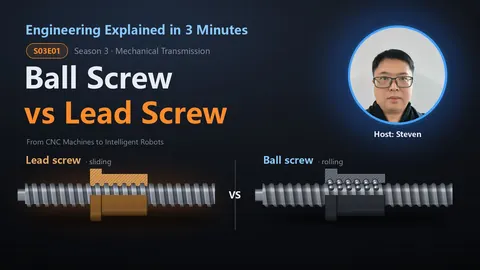
Ball Screw vs Lead Screw: Efficiency, Self-Locking & Life
Season 3, Mechanical Transmission, begins. A lead screw slides; a ball screw rolls. In this episode we animate why a thread is really an inclined plane, how friction sets efficiency and drive torque, what self-locking is and why vertical ball screw axes need a brake, plus wear, preload, accuracy, critical speed, and how to choose between the two.
 lock
2:45
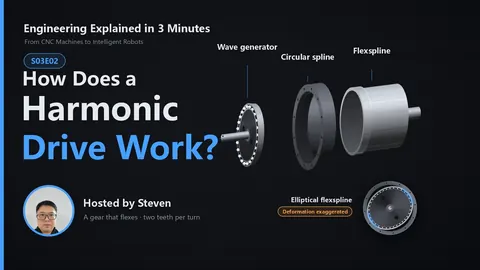
How Does a Harmonic Drive Work? Strain Wave Gearing Explained
A palm-sized gearbox in a robot joint can reduce speed a hundred to one in a single stage with almost no backlash. In this episode we animate the harmonic drive: the wave generator, flexspline, and circular spline, how elliptical flexing makes the mesh travel like a wave, why a two-tooth difference gives a huge ratio, how multi-tooth contact delivers torque and accuracy, and the stiffness and fatigue trade-offs.
 lock
2:47
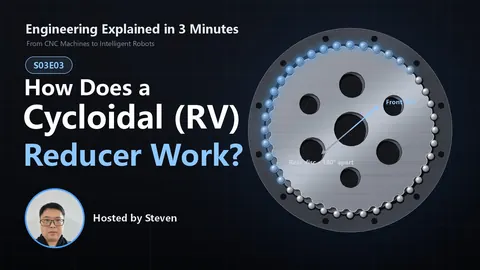
How Does a Cycloidal (RV) Reducer Work? Robot Joints Explained
The base and upper arm of an industrial robot swing hundreds of kilograms and must survive emergency stops. That's the job of the RV reducer. In this episode we animate how a cycloid is drawn, why the disc has one fewer lobe than pins and turns back one lobe per crank revolution, how twin discs balance each other, how the planetary and cycloidal stages combine, and why many lobes in contact make it so stiff. Then we compare it with the harmonic drive across a robot's joints.
 lock
2:41
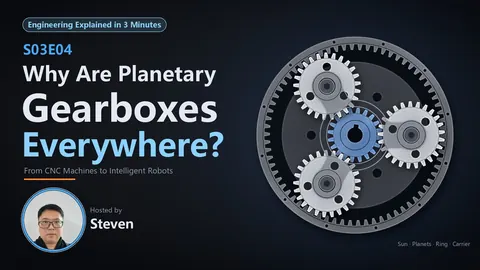
Why Are Planetary Gearboxes Everywhere? Power Splitting Explained
Drills, automatic transmissions, hybrids, and wind turbines all rely on planetary gears. In this episode we animate the sun, planets, ring, and carrier, how to calculate the ratio, why power splitting makes them compact and torque-dense, multi-stage gearboxes, how holding different members gives reverse and direct drive, and how hybrids and wind turbines put them to work.
 lock
2:48
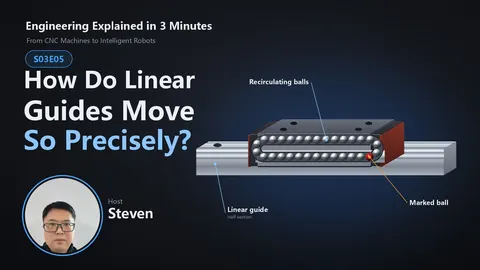
How Do Linear Guides Move So Precisely? Recirculating Balls & Preload
A machine table weighing hundreds of kilograms can be pushed with one finger and moved one micron at a time. In this episode we animate linear guides: why sliding ways stick-slip, how rolling eliminates it, how balls recirculate through the end caps, how four rows at 45 degrees carry load in every direction, pitch, yaw, and roll moments, the benefits and costs of preload, and roller guides.
 lock
2:42
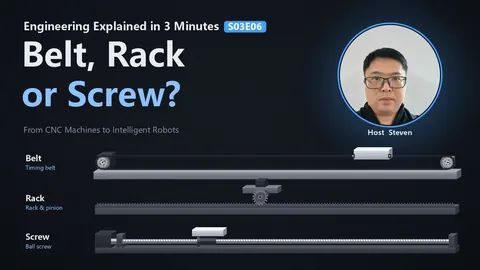
Belt, Rack or Screw? Choosing a Long-Stroke Linear Drive
What should drive a ten-meter gantry axis, or a pick-and-place robot cycling several times a second? In this episode we compare three linear drives: why timing belts are fast and cheap but get softer as they get longer, how rack and pinion extends without limit and removes backlash with dual-pinion preload, and why ball screws struggle on long strokes. We finish with a selection rule of thumb and a look at linear motors.
 lock
2:51
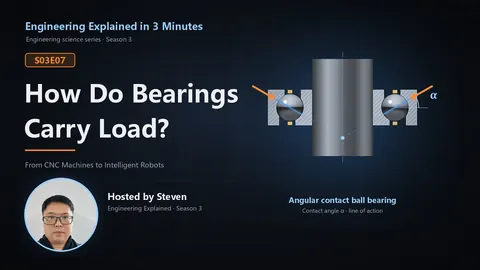
How Do Bearings Carry Load? Contact Angle & Load Zone Explained
Some bearings only take radial loads, some handle axial thrust, and some must be mounted in pairs. In this episode we animate how rolling bearings carry load: the load zone, high Hertzian contact stress, how contact angle sets the load direction, deep groove versus angular contact bearings, back-to-back and face-to-face pairs, cylindrical and tapered rollers, and why life falls with the cube of the load.
 lock
2:56
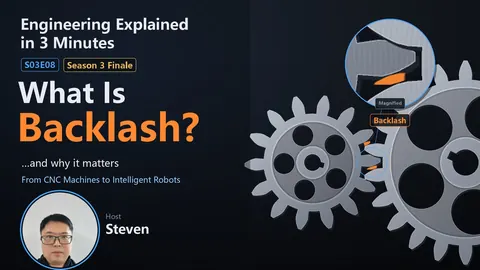
What Is Backlash and Why It Matters
The motor has reversed, but the table hasn't moved, and a milled circle shows steps at its quadrants. In the Season 3 finale we animate backlash: what it is and why some clearance is needed, lost motion versus stiffness, reversal error, bidirectional error, and servo oscillation, how preload, split gears, and dual-motor bias eliminate it, and how CNC compensation and full closed loop handle what's left. Then we recap all eight episodes on mechanical transmission.
Motors, Sensors & Control.
 lock
3:03
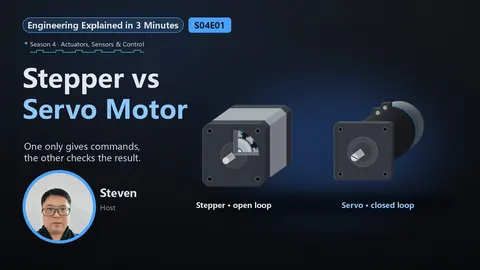
Stepper vs Servo Motor: Open Loop vs Closed Loop
Season 4, Actuators, Sensors & Control, begins. Stepper and servo motors both position precisely, yet one costs ten times more. In this episode we animate how a stepper moves one step per pulse, why microstepping is smoother but not always more accurate, why stepper torque falls with speed, and what a lost step is; then how a servo uses encoder feedback to correct errors and deliver peak torque, the closed-loop stepper compromise, and how to choose.
 lock
3:17
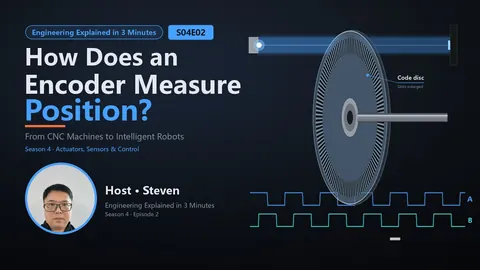
How Does an Encoder Measure Position? Incremental, Absolute & Magnetic
How does the encoder on the back of a servo motor turn rotation into numbers? In this episode we animate how an optical disc creates pulses, how A/B quadrature signals reveal direction and give four counts per line, how sine interpolation splits each cycle into thousands of steps, how absolute discs and Gray code know position at power-up, three ways to count turns, the strengths and limits of magnetic encoders, and why resolution isn't accuracy.
 lock
2:52
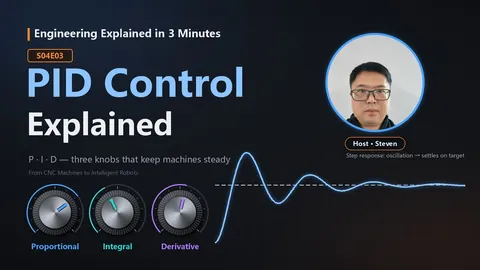
PID Control Explained: Proportional, Integral & Derivative
Ovens, hovering drones, and servo motors all rely on PID. Using a motor-driven arm fighting gravity, this episode animates why the proportional term acts like a spring, leaves a steady-state error, and oscillates at high gain; how the integral term removes that error and what integral windup is; how the derivative term damps motion like a shock absorber but amplifies noise; and a practical order for tuning PID.
 lock
3:13
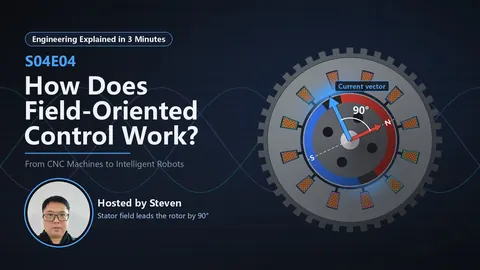
How Does Field-Oriented Control Work? Clarke, Park & d-q Currents
Permanent magnet synchronous motors run on ever-changing three-phase AC, so how does a drive control their torque as precisely as a DC motor? In this episode we animate why torque depends on the angle between stator and rotor fields, why six-step commutation causes torque ripple, how the Clarke and Park transforms turn three-phase currents into two DC values, what d-axis and q-axis currents do, and the field weakening that lets electric cars reach high speed.
 lock
3:00
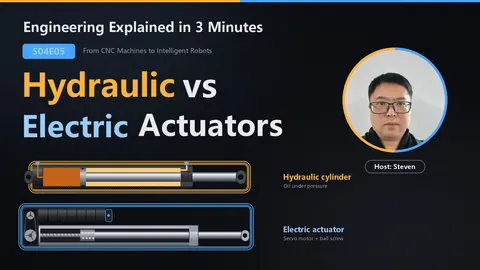
Hydraulic vs Electric Actuators: Force, Precision & Efficiency
Excavators use hydraulic cylinders, while modern injection molding machines and robots switch to electric actuators. In this episode we animate how hydraulics packs tons of force into a small cylinder, how relief valves protect it and valves hold loads, why hydraulics wastes energy, leaks, and struggles with precision, how electric actuators stay efficient, accurate, and clean but face limits, the electro-hydrostatic actuator that combines both, and how to choose.
 lock
2:56
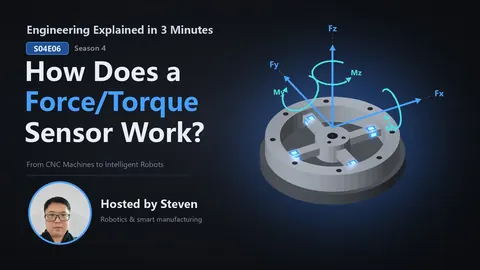
How Does a Force/Torque Sensor Work? Strain Gauges, Bridges & Decoupling
Robotic polishing, precision assembly, and hand guiding all rely on a six-axis force-torque sensor at the wrist. In this episode we animate the six components of force and torque, how strain gauges turn tiny deformation into resistance change, how a Wheatstone bridge amplifies the signal and cancels temperature effects, how cross-beam elements deform under different loads, why a calibration matrix is needed to decouple them, and practical details like gravity compensation and overload protection.
 lock
2:44
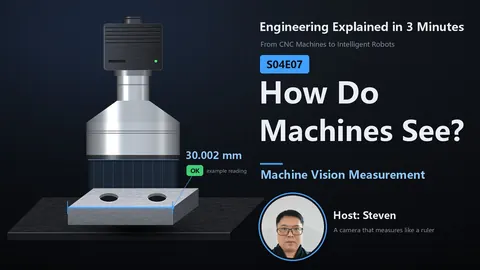
How Do Machines See? Machine Vision Measurement Explained
An industrial camera can measure a part in a single shot, with precision finer than one pixel. In this episode we animate how pixels convert to millimeters, where lens distortion and perspective error come from and how telecentric lenses remove them, what camera calibration does, why lighting makes or breaks a system, how sub-pixel edge detection gains ten times the precision, and the difference between repeatability and accuracy.
 lock
3:07
Linear Motors: Motion Without Screws
The Season 4 finale. Stages in semiconductor equipment that move meters per second and stop within a micron are driven by linear motors. In this episode we animate why a linear motor is a rotary motor laid flat, the trade-offs between iron-core and ironless designs in thrust, attraction, smoothness, and cooling, why direct drive eliminates backlash, critical speed, and wear, and the new problems it brings: heat, no self-locking, chip attraction, and cost. Then we review Season 4 and preview Season 5: industrial robots.
Industrial Robots.
 lock
2:52
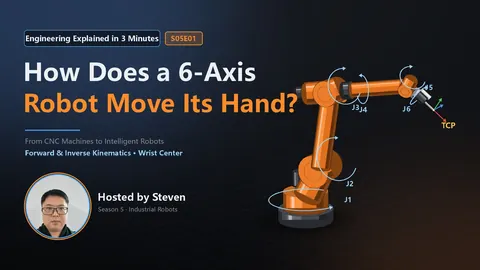
How Does a 6-Axis Robot Move Its Hand? Forward & Inverse Kinematics
Season 5, Industrial Robots, begins. A six-axis robot has only rotating joints, yet its tool can trace perfect lines and curves. In this episode we animate what each axis does, why exactly six are needed, how forward kinematics finds the hand from joint angles, how inverse kinematics works backward using the spherical wrist and the law of cosines, why one target can have up to eight solutions, and how straight-line motion is solved every few milliseconds.
 lock
2:58
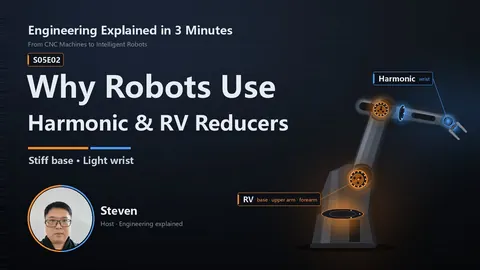
Why Robots Use Harmonic and RV Reducers: Joint Loads & Layout
Why do industrial robots use RV reducers in the base, upper arm, and forearm, but harmonic drives in the wrist? Looking at the whole robot, this episode animates why every joint needs a reducer, how the gear ratio shrinks reflected inertia, why torque differs tens of times from wrist to base, why weight at the tip gets magnified, how RV stiffness, shock capacity, and bearings suit the base, how harmonic drives' light, hollow design suits the wrist, and how cobots and heavy robots differ.
 lock
2:55
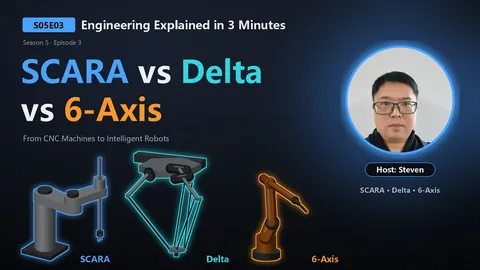
SCARA vs Delta vs 6-Axis Robots: Structure & Workspace
Why do SCARA robots inserting parts, Delta robots grabbing cookies, and six-axis robots welding cars look so different? In this episode we animate how a SCARA moves fast in a horizontal plane and what selective compliance means, how a Delta keeps its platform level with parallelograms and exceeds ten g, the fundamental difference between serial and parallel structures, the flexibility and cost of six-axis robots, and how to choose among them.
 lock
2:56
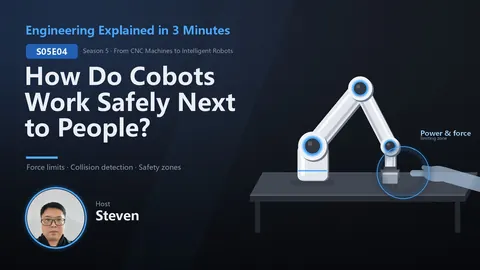
How Do Cobots Work Safely Next to People? Force Limits & Collision Detection
Traditional industrial robots work behind fences, but cobots work right beside people. In this episode we animate the four modes of human-robot collaboration, how international standards limit force and pressure by body region, why clamping is more dangerous than a bump, how cobots detect collisions within milliseconds using a dynamic model and motor current, the role of joint torque sensors, how safety laser scanners slow robots as people approach, and why a safe cobot doesn't guarantee a safe application.
 lock
2:53
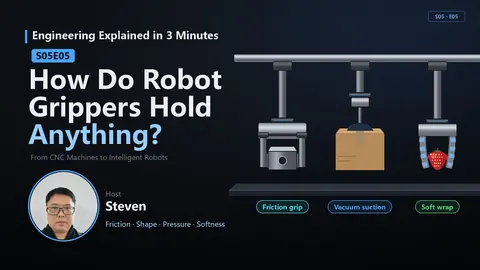
How Do Robot Grippers Hold Anything? Friction, Vacuum & Soft Grippers
Metal parts, cardboard boxes, strawberries: robots grip each in a completely different way. In this episode we animate how much grip force a two-finger gripper needs and why friction matters, how shaped fingers lock parts in place, pneumatic vs electric grippers, why a vacuum cup is really pushed by the atmosphere, how a venturi makes vacuum and why leaks are the enemy, and how soft grippers gently hold fragile objects.
 lock
2:37
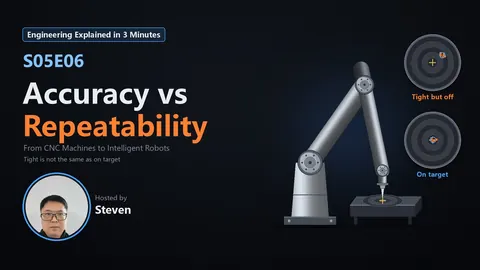
Accuracy vs Repeatability: Robot Errors & Calibration
A robot rated at ±0.02 mm repeatability can still miss a coordinate by nearly a millimeter. In this episode we animate the difference between repeatability and accuracy, why teach programming needs only repeatability, why offline programming and vision guidance depend on accuracy, how link dimensions, joint zeros, deflection, gear errors, and heat stack into absolute error, how laser tracker calibration improves accuracy several times, and everyday TCP and frame calibration.
 lock
2:36
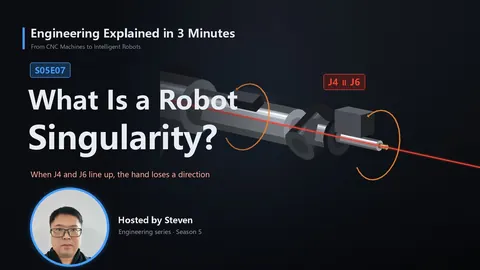
What Is a Robot Singularity? The Jacobian & Wrist, Shoulder, Elbow Singularities
A robot moving along an ordinary line suddenly flips its wrist and stops with an alarm: that's a singularity. In this episode we animate what the Jacobian describes, why a singularity means losing a degree of freedom and why joint speeds blow up nearby, what the wrist, shoulder, and elbow singularities of a six-axis robot look like, their consequences, and how engineers avoid them with tilted tools, joint moves, singularity avoidance, and seven-axis robots.
 lock
3:00
How Does Robotic Welding Work? Weld Pool, Heat Input & Seam Tracking
Robot welds are fast and even, yet every batch of parts varies and warps from heat. In this episode we animate how the arc and weld pool form a bead in gas metal arc welding, how voltage, current, and speed set heat input, why robots miss the joint, how touch sensing, through-arc tracking, and laser seam tracking find and follow the seam, and why positioners improve weld quality.
 lock
3:09
How Do Mobile Robots Navigate a Factory? SLAM, Localization & Path Planning
The Season 5 finale. From AGVs following magnetic tape to AMRs that steer around people, how do mobile robots navigate a factory? In this episode we animate what lidar, wheel encoders, and gyroscopes do, why odometry drifts, how SLAM builds a map while localizing and how loop closure removes accumulated error, how a particle filter finds the robot on the map, how A* global planning and local obstacle avoidance work together, plus safety scanning and fleet management. Then we review Season 5 and preview Season 6: physical AI and intelligent robots.
Humanoids & Robot Learning.
 lock
2:51
What Powers a Humanoid Robot's Joints? Quasi-Direct Drive & Roller Screws
Season 6, Physical AI & Intelligent Robots, begins. A humanoid robot has thirty to forty joints that must be strong, light, shock-tolerant and able to sense force, just like muscles. In this episode we animate why humanoids can't simply copy the 100:1 reducers of industrial robots, how quasi-direct-drive joints use flat high-torque motors and low gear ratios to be back-drivable, absorb impacts and sense force through current, how planetary roller screw linear actuators drive knees and hips like muscles, how actuators are mixed across the body, and why peak torque is limited by heat.
 lock
2:52
How Do Humanoids Keep Their Balance? ZMP, Inverted Pendulum & MPC
Two legs, small feet and a high center of mass: how does a humanoid robot stand, walk and survive a push? In this episode we animate the support region and center-of-mass projection, dynamic balance while walking, why the zero moment point must stay under the foot, how the inverted pendulum model and model predictive control plan the center of mass and footsteps ahead of time, the ankle, hip and stepping strategies with the capture point, and the sensors that make balance possible.
 lock
2:58
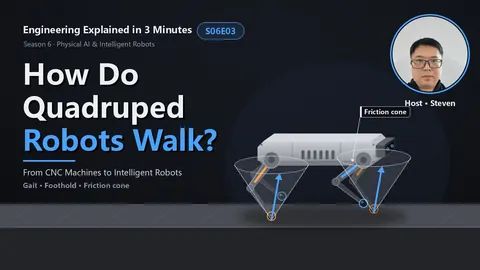
How Do Quadruped Robots Walk? Gaits, Footholds & Friction Cones
Gravel, stairs and slippery slopes: how does a quadruped robot walk through them? In this episode we animate the three joints of a leg and its quasi-direct-drive motors, the walk, trot and bound gaits and how to read a gait diagram, why foot placement moves forward with speed, how stance legs distribute contact forces and stay inside the friction cone, and how the robot senses touchdown and missed steps from motor current and climbs stairs with a height map.
 lock
2:54
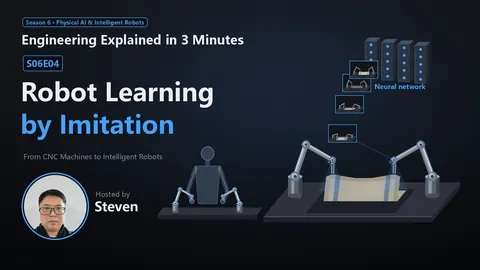
Robot Learning by Imitation: Teleoperation & Behavior Cloning
Folding a towel is nearly impossible to program by hand, so how does a robot learn it? In this episode we animate how demonstrations are collected by teleoperation with leader arms, VR and handheld grippers, what one demonstration records, how behavior cloning trains a neural network to map what it sees to what it does, why small errors compound and how human takeover corrections fix it, why averaging leads straight into an obstacle, and how action chunking makes motion smoother.
 lock
2:40
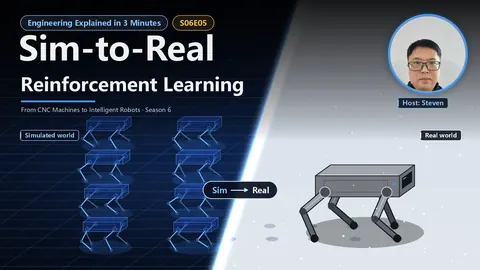
Sim-to-Real Reinforcement Learning: Domain Randomization Explained
No one can demonstrate how to run on ice, so how does a robot learn it by itself? In this episode we animate how reinforcement learning works through rewards and trial and error, why thousands of virtual robots train at once in simulation, what makes up the gap between simulation and reality, how domain randomization turns reality into just one more case, how a terrain curriculum goes from easy to hard, how teacher-student training lets a robot infer the ground from how its feet feel, and how the policy is deployed on a real robot.
 lock
3:02
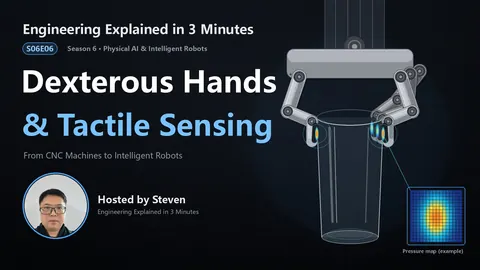
Dexterous Robot Hands & Tactile Sensing Explained
A two-finger gripper can't twist a bottle cap or spin a pen, so what kind of hand does a robot need? In this episode we animate the degrees of freedom of human and robot hands, fully actuated versus underactuated fingers, motors in the fingers versus tendons from the forearm, power grasps, precision pinches and in-hand manipulation, and how pressure arrays and vision-based tactile sensors let a robot feel contact shape and incipient slip, holding a glass with just enough force.
 lock
2:43
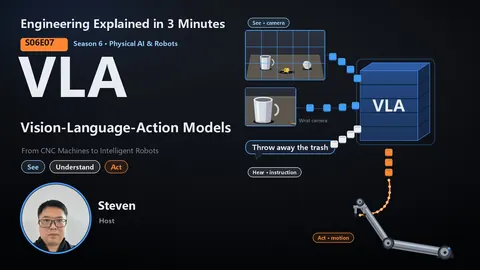
Vision-Language-Action Models: How Robots Turn Words into Actions
Tell a robot to throw away the trash on the table: how does it see, understand and act? In this episode we animate what vision-language models learn from internet images and text, how vision-language-action models turn images, words and actions into tokens, the difference between action tokens and an action expert, how web data and demonstrations from many robots are trained together, why it can follow instructions it never practiced, the slow-thinking plus fast-acting dual-system design, and today's limitations.
 lock
2:42
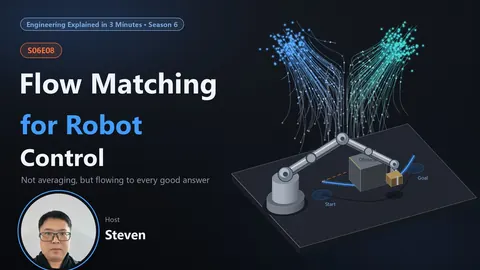
Flow Matching for Robot Control: Generative Action Policies Explained
A robot arm can go around an obstacle on the left or the right, and an ordinary neural network that averages will crash right into it. In this episode we animate why a chunk of motion can be seen as a point in space, how diffusion policy denoises step by step, how flow matching learns a whole map of currents from straight lines between noise and demonstrations, why sampling takes only about ten steps and always lands on the left or right path but never in between, and how it generates action chunks in real time from camera images and language instructions.
 lock
2:47
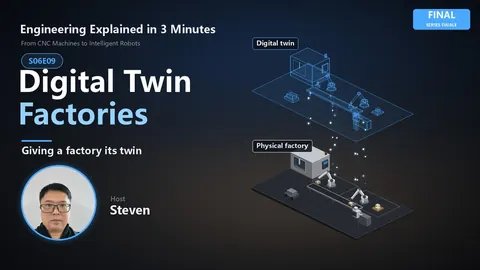
Digital Twin Factories: Virtual Commissioning, Predictive Maintenance & More
The series finale of Engineering Explained in 3 Minutes. A digital twin is more than a nice 3D model. In this episode we animate its four layers of geometry, physics, control logic and live data, how it stays in sync with the real factory, virtual commissioning before a line is built, finding bottlenecks and comparing options, predictive maintenance from vibration and current trends, and training robot AI in the twin to close the loop. Then we look back on six seasons and fifty episodes, from CNC machines to intelligent robots.
Factory Automation.
 lock
2:53
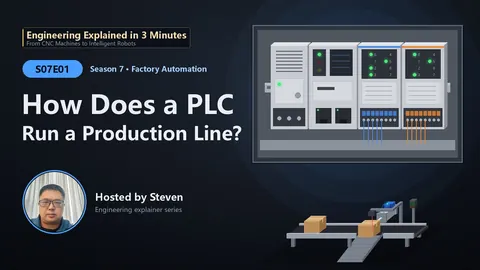
How Does a PLC Run a Production Line? Scan Cycle & Ladder Logic
Season 7 opens with factory automation. A box rides the belt, a sensor fires, a cylinder pushes, and a PLC runs it all. This episode animates what modules sit in a PLC rack and how inputs and outputs are wired; how the scan cycle of read, solve and write repeats every few milliseconds; why ladder logic looks like a relay circuit; and why factories use PLCs instead of ordinary computers.
 lock
3:04
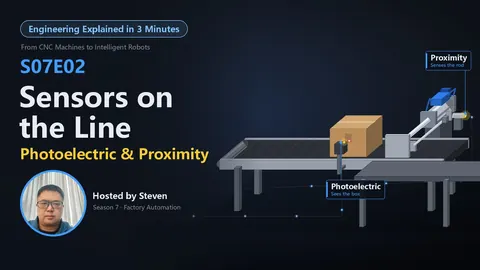
Photoelectric & Proximity Sensors Explained: NPN vs PNP Wiring
How does a production line know a box has arrived or a cylinder is in position? This episode animates the three kinds of photoelectric sensors — through-beam, retro-reflective and diffuse — and why black objects and bright backgrounds fool them; how an inductive proximity sensor detects metal with eddy currents; the difference between NPN and PNP three-wire sensors, and why a mismatch leaves the sensor light on while the PLC sees nothing; plus practical mounting tips from the field.
 lock
2:56
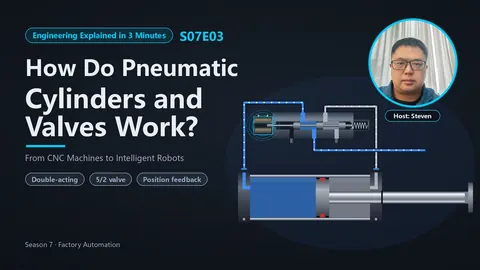
How Do Pneumatic Cylinders and Valves Work? Solenoid Valves, Speed Control & Air Supply
The sensor sees the box — so what does the pushing? On most production lines, it's a pneumatic cylinder. This episode animates how a double-acting cylinder extends and retracts and why its pull is weaker than its push; how a solenoid valve turns a 24-volt PLC signal into a change of airflow; why flow control usually throttles the exhaust; how magnetic switches report the end of stroke; and where compressed air comes from and why it costs so much.
 lock
2:40
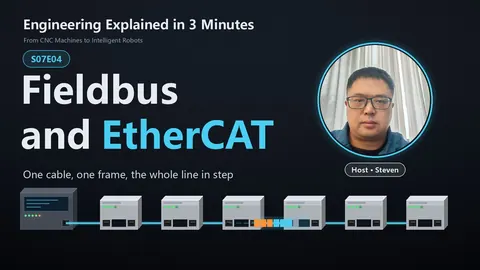
Fieldbus and EtherCAT: How One Frame Updates a Whole Machine
How do hundreds of sensors, valves and servo motors connect to one PLC? This episode animates the move from point-to-point wiring to fieldbuses and remote I/O; why ordinary Ethernet struggles with real-time control; how EtherCAT lets one frame pass through every station and read and write on the fly; and how distributed clocks line up every station to within a microsecond.
 lock
2:57
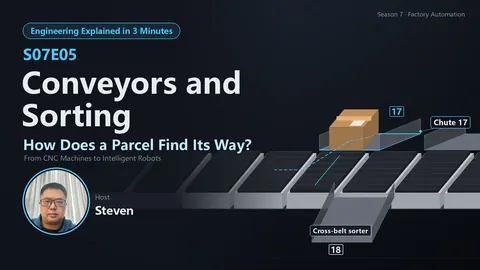
How Does a Parcel Find Its Way? Conveyor Tracking & Sorters
In a sorting hub, tens of thousands of parcels an hour land in the right chutes, yet no parcel knows the way. This episode animates how induction belts space parcels apart and a scan tunnel scans, weighs and measures them; how the controller tracks every parcel by distance with an encoder instead of by time; why the sort command fires early and how photo-eyes correct drift; how pushers, pop-up wheels, cross-belt and tilt-tray sorters work; and what happens to no-reads and full chutes.
 lock
2:53
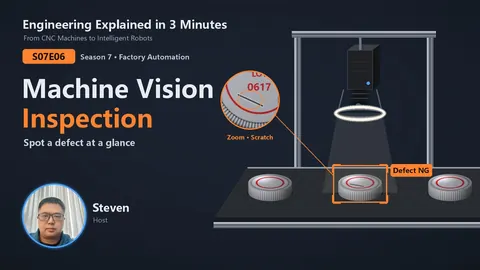
Machine Vision Inspection: Lighting, Strobing & Deep Learning
Bottle caps, tablets and circuit boards race down the belt, and a camera checks dozens every second. This episode animates why lighting decides whether a defect can be seen, how triggering and strobing freeze fast-moving parts, how rule-based inspection and deep learning judge good from bad, and how rejects are tracked, blown off the line and confirmed.
 lock
2:59
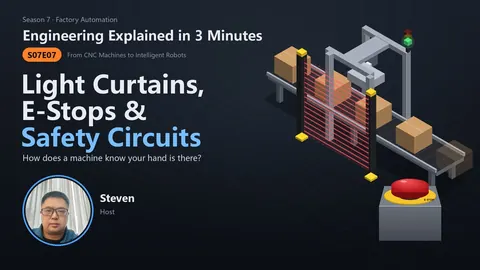
Light Curtains, E-Stops and Safety Circuits: How Machines Stop in Time
When an operator reaches into a machine, how does it stop first? And how do we know it still stops when something inside fails? This episode animates how a safety light curtain scans beam by beam, why the safety distance comes from stopping time, why emergency stops use normally closed contacts, and how dual channels and safety relays catch welded contacts and shorted wires.
 lock
3:13
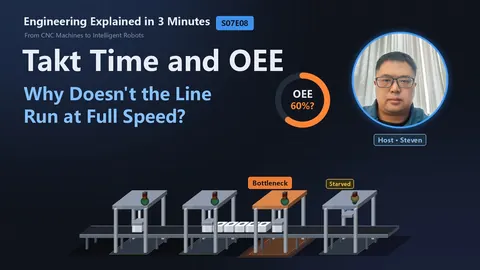
Why Doesn't the Line Run at Full Speed? Takt Time, Bottlenecks & OEE
The Season 7 finale. Modern equipment, no breakdowns, yet the line builds only sixty percent of the plan. Where did the capacity go? This episode animates how takt time is set by demand, how a bottleneck station limits the whole line and how to relieve it, why OEE is availability times performance times quality, where the six big losses hide and why minor stops are the sneakiest. Then we review Season 7: factory automation.