

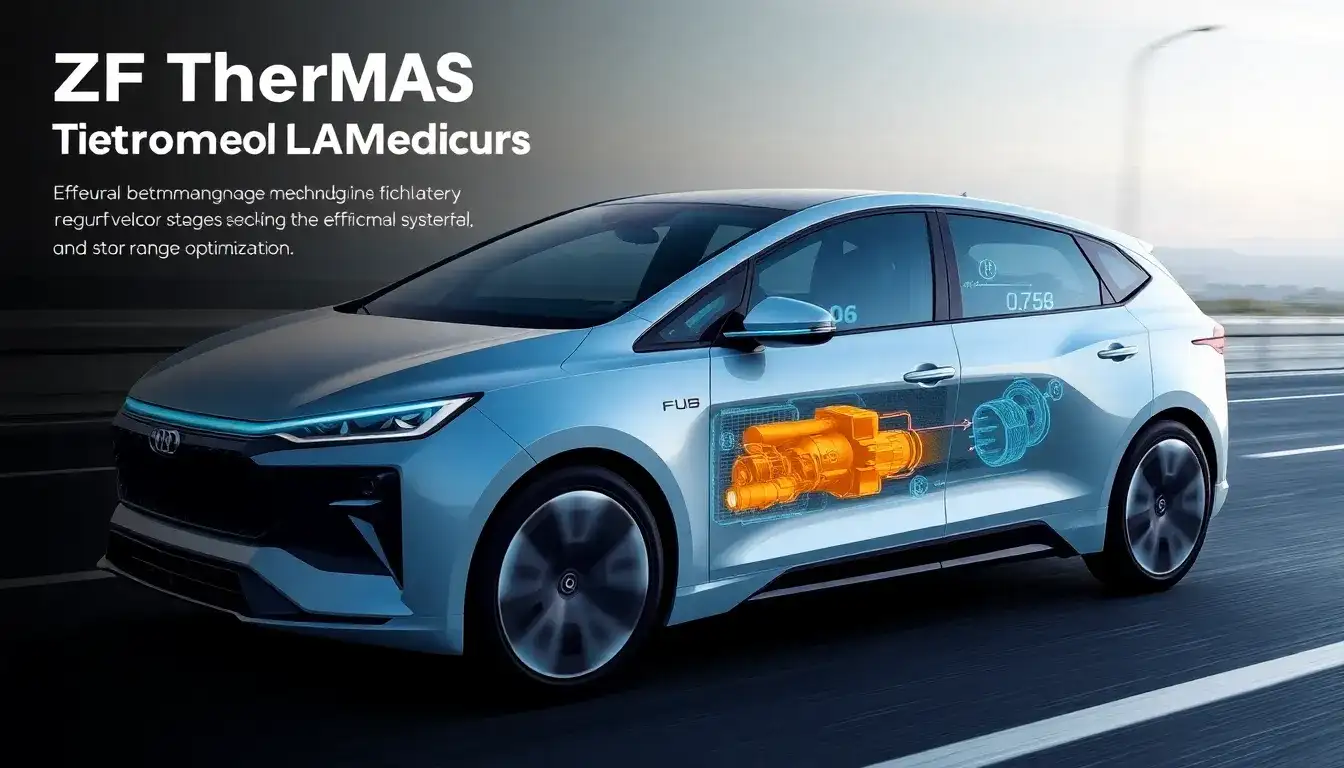
New ZF Thermal Management System Increases Range by Up to 10 Percent
The introduction of highly efficient thermal management systems can enhance the range of battery-electric and plug-in hybrid vehicles without the need for pricier drivetrains or larger batteries. With its latest innovation, TherMaS, ZF is showcasing its expertise in vehicle technology within this promising development area.
TherMaS is a compact and integrated system that is both lighter and smaller than comparable options, yet offers improved efficiency and cost-effectiveness. Utilizing propane as a refrigerant significantly boosts cooling performance while allowing for a more streamlined and lightweight design.
In testing, the optimized thermal management system and enhanced use of waste heat from the drivetrain have demonstrated an increase in electric range of up to 10 percent in challenging winter conditions, and up to 30 percent under extreme circumstances—establishing new standards for climate control functionality.
How can drivers maximize the range of an electric vehicle’s battery charge? Many might consider increasing the electric motor’s efficiency or opting for larger, more expensive batteries. However, a substantial portion of energy consumption comes from heating and cooling demands for both the vehicle’s interior and the electric drive, which fluctuate based on environmental conditions. This is where thermal management systems play a crucial role.
Dr. Otmar Scharrer, Senior Vice President of R&D at ZF, explains, “The battery of an electric car is particularly sensitive to operating temperatures, functioning best between 15 and 25°C.” Consequently, ambient temperature significantly impacts the effective range of an electric vehicle. In extremely cold or hot weather, the thermal management system faces increased strain, resulting in higher energy consumption that can nearly halve the available range. “Enhancing thermal management is thus beneficial for both manufacturers and drivers,” adds Scharrer. This insight motivated ZF to develop its proprietary thermal management system, TherMaS, to market readiness.
Superior Performance with Less Complexity
Earlier in 2023, ZF presented a concept for a centralized thermal management system that regulates thermal processes for the drive, battery, and interior of a vehicle. Since then, they have made significant advancements. “With superior capabilities and an easy-to-integrate design, our customers can anticipate improved e-drivetrain performance and longer electric ranges without sacrificing comfort,” summarizes Scharrer.
TherMaS is equipped with cooling and heating capacities of at least 10 kW, effective in outside temperatures ranging from -25°C to +35°C. This power ensures that the battery remains within its optimal thermal operating range, all while minimizing noise and vibrations compared to existing benchmarks. Furthermore, ZF’s approach is more holistic than current alternatives.
The engineers at ZF have integrated all thermal management functions into a complete, independent subsystem, including the company’s first in-house heat pump. These innovations have resulted in TherMaS being simpler, lighter, and more efficient, offering a cost-effective solution for customer integration compared to market alternatives.
A standout feature of TherMaS is its compact, propane-based heat pump refrigeration circuit, which customizes the integration of individual components based on temperature and heating/cooling needs. In addition, two separately controllable cooling circuits operate with frost-protected water: one for the electric motor and another for the power and charging electronics, including the battery.
Thanks to propane’s superior cooling properties, ZF engineers have been able to create smaller circuits while maintaining performance levels. The overall complexity of the system has been reduced, particularly in terms of electrical/electronic architecture and the control of water and glycol circuits. A lighter and more compact housing also offers additional advantages to manufacturers.
The compact design saves installation space and reduces assembly time while minimizing heat and cooling losses, as it can be positioned closer to the cabin, enabling shorter lines. The high level of integration also lowers expected maintenance efforts, thereby enhancing the cost-benefit ratio for automotive manufacturers.
Outstanding in Testing, Ready for Market
ZF has conducted extensive testing of TherMaS in a demonstration vehicle, where the system delivered up to ten percent more electric range in demanding winter conditions and even up to 30 percent more under extreme circumstances. TherMaS has also proven effective in various real driving scenarios.
The new thermal management system from ZF will be available in three performance classes, catering to a broad range of applications and vehicle platforms. Automotive manufacturers have expressed significant interest and acknowledged the prototype’s high level of maturity.
Original article by NenPower, If reposted, please credit the source: https://nenpower.com/blog/zf-unveils-thermas-thermal-management-system-promising-up-to-10-increased-electric-vehicle-range/

