

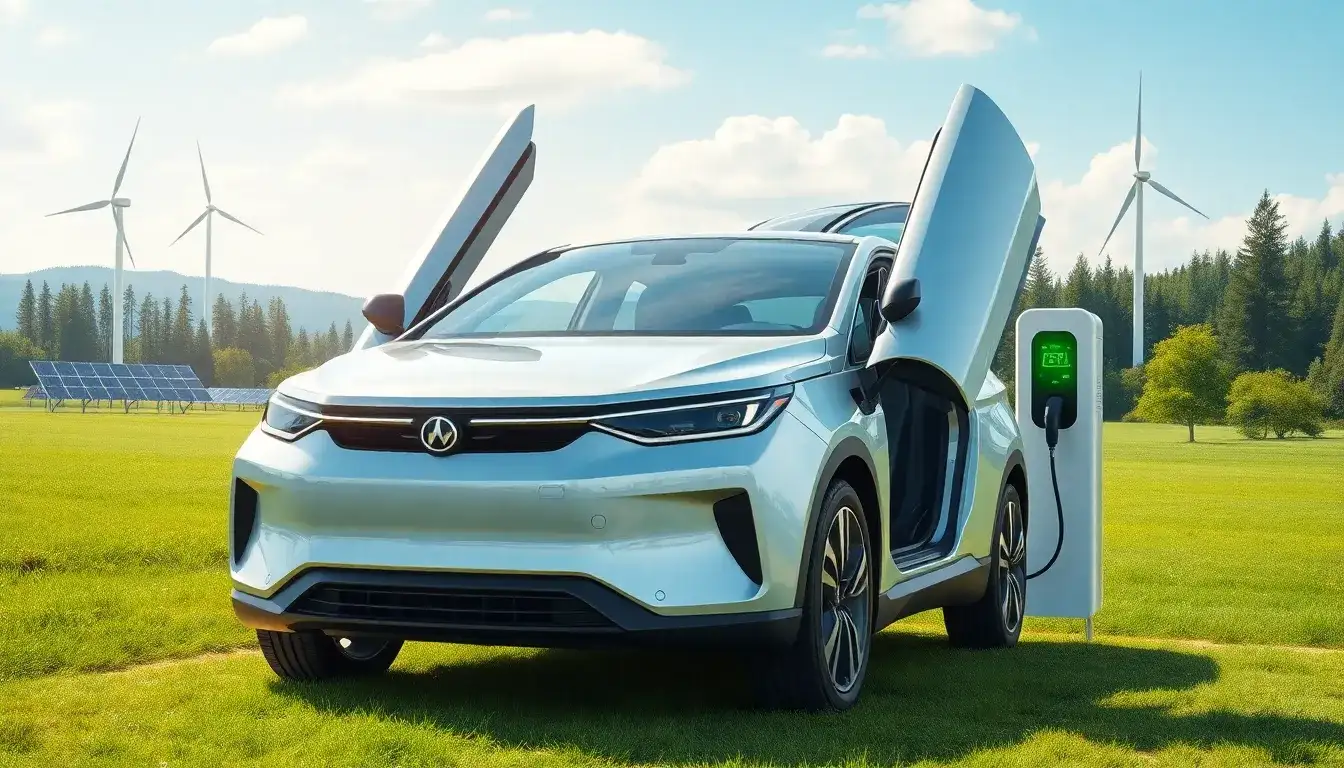
Yang Yusheng, an academician of the Chinese Academy of Engineering, recently emphasized in an interview that range-extended electric vehicles (EREVs) could be the optimal solution for achieving carbon neutrality. He stated, “Range extension is not a transitional technology, but one of the mainstays of future automobiles.” Since 2017, Yang has advocated for the development of EREVs due to the current limitations of battery technology.
The unique advantages of range extension technology align well with global carbon neutrality goals. EREVs utilize a parallel architecture of “battery + range extender” that allows for flexible switching between pure electric drive and fuel-based power generation. Yang highlighted its core advantage with the design philosophy of “electricity for city commuting, fuel for long-distance travel,” which effectively alleviates the range anxiety associated with purely electric vehicles.

Range extension technology is not a simple either-or choice; rather, it represents a complex application aimed at meeting the maximum number of scenarios at the lowest cost. Data shows that in 2024, over <b>65%</b> of the driving distance for EREV users in China will be purely electric, with nearly <b>90%</b> of the time spent operating on electricity, thus validating the practicality of this model.

From an environmental perspective, EREVs can reduce carbon emissions by more than <b>50%</b> compared to traditional fuel vehicles. Yang noted that if green fuels such as methanol and ethanol are adopted, the reduction in emissions could be even more significant. Once green liquid fuels become widespread, EREVs could completely eliminate dependence on petroleum, becoming a key vehicle for achieving carbon neutrality.

Sales of range-extended vehicles are experiencing rapid growth, with prices dropping to more mainstream levels. Public data indicates that in 2024, <b>1.18 million</b> range-extended electric vehicles were sold in China, representing a <b>63%</b> year-on-year increase, with models priced above <b>250,000 yuan</b> accounting for over <b>60%</b> of sales. As technology matures, prices have decreased from over <b>200,000 yuan</b> to a range of <b>100,000 to 150,000 yuan</b>, making these vehicles accessible to a broader consumer base.

Liu Ligao, Vice President of Li Auto, recalled at the 2025 China Electric Vehicle 100 Forum that in 2020, he presented a slide stating, “Range extension is the mainstay of the future,” which was met with more skepticism than applause. However, Li Auto not only achieved profitability but also sparked a wave of enthusiasm for range extension technology, with models from its brand accounting for <b>90%</b> of sales.

The trend of the industry and policy drivers are guiding a convergence in technology routes. Once seen as a “transitional solution,” range extension technology has now become a competitive arena for car manufacturers. New players like Xpeng, Xiaomi, and Geely, alongside traditional automakers, are increasing their investments. Plans for over <b>10</b> range-extended models spanning sedans, SUVs, and high-end vehicles are set for release by 2025, with price ranges from <b>150,000 to 1 million yuan</b>, while major brands like Volkswagen and Hyundai have also announced their entry into this market.

Yang categorized range extension technology into three generations: the first generation, represented by the BMW i3, simply added a generator; the second generation leveraged a parallel system of battery and engine to reduce both displacement and battery size; and the third generation employs direct drive through generators, exemplified by the Nissan e-POWER, achieving fuel consumption as low as <b>2.7 liters</b> per 100 kilometers. The latest range-extending hybrid battery from CATL boasts a pure electric range exceeding <b>400 kilometers</b>, surpassing many pure electric models, indicating that the “large battery + fuel tank” approach is becoming mainstream.

Despite a gradual reduction in subsidies for new energy vehicles, range-extended models still benefit from policies such as tax exemptions and preferential license plate allocations. Yang pointed out, “By 2025, the average energy consumption target for new pure electric vehicles is set at <b>12 kWh</b> per 100 kilometers. Range-extended vehicles, due to their lower battery usage and lightweight design, are more likely to meet this standard.” Furthermore, the characteristic of not relying on charging stations makes them particularly suitable for rural and extremely cold regions, aligning well with rural revitalization and dual carbon goals.

Looking ahead, safety, cost, and collaboration across the entire industry chain will be crucial. As battery technology advances, the range and charging efficiency of range-extended vehicles are expected to improve significantly, but battery safety remains foundational. “Due to the reduced battery usage, range-extended vehicles can utilize safer lithium iron phosphate batteries, which have a significantly lower accident rate compared to long-range pure electric vehicles,” Yang emphasized. He stressed that safety must be prioritized, rather than pursuing high energy density at all costs. “Lithium iron phosphate and ternary batteries exceeding <b>180</b> and <b>250 Wh/kg</b> respectively require heightened safety measures.”

Yang proposed three recommendations for current battery technology: develop high-rate capacitive batteries suitable for range-extended energy recovery needs; prioritize safety, keeping the energy density of lithium iron phosphate batteries below <b>180 Wh/kg</b>; and adopt a rational perspective on solid-state batteries to avoid excessive investment that could overshadow the development of other technologies.

In the future, range extension will be closely tied to green liquid fuels. Yang introduced the concept of “VG2G” (Vehicle Generating to Grid): when renewable energy generation is insufficient, <b>3 million</b> range-extended vehicles could generate enough methanol power to fill a gap of <b>100 million kWh</b>, serving as mobile energy storage units. Additionally, hydrogen internal combustion engines, as a substitute for fuel cells due to their lower costs and ease of maintenance, may see early implementation in specific areas.

Yang shared that by 2027, range-extended vehicles (including plug-in hybrids) are expected to account for <b>one-third</b> of the electric vehicle market in China, increasing to <b>55%</b> by 2030, establishing a tripartite balance among pure electric vehicles, fuel cars, and range-extended vehicles. “This judgment is based on multiple factors: consumer demand for endurance and environmental friendliness, technological investments from car manufacturers, and policies favoring truly energy-efficient and emission-reducing technologies.”

The rise of range-extended electric vehicles from the “margins” to the “mainstream” is not only a victory of technological direction but also an inevitable choice driven by market and policy synergies. In the global race toward carbon neutrality, China’s range extension technology could become a core force driving the transformation of the automotive industry. “Range extension is not a transition to pure electric vehicles; it is one of the mainstays of future automobiles, not just in China but around the world,” Yang concluded.
Original article by NenPower, If reposted, please credit the source: https://nenpower.com/blog/yang-yusheng-range-extended-electric-vehicles-may-be-the-optimal-solution-for-carbon-neutrality/

