

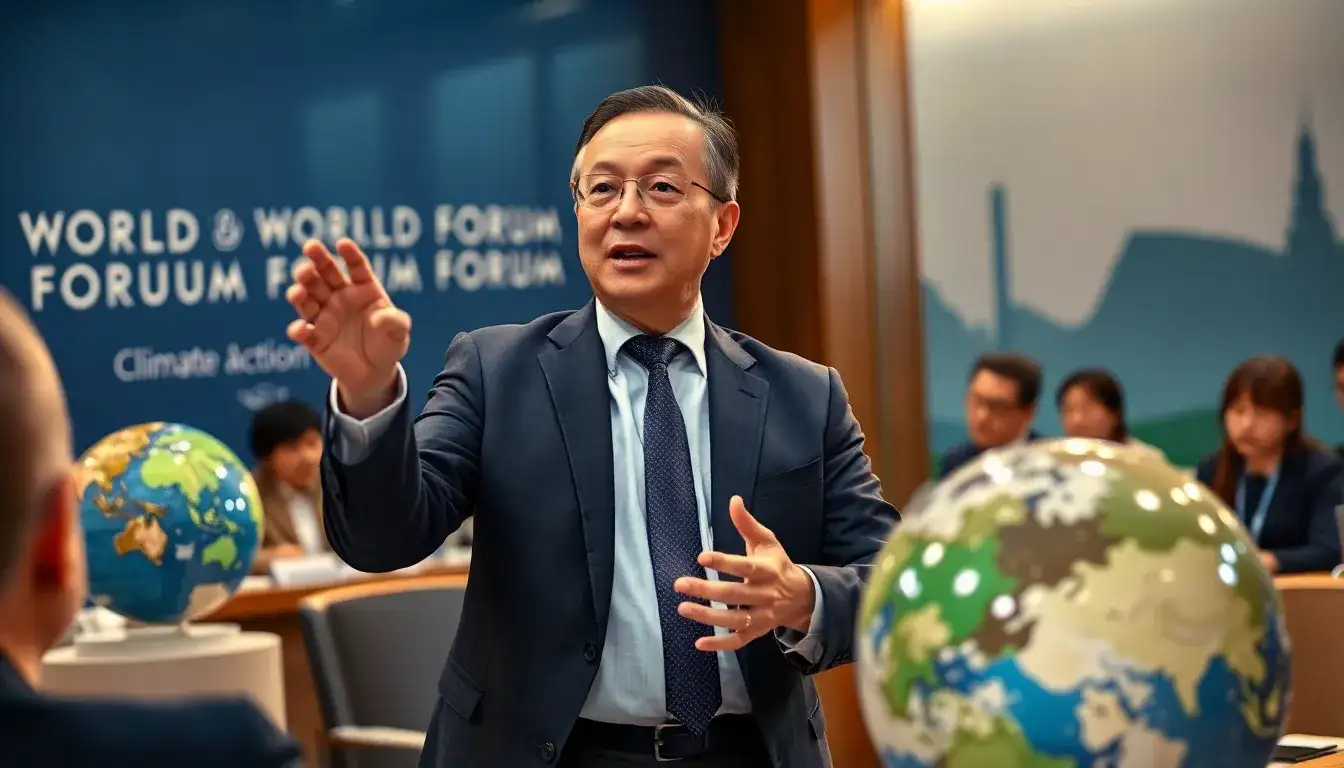
Interview with a World Economic Forum Expert: Climate Change is Becoming More Urgent, and China Will Play an Important Role in Global Decarbonization
The international community anticipates that China will take on a greater role in leading countries and enterprises to implement the Paris Agreement and accelerate the global decarbonization process.
The 2020s is a critical decade for enhancing climate action, and with less than half the time passed, the world briefly surpassed the 1.5°C warming threshold in 2024. This 1.5°C is a significant temperature, representing one of the key goals of the Paris Agreement signed in 2015, which aims to ensure that global temperature changes do not exceed 1.5°C above pre-industrial levels, while striving to keep the overall increase below 2°C.
The implications of the 1.5°C threshold have become increasingly tangible. In January 2025, the strong dry wind known as the “Santa Ana winds” swept through California, causing severe wildfires that burned nearly 40,000 acres (approximately 161.87 square kilometers) and destroyed over 16,000 buildings. In March, multiple forest fires in southeastern South Korea, exacerbated by dryness and strong winds, affected an area of 48,000 hectares, marking the largest scale of damage and casualties in recorded history.
“Our planet is sending out continuous distress signals. However, it is still possible to limit long-term global warming to 1.5 degrees Celsius. With new national climate plans set to be established this year, leaders must take concrete action to seize the opportunities of affordable, clean renewable energy for their people and economies,” said United Nations Secretary-General António Guterres in March 2025.
Addressing the climate crisis is a collective mission that requires global cooperation. Earlier this year, the United States announced its withdrawal from the Paris Agreement, raising concerns about the future of global climate action. On the other side of the globe, as the world’s largest energy consumer, China is actively constructing a new energy system primarily based on renewable energy, driven by policy.
By 2024, China’s green energy industry is projected to exceed 8.5 trillion yuan, with expectations to reach 10 trillion yuan by 2025, reflecting a compound annual growth rate of over 18%.
In the context of ongoing geopolitical fragmentation, political polarization, and value divergences, what actions are essential? How can China play a role in the global response to climate change? Interface News interviewed Fang Weiquan, the head of the Climate and Resources Team for the Greater China region at the World Economic Forum.
Interface News: In recent years, extreme weather events such as floods, wildfires, and heatwaves have been frequent. Do you believe this urgent trend will compel countries to break political stalemates and accelerate the establishment of a unified global climate action consensus?
Fang Weiquan: Absolutely, but it will not happen automatically. The urgency of climate change is no longer abstract; climate damage has become a reality felt by millions, prompting a shift from procrastination to action. The scientific conclusions are unequivocal, public demand for action is rising, and the market is responding. However, mere urgency is insufficient. To break the political deadlock, we need to share responsibilities, formulate wise policies, and invest significantly. It is crucial to convert pressure into progress.
Interface News: What impact has the U.S. withdrawal from the Paris Agreement had on global emission reduction targets? How should other countries collaborate to fill this “gap”?
Fang Weiquan: Climate action has never been led by a single entity. The U.S. exit from the Paris Agreement underscores the importance of building a climate system that is resilient, widely distributed, and driven by common goals. In the face of political shifts, the world must rely on enduring structures. The key now is momentum. Many countries, including China, remain committed to climate action, reinforcing the consensus that global emission reductions are a collective effort.
Interface News: Given the current international crisis, can it serve as an opportunity for a global green low-carbon transition? How can we achieve a decoupling of economic growth from carbon emissions?
Fang Weiquan: Crises can indeed catalyze change. In the face of ongoing geopolitical fragmentation, political polarization, and value divergences, we need to promote investment in climate and clean technology through cooperative dialogue more than ever. Decoupling economic growth from carbon emissions relies on the development of emerging technologies. Investing in clean technologies can foster economic growth while minimizing environmental impacts. We need to scale up the application of these emerging technologies rapidly to achieve decarbonization in industry and establish strong market demand to drive their commercial adoption.
Specifically, stakeholders from high-emission industries can form collaborations and seek new economic opportunities through collective climate action. For example, the World Economic Forum’s NOVA initiative is working in China to bring together public and private stakeholders to identify new economic opportunities in the decarbonization process and promote collective action from a value chain perspective.
Interface News: Currently, there are growing discrepancies among countries regarding ESG, with a trend of ESG “rollback” emerging in Europe and the United States. How can we encourage companies to adopt more sustainable and responsible practices in their operations?
Fang Weiquan: It is crucial for companies to recognize that protecting the environment is not only a matter of survival but also a necessary condition for achieving economic development. The cost of inaction regarding climate change is staggering. Our report, The Cost of Inaction: A CEO’s Guide to Climate Risk, indicates that since 2000, climate-related disasters have incurred losses exceeding $3.6 trillion. The business logic is clear: the green market is expected to grow from $5 trillion in 2030 to $14 trillion, and companies that act proactively will have a competitive advantage in adaptive market supply.
During the recent Climate and Nature Action Day event held in Beijing by the Forum, our stakeholders emphasized the need for businesses to shift from compliance to embracing climate and nature action in their business models and growth strategies. Companies must make commitments to ensure progress towards the global climate and nature agenda, including the goals set by the Paris Agreement, to achieve transformative change.
Interface News: In recent years, there has been increasing attention on emission reductions in the transportation sector, which is a significant source of carbon emissions and faces urgent demands for energy structure transformation. How do you view China’s innovative breakthroughs and rapid deployment in this area, and what insights does this provide for promoting a green transition in global transportation and for Chinese enterprises to provide “green power” globally?
Fang Weiquan: The transportation sector is a key component of global sustainable development, currently accounting for 23% of global carbon emissions. However, this sector still relies on fossil fuels for over 90% of its energy, facing multiple challenges, including energy price volatility, supply chain disruptions, and climate risks. At the same time, virtually every industry has transportation and delivery needs, making this sector a significant contributor to indirect emissions, also known as “Scope 3” emissions. Therefore, accelerating the green transition in the transportation sector is imperative for society as a whole.
In this context, China’s rapid deployment in areas such as road transport is particularly noteworthy, with advancements in aviation and maritime sectors also accelerating. As of now, over 1 million new energy logistics vehicles have been put into operation nationwide, effectively promoting emission reductions in transportation while driving the synergistic development of the upstream and downstream industrial chains. Additionally, China’s first cross-regional hydrogen energy heavy-duty truck corridor has officially opened, spanning Chongqing, Guizhou, and Guangxi, providing robust support for the development of hydrogen fuel heavy-duty trucks. This year, China also expanded its pilot program for sustainable aviation fuels, with all domestic flights departing from Beijing Daxing, Chengdu Shuangliu, Zhengzhou Xinzheng, and Ningbo Lishe airports regularly using a blended fuel of 1% SAF starting in March. These achievements demonstrate how sustainable development and industrial growth can mutually reinforce each other, making green productivity the foundation of new productive forces.
The closed-door meeting on “Sustainable Transportation and Logistics Driving Climate Transition,” held by the World Economic Forum in Shanghai in April, also discussed how the demand for green transport capacity will continue to rise as urbanization accelerates in emerging markets, trade volumes increase, and infrastructure construction speeds up. China’s innovative practices are providing replicable and scalable solutions for the world, injecting “green power” into the global transportation sector’s green transition. In the future, companies and technologies from China will play an increasingly important role in the global decarbonization process.
Interface News: In September 2020, China announced its “dual carbon” goals. How do you view the progress of these goals? What is your assessment of China’s role in the global effort to combat climate change?
Fang Weiquan: China is playing an increasingly significant role in global decarbonization efforts. As the world’s largest emitter, China has made remarkable progress towards achieving its carbon peak goals. China has also made significant strides in reducing the costs of key climate technologies such as solar energy, wind energy, batteries, and electric vehicles. The international community looks to China to take on a larger role in leading countries and businesses to implement the Paris Agreement and accelerate global decarbonization.
Original article by NenPower, If reposted, please credit the source: https://nenpower.com/blog/world-economic-forum-expert-discusses-urgency-of-climate-change-and-chinas-key-role-in-global-decarbonization-efforts/

