

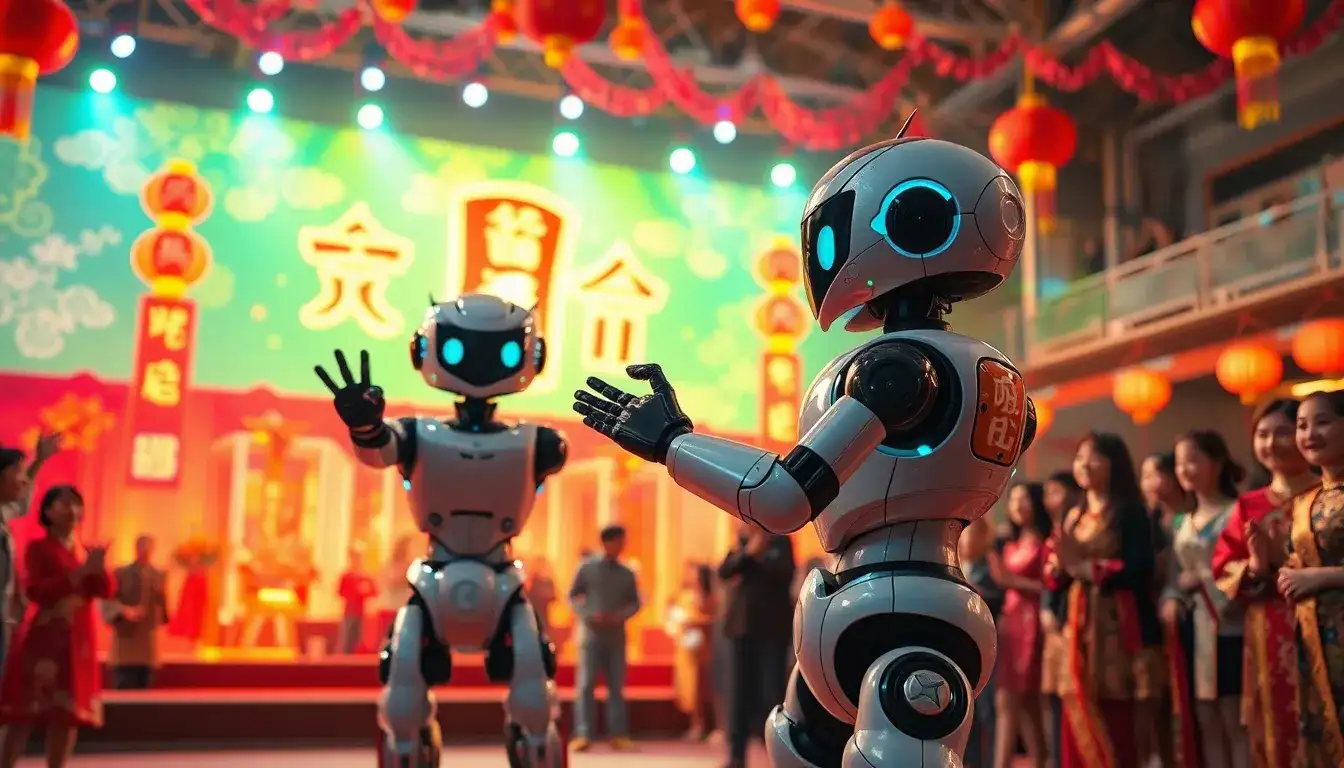
This year’s Spring Festival Gala showcased a significant evolution in its narrative surrounding technology. As robots began to demonstrate their true capabilities, the portrayal of technology at the gala transformed. In previous years, robots appeared on various stages mainly as symbols of technology, often performing slow-paced dance routines or acting as cute interactive toys—delighting audiences with their novelty. However, when Yushutech introduced the G1 and H2 humanoid robots during the 2026 Spring Festival Gala, it became clear to everyone: the demonstration of robots had entered a new phase.
The robots executed a series of high-intensity, fast-paced, and unpredictable movements—parkour, table flips, continuous single-leg flips, nunchaku tricks, and drunken boxing. The audience’s immediate reaction was one of astonishment at how rapidly the performance unfolded, leading some to question whether what they were witnessing was AI-generated. This robot martial arts show, titled “WuBOT,” quickly gained traction both domestically and internationally. On social media platform X, snippets of the performance garnered millions of views, thousands of likes and shares, and hundreds of comments. Enthusiasts marveled at the robots’ evolution, stating, “In just a year, they have evolved from robots into ‘humans’,” and “It’s simply insane… its significance lies in making 1.4 billion Chinese people aware of where the future is headed.”
The comment sections were filled with amazement and disbelief: “Is this AI-generated?” “Are these humans in disguise?” “Why has Yushutech achieved in a short time what American labs, spending billions, took over a decade to accomplish?” This sparked a divide in opinions. On one side, there was awe at the technology, while on the other, skepticism arose regarding whether this was merely a performance. The age-old debate of “performance robots vs. working robots” resurfaced, yet it did not dominate the discussion. Before any controversy could gain momentum, a more pressing question emerged: why is it always Yushutech that pushes robots into the global spotlight?
To grasp this question, one must first understand the level of difficulty presented by this year’s performance. Compared to last year’s “YangBOT,” which featured robots moving in a clumsy, staggered manner, this year’s “WuBOT” showcased the world’s first fully autonomous humanoid robot martial arts performance. According to Yushutech, this “world first” is a series of technical milestones: the first continuous parkour with fancy table flips, where robots cleared multiple obstacles like parkour athletes; the first ejection flip, using custom launchers to soar over 3 meters and complete flips in mid-air before landing smoothly; the first continuous single-leg flips and wall jumps, performing fluid movements akin to professional martial artists; and the first air flare with seven and a half rotations, landing accurately after continuous spins.
“Up close, it can jump as high as the ceiling,” revealed Yushutech founder Wang Xingxing to CCTV News. To achieve this, the team conducted billions of training sessions on simulation platforms before fine-tuning the physical robots. “This movement poses extremely high demands on the robot’s balance control, dynamic response, and landing stability, making it a global first.” A more intricate challenge lies in the coordination of multiple robots. With dozens of robots performing simultaneously, the system’s requirements increase exponentially: real-time positioning must not falter in high-speed scenarios, formations must not accumulate errors, and individual robots must self-correct without triggering chain failures. If any robot experiences a delay or drift, it risks exposing the entire performance. As one viewer remarked after watching the show, “This was undoubtedly the most explosive and stunning moment of the night.”
From domestic to international audiences, and from casual viewers to engineers, a recurring phenomenon was noted—Yushutech consistently stands at the forefront of these high-risk, high-exposure showcases. This raises further questions: If it’s merely about “performing,” why aren’t more companies taking turns on such a stage? If it’s just about “showing off,” what gives them the confidence to repeatedly perform under extreme scrutiny? This is likely not a coincidence, but rather a result of capability selection.
Over the past year, Yushutech’s evolution has been remarkable. If one focuses solely on the performance, the progression from last year’s rhythmic, low-speed coordination to this year’s high-speed, dynamic, and complex martial arts display is impressive. However, the substantial changes have occurred at a deeper level within their capability structure: motion control has shifted from “execution” to “adaptation,” with positioning and perception becoming foundational elements. What does this mean? Last year, robots were primarily executing pre-set trajectories; even slight changes in the environment could derail their performance. This year, robots are able to autonomously maintain precise positioning and formation consistency while dynamically navigating, quickly recovering from any deviations.
According to relevant personnel, Yushutech has undergone comprehensive upgrades in algorithms, hardware, and systems. On the algorithm front, the team enhanced their reinforcement learning framework, utilizing extensive stunt data to pre-train a stunt model with diverse movement capabilities and interference resistance. This significantly improves the efficiency of subsequent model fine-tuning. They also employed integrated perception technology to effectively resolve positioning drift during high-speed movements, achieving centimeter-level landing accuracy.
In terms of hardware, they specifically upgraded the power density of core joint motors, optimized limb strength, and improved dexterous hands and cushioning components to support high-impact dynamic motions. With these upgraded dexterous hands, the robots can securely grasp objects and respond to external disturbances, allowing them to deftly catch sticks and perform impressive nunchaku tricks, effectively handling impacts from human opponents during duels.
On the systems level, Yushutech developed a new automated control system for their robot clusters, achieving full automation from action choreography to formation design and real-time multi-robot coordination. Dozens of robots can synchronize in milliseconds during complex formations and high-difficulty maneuvers, equipped with self-monitoring and anomaly recovery capabilities. This means the robots have established a complete perception-decision-execution feedback loop and can operate stably in complex, high-dynamic scenarios.
This evolution in capability structure is the most fundamental difference between “WuBOT” and “YangBOT.” The ongoing debate surrounding the Spring Festival robots reflects a common perspective: is it more valuable for robots to perform on stage or to “work” off-stage? Why does this question arise every year? The industry, public, and investors are eager for robots to quickly enter real production and service scenarios, harboring a natural wariness towards “stage displays,” fearing they might be “only performers, unable to work.” However, this judgment often overlooks a crucial premise: all complex tasks begin with stable bodily control. If robots cannot move and collaborate in high-speed, uncertain environments, even the most elaborate task concepts will falter.
As Wang Xingxing stated in a recent interview, “Motion capability is a prerequisite for intelligent robots; they must first be able to stand and run steadily before discussing any work.” Traditional so-called “working robots” typically focus on static, structured actions like pick-and-place operations, an area where many peers excel. In contrast, Yushutech’s robots demonstrate motion planning and control in fast, unpredictable environments, a technical complexity far beyond fixed-point pick-and-place tasks. In fact, the technical challenges overcome in “WuBOT” are exactly the foundational capabilities essential for robots to “work” in the real world. For example, the multi-robot coordination system showcased in the performance could be applied to industrial scenarios such as collaborative inspections, warehouse sorting, and assembly lines.
Moreover, the compliant operation and response to external forces seen in the performance, where robots needed to grasp tools while handling impacts from humans, have direct applications in precision assembly, heavy lifting, and household services, enabling robots to sense and adapt to external disturbances in real-time. The relative positioning and environmental interaction required for the parkour and table-flipping maneuvers necessitate that robots accurately assess their relative position to obstacles during high-speed movements and dynamically adjust their gaits to overcome challenges. This capability aligns closely with tasks such as placing goods on shelves, navigating tight spaces, and climbing stairs.
Wang Xingxing remarked, “If robots can perform martial arts in complex formations and rapid movements, it indicates that they will likely be more stable in future work scenarios, providing greater reassurance to users.” Returning to the original question: why does Yushutech consistently propel robots into such globally recognized moments? Perhaps it is because when technological maturity, engineering stability, and scalability begin to manifest simultaneously, the so-called “top-tier” status is simply a natural outcome. On one hand, Yushutech continues to choose the most public and rigorous environments to validate their most challenging technologies; on the other hand, off-stage, Yushutech has already achieved the highest global sales of humanoid robots in 2025. This indicates that every appearance on stage is backed by the capability for large-scale production and engineering delivery.
According to Wang Xingxing, the target shipment volume for Yushutech this year is around 10,000 to 20,000 units, with global humanoid robot shipments projected to reach at least tens of thousands. This validated path of humanoid robot evolution is pushing the entire industry into a new phase. As Wang Xingxing stated, “Our shared goal is to enable robots to genuinely drive progress in human productivity.”
Original article by NenPower, If reposted, please credit the source: https://nenpower.com/blog/why-yu-shu-technologys-robots-stole-the-show-at-this-years-spring-festival-gala/

