

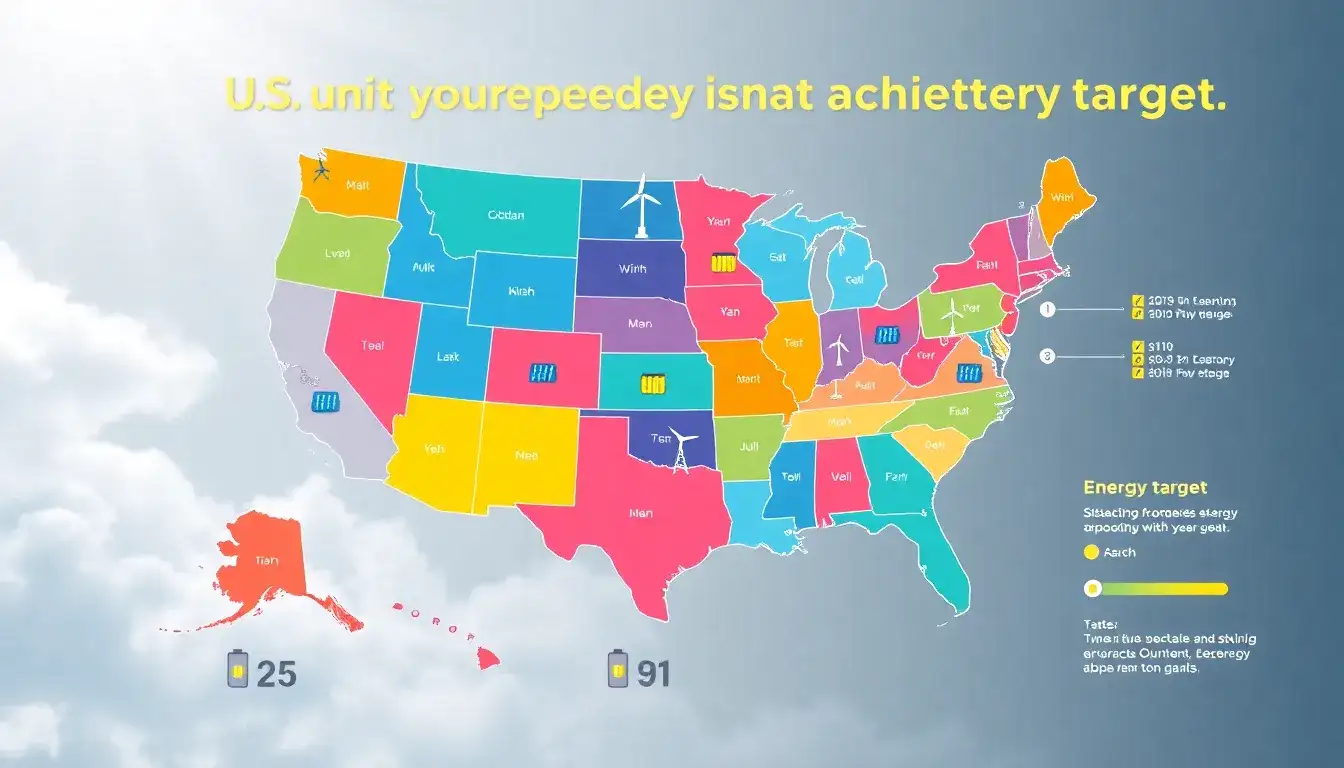
Several U.S. states have set ambitious energy storage targets and are actively making progress toward meeting them, with some states notably closer to their goals due to policy support and ongoing deployment.
States Closest to Meeting Energy Storage Targets
Connecticut has progressive interim goals aiming for 300 MW of energy storage by 2024, 650 MW by 2027, and 1,000 MW by 2030. The state has been advancing steadily against these benchmarks since setting these goals in 2021.
Maine targets 300 MW by 2025 (interim) and 400 MW by 2030, with progress reportedly on track following goal adoption in 2021.
Nevada is recognized for showing steady growth in battery storage and is on target to reach its 1,000 MW (1 GW) capacity goal by 2030. Its Public Utilities Commission established this target in 2020, complemented by supportive legislation like SB448 expanding renewable energy tax credits to battery storage. Nevada’s deployment momentum and innovative projects such as the Crescent Dunes thermal energy storage plant underpin its proximity to meeting its target.
Massachusetts has set a target of 1,000 MWh (1,000 megawatt-hours) by 2025, backed by legislative action in 2018 and ongoing state initiatives, placing it among leading states advancing toward storage goals.
New York initially set a 3 GW target for 2030 but recently doubled this to 6 GW, signaling highly ambitious goals. While this is a stretch target, the state’s strong policy framework and procurement mechanisms foster ongoing progress toward these objectives.
Maryland, as the newest state with an energy storage target set in 2023, aims for 3 GW by 2033. Although early in its timeline, it has clear legislative mandates and programs being established, positioning it on a path to meet future targets.
Summary Table of Selected States’ Energy Storage Targets and Progress
| State | Target (MW or GW) | Target Year | Progress & Notes |
|---|---|---|---|
| Connecticut | 300 MW (2024), 650 MW (2027), 1,000 MW (2030) | 2024-2030 | Steady progress toward interim milestones |
| Maine | 300 MW (2025), 400 MW (2030) | 2025-2030 | On track post-2021 goal adoption |
| Nevada | 1,000 MW (1 GW) | 2030 | Significant growth; supportive policies & projects |
| Massachusetts | 1,000 MWh | 2025 | Legislative support and advancing deployments |
| New York | 3 GW (initial), 6 GW (revised) | 2030 | Ambitious doubling; strong policy push |
| Maryland | 3 GW | 2033 | New target with program establishment underway |
Conclusion
Nevada and Connecticut stand out for their steady progress and supportive policy environments that have resulted in tangible growth toward their storage capacity goals. Massachusetts and Maine also show solid advancement with interim targets approached or met. New York’s doubled goal represents aggressive ambition supported by ongoing state efforts, while Maryland’s recent target marks a new and promising development in energy storage commitment.
These states exemplify leadership in U.S. energy storage deployment, reflecting a combination of clear targets, legislative backing, and programmatic support that position them closest to meeting their energy storage ambitions to date.
Original article by NenPower, If reposted, please credit the source: https://nenpower.com/blog/which-states-are-closest-to-meeting-their-energy-storage-targets/

