

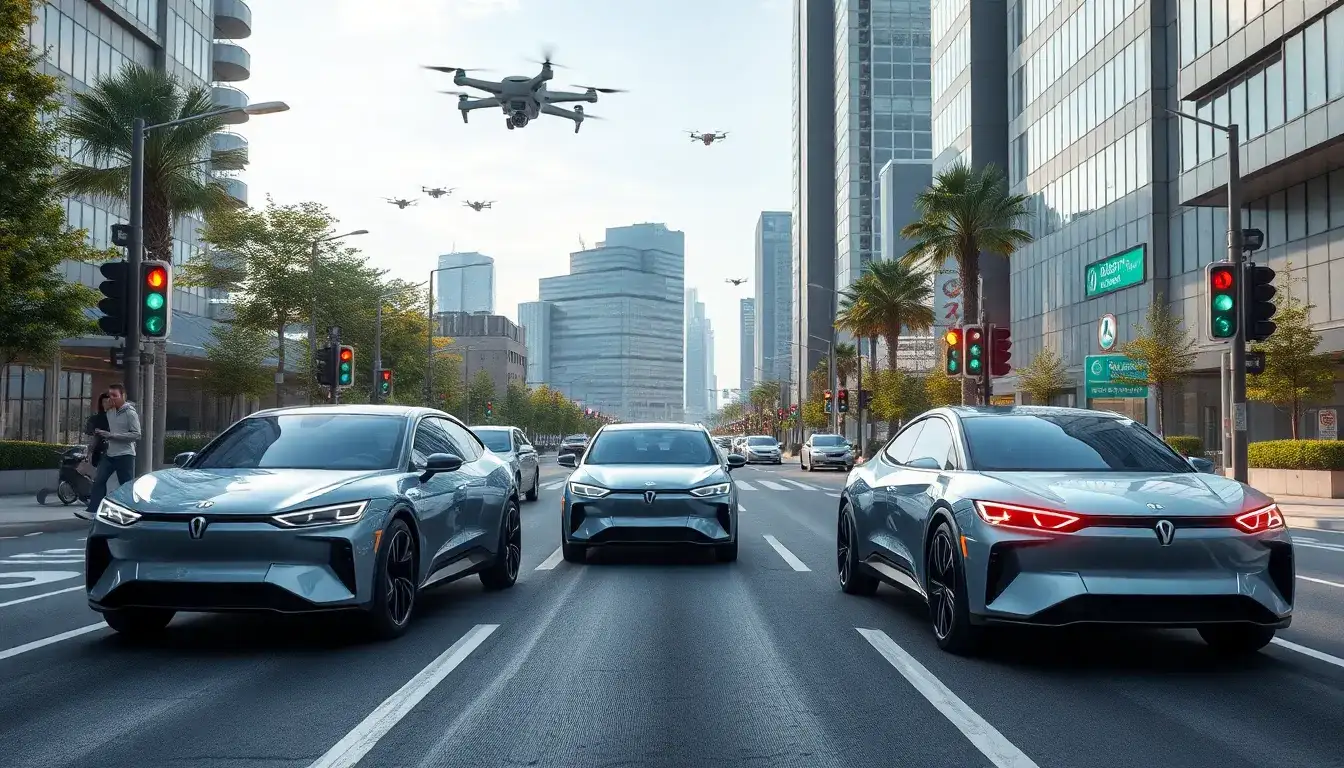
Several electric vehicles (EVs) are expected to feature advanced autonomous driving capabilities in 2025, largely at Level 2 autonomy (partial automation) with some companies pushing boundaries toward higher levels.
Leading EVs with Advanced Autonomous Driving Features in 2025
Tesla
Tesla continues to push the envelope on recall (operational domain) of its Autopilot and Full Self-Driving (FSD) software. Tesla’s systems emphasize hands-off driving in a wider range of scenarios but still require driver attention. Tesla is among the leaders progressing toward SAE Level 3 and beyond, though full Level 5 autonomy is not yet realized.
Waymo (in partnership with OEMs)
Waymo focuses primarily on precision, striving for extremely high safety standards measured by metrics like mean time between failures (MTBF). Their approach targets fully autonomous driving but is often more limited in operational design domains compared to Tesla. Waymo is advancing rapidly toward high reliability autonomous tech, often considered Level 4 or 5 in controlled environments.
Mobileye (Intel)
Mobileye is taking a different strategy with its SuperVision platform, an eyes-on, hands-off system slated to mature by 2025. This approach balances safety and operational domain and aims to scale autonomous driving in a cost-effective way. Mobileye targets a reliable, widely scalable Level 2+ system that improves driver assistance and autonomy gradually.
Rivian
Rivian has announced it will deploy a hands-free advanced driver assistance system in 2025, with plans for an eyes-off system in 2026. This positions Rivian as a strong contender in the EV space for near-autonomous driving features, focusing on highway and hands-free capabilities initially.
Industry Trends Impacting Autonomous Driving in 2025
- Level 2 Autonomy Dominance: Most mainstream EVs in 2025 will be equipped with Level 2 autonomy, where the vehicle handles most steering and acceleration tasks but still requires driver supervision.
- Advanced Driver Assistance Systems (ADAS): Cutting-edge ADAS and highly integrated sensor suites will support increased highway autonomy and improve safety and comfort.
- Intelligent Speed Assistance (ISA): New regulations, such as those in the EU, mandate ISA systems that help vehicles recognize and respect speed limits even when signage is poor or missing, enhancing autonomous safety.
- Operational Domain and Safety Measures: Manufacturers focus on expanding the conditions under which autonomous systems operate (recall) and dramatically improving safety metrics (precision or MTBF).
Summary
| EV Brand/Technology | Expected Autonomy Level in 2025 | Key Features & Focus |
|---|---|---|
| Tesla | Level 2+ with advancing recall | Wide operational domain, hands-off driving, FSD |
| Waymo | Level 4-5 in limited domains | Ultra-high safety (precision), controlled areas |
| Mobileye | Level 2+ | Eyes-on, hands-off, scalable, cost-effective |
| Rivian | Level 2+ (hands-free) | Hands-free driver assistance starting 2025 |
In conclusion, Tesla’s Autopilot/FSD, Waymo’s precision-focused autonomy, Mobileye’s innovative SuperVision, and Rivian’s upcoming hands-free system are among the best autonomous driving technologies expected in EVs by 2025. However, fully driverless, Level 5 autonomy at scale remains under development and is unlikely to be widespread within the year.
Original article by NenPower, If reposted, please credit the source: https://nenpower.com/blog/which-evs-are-expected-to-have-the-best-autonomous-driving-features-in-2025/

