

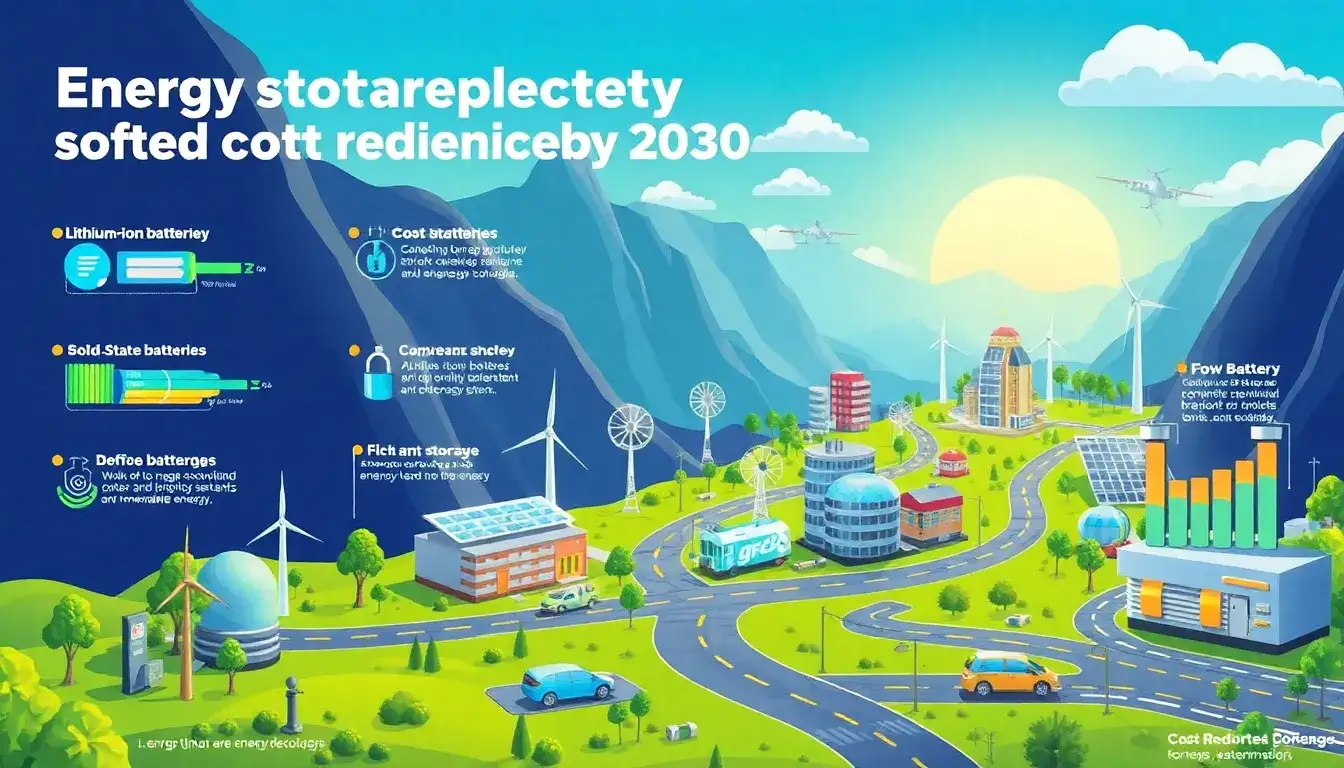
By 2030, several energy storage technologies are expected to see significant cost reductions, driven by advancements in technology and economies of scale. Here are some of the technologies anticipated to experience the largest cost drops:
- Flow Batteries:
- Cost Reduction: Expected to decrease by up to 66%.
- Advantages: Independently scalable power and energy storage, operate at ambient temperatures, and offer high cycle life.
- Pumped Hydro Storage (PHS):
- Cost Reduction: Potential for an 85% reduction in costs through innovations.
- Advantages: High energy storage capacity and long duration, ideal for grid-scale applications.
- Lead-Acid Batteries:
- Cost Reduction: Up to 77% cost reduction potential.
- Advantages: Established technology with potential for cost-effective improvements.
- Compressed Air Energy Storage (CAES):
- Cost Reduction: 60% cost reduction achievable through innovation.
- Advantages: Long-duration storage capabilities suitable for balancing grid fluctuations.
- Sodium-Ion Batteries:
- Cost Reduction: Approximately $0.31/kWh cost reduction possible.
- Advantages: Emerging alternative to lithium-ion batteries with cost-efficient potential.
These technologies are being developed to support a transition towards renewable energy sources by improving grid stability and reducing reliance on fossil fuels. However, achieving the U.S. Department of Energy’s goal of $0.05/kWh for long-duration storage by 2030 will require significant innovation.
Original article by NenPower, If reposted, please credit the source: https://nenpower.com/blog/which-energy-storage-technologies-are-expected-to-see-the-biggest-cost-reductions-by-2030/

