

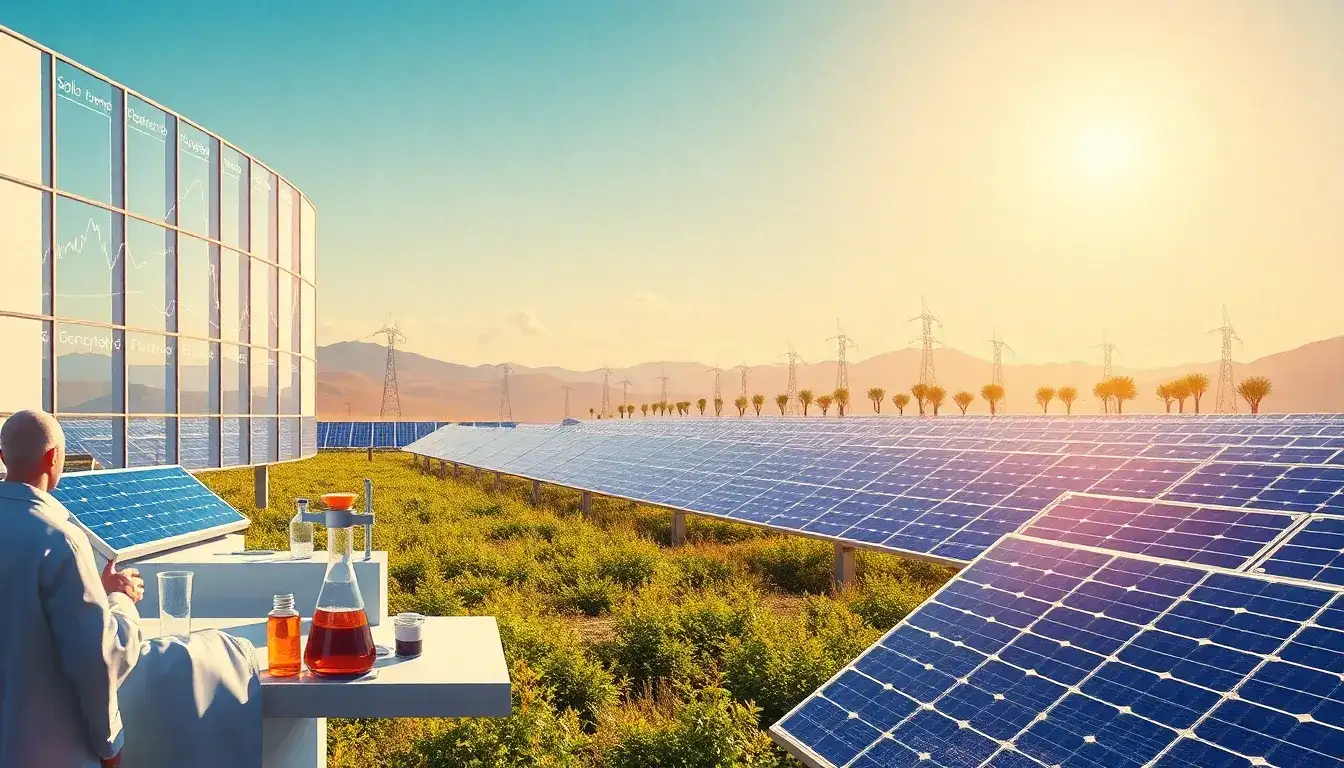
Several key technological advancements are driving improvements in solar panel efficiency as of 2025:
Perovskite Solar Cells
- Perovskite cells are a major breakthrough because they offer significantly higher efficiencies and lower production costs than traditional silicon-based cells.
- Researchers focus on enhancing their stability and scalability to enable widespread commercial use.
- These cells are part of tandem solar panel technology, where perovskite layers are combined with silicon cells to boost overall energy output beyond what either can achieve alone.
Tandem Solar Cells
- Combining perovskite and silicon cells into tandem structures is a leading approach to push efficiency beyond current limits. These allow capturing a broader spectrum of sunlight.
- Tandem cells have shown promising efficiency gains and are expected to become more common commercially in the near future.
Bifacial Solar Panels
- Bifacial panels can capture sunlight on both their front and back surfaces, increasing total energy harvesting, especially when mounted over reflective surfaces or raised installations.
- This technology enhances energy yield without a proportional increase in panel size or cost.
Smart Solar Panels and IoT Integration
- Incorporating sensors and Internet of Things (IoT) capabilities allows solar panels to monitor and optimize their own performance in real-time.
- Smart panels can adjust orientation, track sunlight more effectively, and proactively address performance issues, leading to higher efficiency and reliability over their lifespan.
- Data analytics and automation embedded in smart solar panels contribute to maximizing electricity output and system sustainability.
Improvements in Panel Materials and Durability
- Manufacturers like Maxeon and Canadian Solar have developed panels with improved temperature coefficients, meaning they maintain higher output as temperatures rise.
- Enhanced durability and longer production guarantees (e.g., panels producing over 90% capacity after 25 years) also contribute to effective efficiency over time.
In summary, the top technological advancements boosting solar panel efficiency today are perovskite and tandem cell technologies, bifacial panels, smart IoT-enabled systems, and improvements in materials that improve durability and temperature resilience. These innovations collectively represent a transformative leap toward more efficient, cost-effective, and reliable solar energy generation in 2025 and beyond.
Original article by NenPower, If reposted, please credit the source: https://nenpower.com/blog/what-technological-advancements-are-being-made-to-improve-solar-panel-efficiency/

