

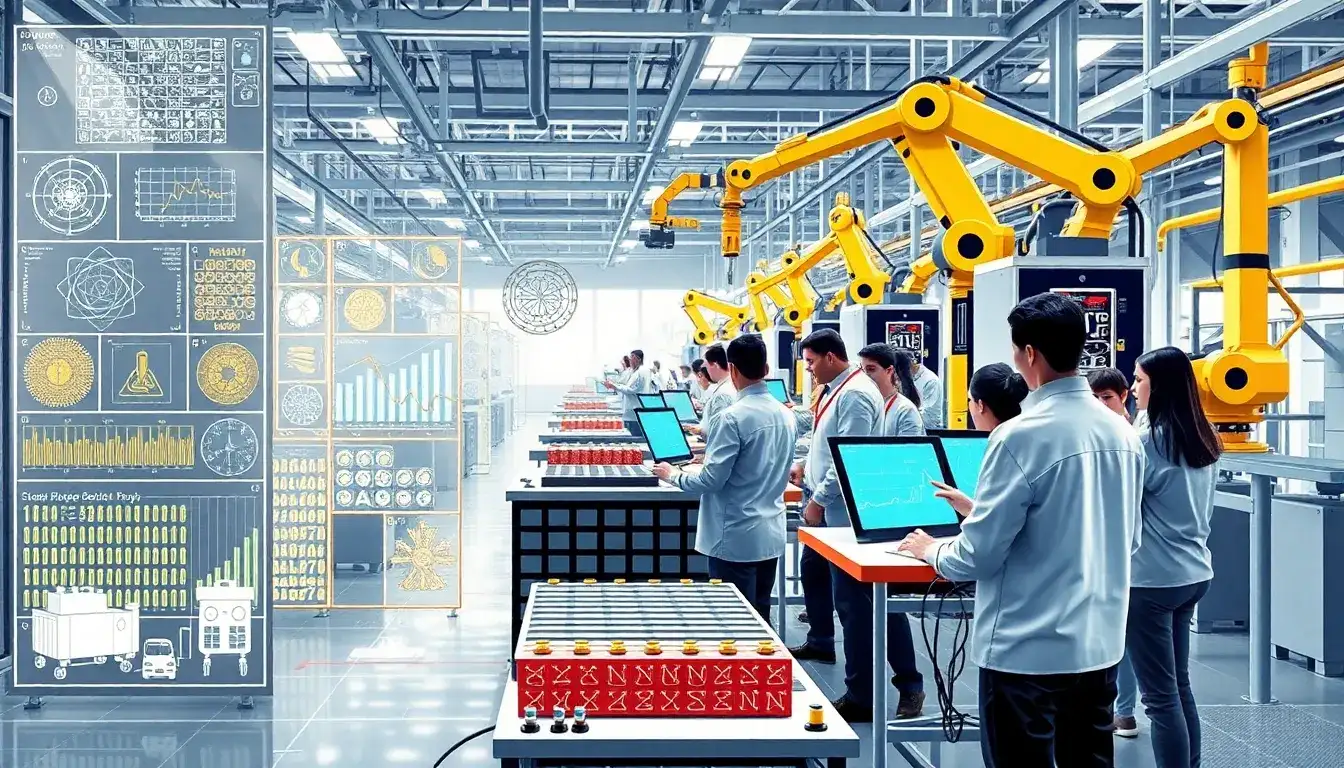
AI-driven root cause analysis addresses several specific challenges in battery manufacturing, particularly in the context of scaling production and ensuring high-quality outputs under complex, multi-step processes. Key challenges that AI can solve include:
Challenges in Battery Manufacturing Solved by AI-Driven Root Cause Analysis
1. Early Anomaly Detection and Faster Corrective Actions
- Battery manufacturing involves numerous intricate process steps with complex interdependencies, making it difficult to detect early anomalies that could lead to defects.
- AI-driven root cause analyzers can identify anomalies early in the production line, enabling faster corrective actions that reduce downtime and improve yield.
2. Managing Complexity and Interdependencies in Production
- Battery cell production is highly complex, involving multi-stage processes with many cause-effect relationships spread across different experts and departments.
- AI models, such as Bayesian Networks combined with expert knowledge (e.g., FMEA-based approaches), help integrate cross-process information to identify root causes of failures more effectively than traditional methods.
3. Reducing Yield Losses and Delays During Ramp-Up
- Scaling battery production from lab-scale to mass production introduces unexpected deviations and new technological challenges that can cause yield losses and slow down time to market.
- AI can analyze large datasets from ramp-up projects to pinpoint specific process deviations, accelerating troubleshooting and stabilizing production lines.
4. Cutting R&D and Testing Time Significantly
- Testing battery technologies for quality and longevity traditionally takes a long time, limiting rapid innovation cycles.
- AI tools like Battery Lifetime Predictors and Root Cause Analyzers drastically reduce testing times (e.g., from 42 days to 15 hours), maintaining high prediction accuracy and enabling faster iteration on battery designs.
5. Handling Voltage and Quality Variations
- Voltage variation and other quality inconsistencies pose significant challenges during battery production.
- Causal AI approaches analyze these variations to determine underlying root causes, improving process control and product consistency.
Summary Table of Challenges and AI Solutions
| Challenge | AI-Driven Solution | Benefits |
|---|---|---|
| Early anomaly detection | AI Root Cause Analyzer | Enables quick corrective actions, reduces downtime. |
| Complex process interdependencies | Bayesian networks combined with expert knowledge | Identifies multi-stage root causes efficiently. |
| Ramp-up process deviations | Automated root cause analysis in ramp-up | Reduces yield losses, accelerates scale-up. |
| Long R&D/testing times | AI Battery Lifetime Predictor | Cuts testing time from weeks to hours, speeds innovation. |
| Voltage and quality fluctuations | Causal AI analysis | Improves process stability and product quality. |
In essence, AI-driven root cause analysis transforms battery manufacturing by enabling deeper understanding and faster resolution of production problems, significantly enhancing yield, quality, and time to market in an industry under intense pressure to scale and innovate.
Original article by NenPower, If reposted, please credit the source: https://nenpower.com/blog/what-specific-challenges-in-battery-manufacturing-can-ai-driven-root-cause-analysis-solve/

