

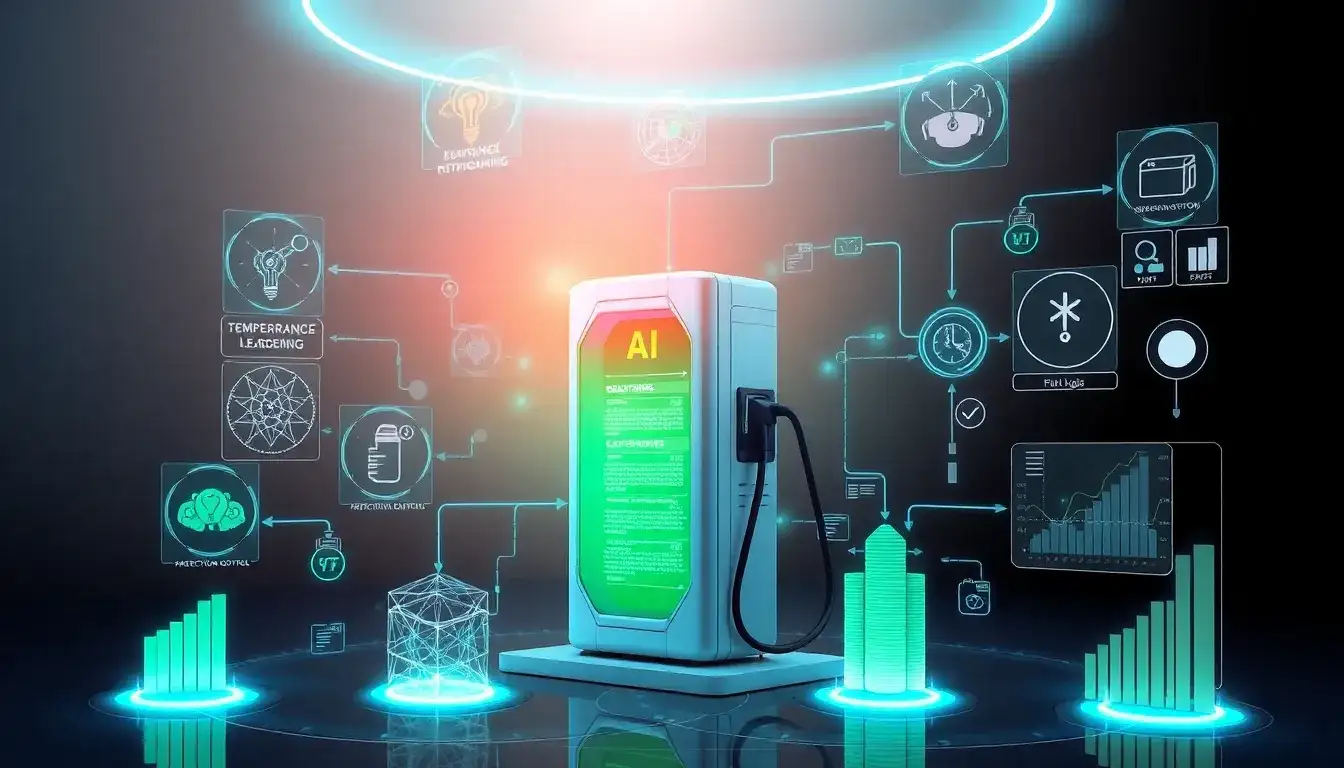
AI algorithms used in Battery Management Systems (BMS) for fast charging primarily include machine learning (ML) models and data-driven adaptive algorithms designed to optimize charging profiles dynamically and ensure battery safety and longevity.
Specific AI Algorithms and Techniques in BMS for Fast Charging
1. Machine Learning (ML) and Data-Driven Modeling
ML algorithms analyze real-time data such as battery temperature, charge cycles, cell health, and chemistry to adjust charging profiles dynamically and optimize performance while preventing damage. These algorithms are capable of predicting battery state and adjusting charging current to enhance efficiency and battery life during fast charging.
2. Deep Neural Networks (DNN)
DNNs are employed to precisely estimate critical battery states such as State of Charge (SoC) and State of Health (SoH), minimizing error rates in these estimations. This helps in managing charging rates adaptively based on battery aging and health, ensuring efficient and safe fast charging without over-stressing the battery cells.
3. Predictive Fault Diagnosis Algorithms
AI-driven fault diagnosis models monitor battery behavior to detect early signs of failure or unsafe conditions. These algorithms prevent incidents like thermal runaway by proactively managing charging or triggering safety measures during fast charging.
4. Kaplan–Meier Algorithm
This algorithm has been specifically mentioned in the context of fast-charging R&D by StoreDot. It assists in analyzing charging data for improving battery life and optimizing extreme fast charging strategies by probabilistically modeling battery degradation and failure times.
5. Adaptive Battery Modeling and Real-Time Controls
Proprietary AI solutions like Electra’s EVE-Ai 360* use advanced battery modeling combined with AI to achieve highly accurate SoC and SoH estimation (within 1-3% error). These adaptive algorithms enable real-time control of charging parameters, energy distribution, and thermal management tailored to battery chemistry and condition.
6. AI-Driven Thermal Management Strategies
AI models predict temperature rise during charging and activate cooling systems proactively rather than reactively, thereby maintaining optimal battery conditions during fast charging. These models optimize thermal conditions to prevent degradation and ensure charging speed does not compromise battery safety.
7. Dynamic Charging Profile Adjustment Based on Chemistry
AI algorithms recognize the battery chemistry (NMC, LFP, etc.) and adjust fast charging protocols accordingly, as different chemistries respond uniquely to high charging rates. This customization minimizes stress on cells and extends battery lifespan.
Summary Table of AI Algorithms in BMS for Fast Charging
| AI Algorithm / Technique | Role in Fast Charging BMS |
|---|---|
| Machine Learning (general) | Dynamic adjustment of charging profiles based on real-time battery data |
| Deep Neural Networks (DNN) | Accurate SoC and SoH estimation to optimize charging safely |
| Predictive Fault Diagnosis | Early detection of faults to prevent battery damage |
| Kaplan–Meier Algorithm | Modeling battery degradation timing for extreme fast charging R&D |
| Adaptive Battery Modeling (Proprietary, e.g., EVE-Ai 360*) | High-precision state estimation; real-time control and optimization |
| AI Thermal Management Models | Predictive cooling activation to manage heat during charging |
| Chemistry-Specific Charging Adaptation | Customized charging protocols based on battery chemistry |
These AI-driven approaches collectively optimize fast charging by balancing speed, battery health, thermal safety, and overall battery longevity, transforming traditional BMS functionality to be more intelligent and adaptive.
Original article by NenPower, If reposted, please credit the source: https://nenpower.com/blog/what-specific-ai-algorithms-are-used-in-bms-for-fast-charging/

