

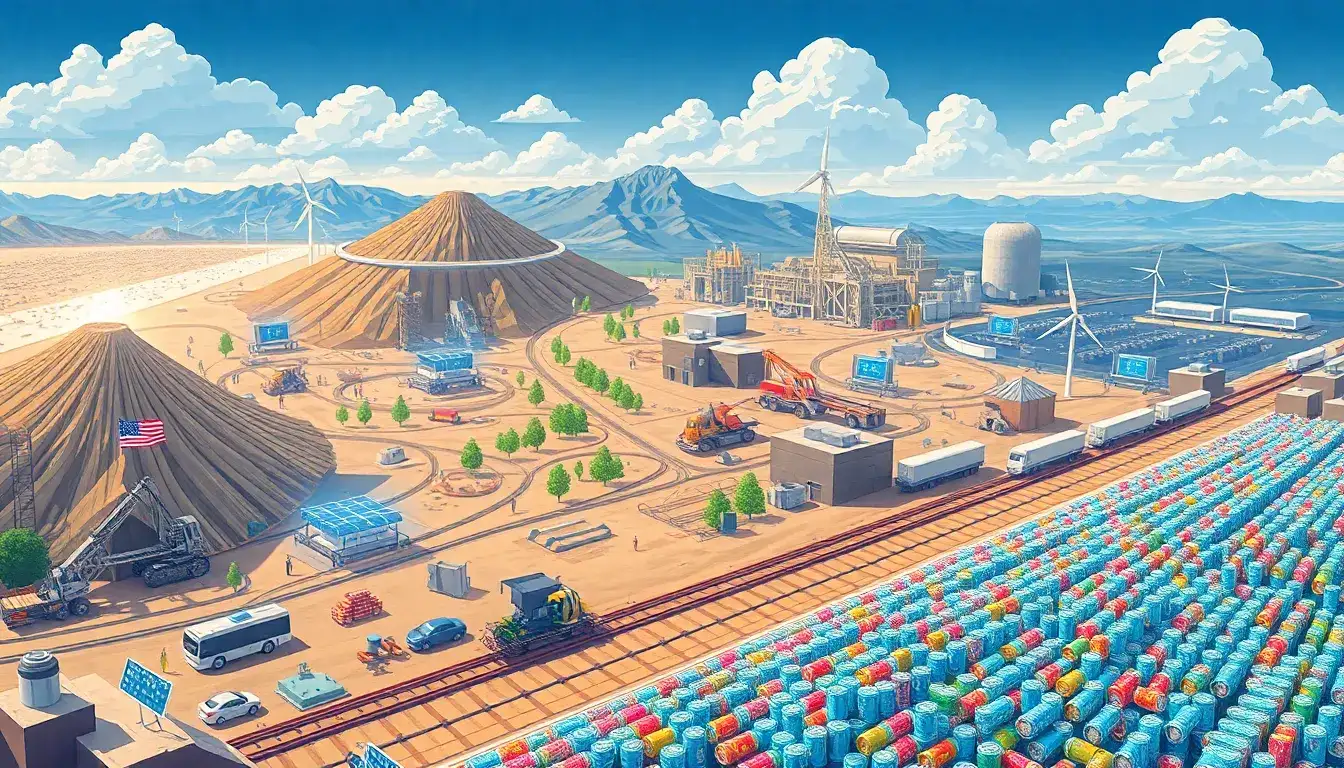
The United States plays a significant and evolving role in the global lithium-ion battery supply chain, focusing primarily on building domestic capacity to reduce dependence on foreign sources, particularly China.
Key Roles of the United States in the Lithium-Ion Battery Supply Chain
-
Developing Domestic Manufacturing and Processing Capabilities
The U.S. government, through initiatives like the Bipartisan Infrastructure Law and the Inflation Reduction Act, is investing billions of dollars to support domestic manufacturing of lithium-ion batteries and electric vehicles. These investments aim to establish a strong and resilient battery supply chain within the U.S., encompassing raw material extraction, refining, and final battery cell assembly. According to the DOE-backed Li-Bridge initiative, by 2030, the goal is for about 90% of lithium battery cells consumed in the U.S. to be manufactured domestically, with about 50% domestic production targets for raw materials, processing, and components. -
Securing Domestic Raw Materials
The U.S. has significant lithium reserves, such as those at the Thacker Pass site in Nevada, which are critical to achieving supply chain independence. In 2024, the Department of Energy announced a record $2.26 billion conditional loan to develop these reserves, aiming to supply lithium carbonate to support battery production for up to 800,000 electric vehicles annually. This development is expected to reduce reliance on imports and lower carbon footprints and transportation costs. -
Research and Collaboration
Agencies like the National Renewable Energy Laboratory (NREL) support creating databases and partnerships that map and strengthen the North American lithium-ion battery supply chain. These efforts help catalyze collaboration between private sector industries, advancing technical innovation and supply chain resilience.
Current Challenges and Context
Despite these efforts, China still dominates lithium processing and EV battery production globally. The U.S. aims to shift this balance by increasing domestic value-added production across the supply chain, but projects involving raw material development face longer timelines and more uncertainty.
Summary Table of U.S. Lithium-Ion Battery Supply Chain Goals (by 2030)
| Supply Chain Stage | Target Domestic Share (%) |
|---|---|
| Cell Manufacturing | ~90% |
| Active Materials & Components | ~50% |
| Material Refining & Processing | ~50% |
| Raw Material Production (Lithium) | ~50% |
In conclusion, the United States is actively working to become a major player in the lithium-ion battery supply chain by expanding domestic mining, processing, and manufacturing capabilities while reducing dependence on foreign sources, especially China. Federal support through legislation and funding is driving this transformation, though challenges remain in fully realizing domestic raw material supply.
Original article by NenPower, If reposted, please credit the source: https://nenpower.com/blog/what-role-does-the-united-states-play-in-the-global-lithium-ion-battery-supply-chain/

