

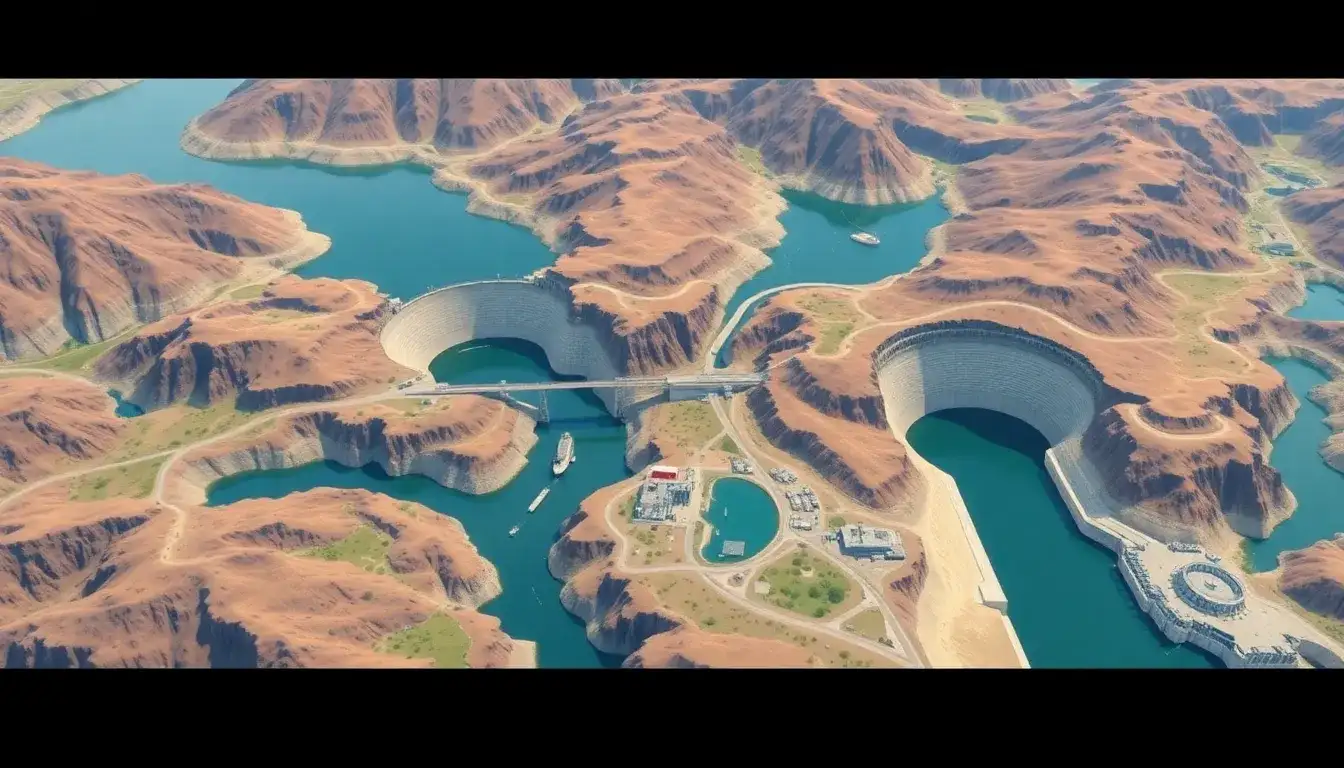
Terrain plays a critical role in determining the feasibility of a pumped hydro storage (PHS) project, influencing technical, economic, and environmental aspects of development.
Key Terrain Factors Affecting Feasibility
Topography and Elevation Difference (Head):
- Traditional PHS projects rely heavily on natural elevation differences, such as mountainous or hilly terrain, to create the gravitational head needed for efficient energy storage and generation. The vertical distance between the upper and lower reservoirs directly affects the energy storage capacity and project efficiency.
- Greater elevation difference reduces the volume of water needed for a given energy storage capacity, lowering construction costs for reservoirs and penstocks.
Land Availability and Geology:
- Adequate land area is essential for constructing reservoirs. In mountainous regions, reservoirs can often be naturally contained, reducing earthworks. In flat regions, reservoirs require extensive land, increasing costs and possibly environmental impacts.
- Geology and soil conditions affect the stability and impermeability of reservoirs. Suitable solid rock formations simplify reservoir construction and reduce water seepage risks.
Water Proximity and Availability:
- Proximity to water sources influences reservoir filling and sustainability. Lack of natural water sources can challenge reservoir management and long-term operation.
Terrain Challenges and Innovations
- Flat terrain typically poses challenges due to the need for large surface reservoirs and lack of natural elevation differences, which increases land use demands and evaporation losses in open-air reservoirs. However, innovative approaches such as Estonia’s Zero Terrain project demonstrate that pumped hydro storage can be engineered in flat areas by constructing underground reservoirs and using mechanical means to create the needed head, thus expanding site feasibility beyond traditional geography.
- Modular pumped storage hydro (m-PSH) concepts seek to overcome terrain and cost barriers by using smaller, potentially less site-constrained units, but their overall feasibility still depends on existing infrastructure and terrain suitability.
Summary Table of Terrain Influences
| Terrain Factor | Impact on PHS Feasibility | Notes |
|---|---|---|
| Elevation difference | Essential for efficient energy storage | Greater head reduces water volume and costs |
| Land availability | Limits reservoir size and footprint | Flat land requires more space and investment |
| Geology | Affects reservoir stability and leakage | Rock formations preferred for construction |
| Water proximity | Influences reservoir filling and sustainability | Necessary for long-term operation |
| Terrain innovation | Enables PHS in otherwise unsuitable areas | Underground reservoirs and modular designs |
In conclusion, the terrain is a fundamental determinant in the feasibility of pumped hydro storage projects. Traditional systems require hilly or mountainous terrain to minimize costs and maximize efficiency, while recent technological innovations are beginning to enable feasibility in flat regions, though often at increased engineering complexity and capital expense.
Original article by NenPower, If reposted, please credit the source: https://nenpower.com/blog/what-role-does-the-terrain-play-in-determining-the-feasibility-of-a-pumped-hydro-storage-project/

