

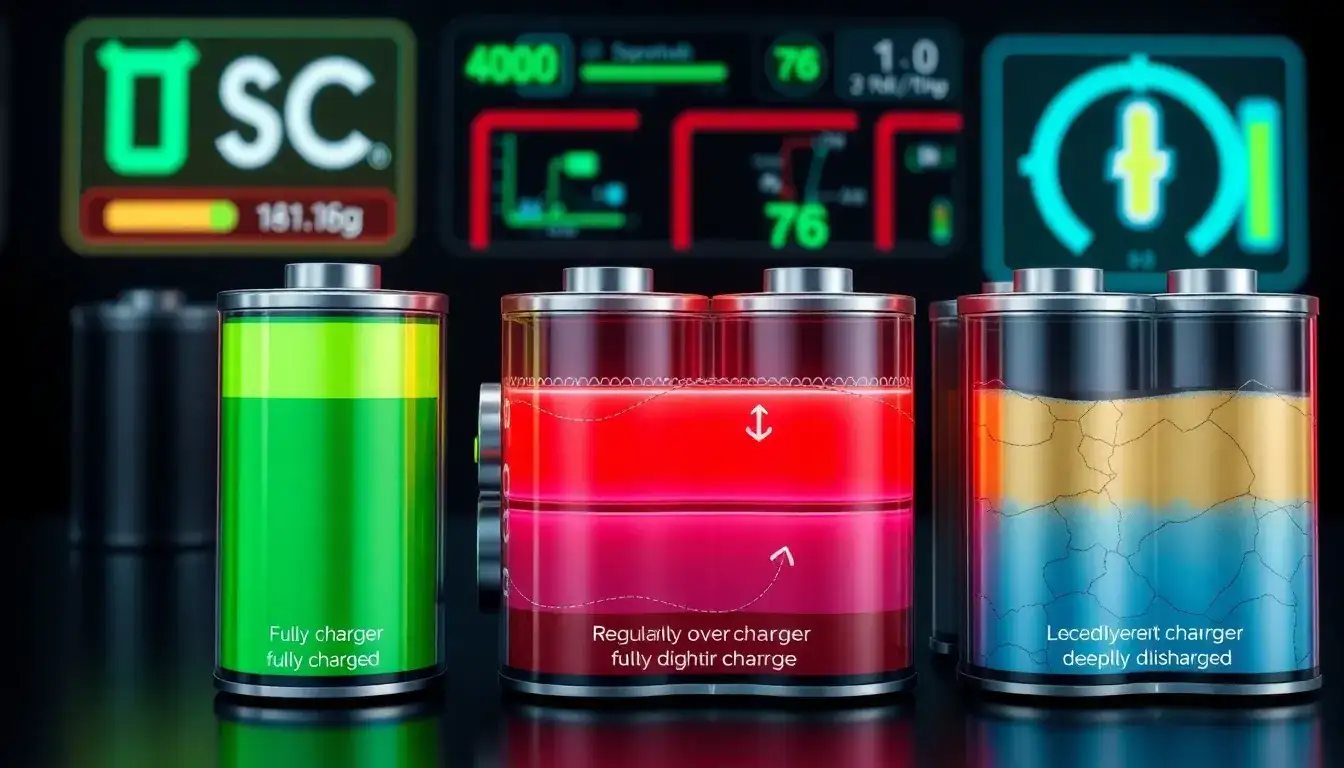
The state of charge (SoC) plays a crucial role in the longevity of lithium-ion batteries. Here are key aspects of how the state of charge affects battery life:
Impact of Charging Levels
- Avoiding High and Low Extremes: Lithium-ion batteries benefit from avoiding both high and low charge states. Keeping a battery at very high charge levels (near 100% SoC) for extended periods can cause stress due to high voltages, which can degrade the battery more quickly than cycling at moderate charge levels.
- Benefits of Mid-State Charging: Cycling in the mid-state of charge, ideally between 20% and 80% SoC, is generally considered the best practice for prolonging battery life. This range minimizes stress on the battery cells and reduces degradation compared to full charge and discharge cycles.
- Preventing Deep Discharge: Very low states of charge, or deep discharges, should also be avoided. Deeply discharging a lithium-ion battery can lead to irreversible damage, including damage to the solid electrolyte interphase and a reduction in the battery’s overall capacity.
Practical Strategies
- Partial Cycles: Utilizing partial charge and discharge cycles can help extend battery life by reducing strain on the cells. This approach is beneficial for most applications, as it avoids the stress associated with full charge and discharge cycles.
- Storage Conditions: If a lithium-ion battery must be stored for an extended period, it is advisable to charge it to about 50% SoC and then store it in a cool place to minimize degradation.
Conclusion
In summary, managing the state of charge is vital for maximizing the longevity of lithium-ion batteries. Maintaining moderate charge levels, avoiding extreme states, and using optimal charging practices can significantly extend the lifespan of these batteries.
Original article by NenPower, If reposted, please credit the source: https://nenpower.com/blog/what-role-does-the-state-of-charge-play-in-the-longevity-of-lithium-ion-batteries/

