

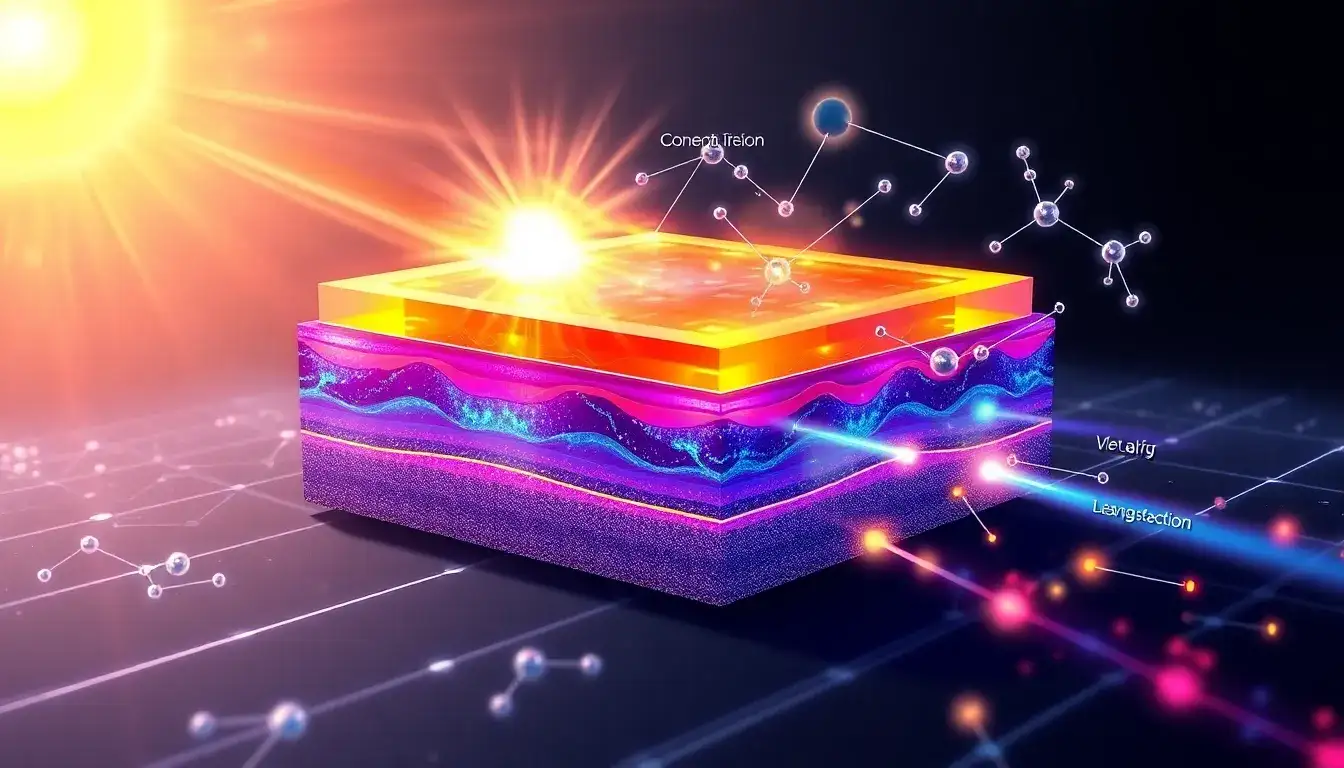
The low exciton binding energy in perovskite solar cells plays a crucial role in enhancing their efficiency. Exciton binding energy is the energy required to separate an electron-hole pair (exciton) into free charge carriers that can contribute to electrical current.
Role of Low Exciton Binding Energy in Perovskite Solar Cell Efficiency
- Facilitates Exciton Dissociation
A low exciton binding energy means that the Coulombic attraction between the electron and hole is weak, allowing excitons to dissociate more easily into free carriers at room temperature. This efficient exciton dissociation leads to a larger population of free charge carriers available for photocurrent generation, which directly improves the power conversion efficiency of the solar cells. - Enhances Carrier Transport and Collection
When excitons dissociate readily, charge carriers can be transported and collected more efficiently before they recombine. This results in higher charge extraction efficiency and improved device performance. Materials with lower exciton binding energies generally exhibit better charge carrier mobility and reduced recombination losses. - Influence of Dielectric Screening
The low exciton binding energy is partly due to strong dielectric screening in perovskite materials, which reduces the Coulomb interaction between electrons and holes. For example, organic components that increase the dielectric constant can help lower the exciton binding energy, enabling more effective free-carrier generation essential for photovoltaic applications. - Polaron Effects and Exciton Fine Structure
In metal-halide perovskites, polaron effects—where carriers are coupled to lattice vibrations—also contribute to lowering the effective exciton binding energy. This complex carrier-phonon coupling helps explain the high efficiency of perovskite solar cells despite their intrinsic excitonic nature. - Comparison with Related Perovskites
Studies have shown that reducing exciton binding energy correlates with improved photovoltaic performance across different perovskite compositions, including antimony-based perovskites where enhanced phase purity and increased dielectric response reduce the exciton binding energy and improve solar cell efficiency.
In summary, the low exciton binding energy in perovskite solar cells enables efficient separation of excitons into free carriers, optimizing charge generation and transport, which is fundamental for their remarkable high efficiency in converting sunlight to electricity.
Original article by NenPower, If reposted, please credit the source: https://nenpower.com/blog/what-role-does-the-low-exciton-binding-energy-play-in-the-efficiency-of-perovskite-solar-cells/

