

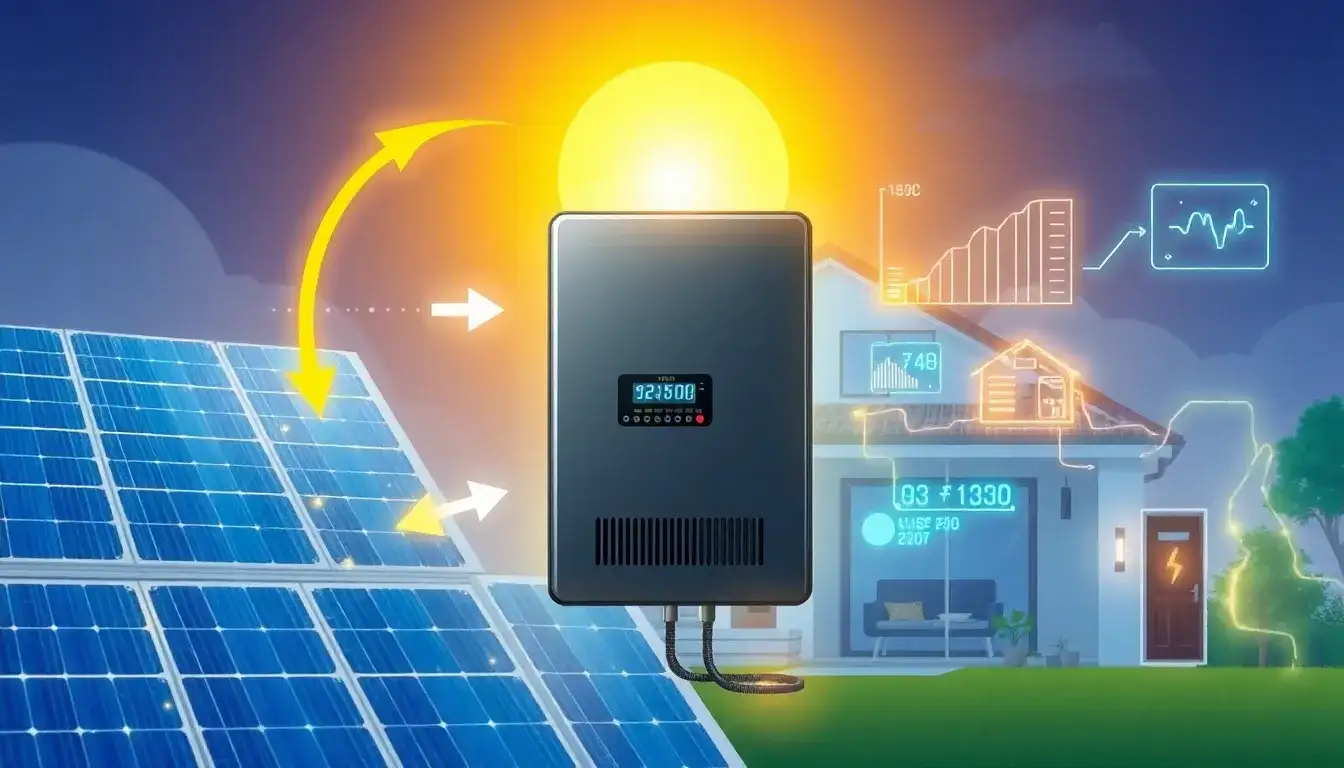
An inverter plays a critical role in the overall efficiency and functionality of a solar power system by converting the direct current (DC) electricity generated by solar panels into alternating current (AC) electricity, which is the usable form for homes, businesses, and the electrical grid.
Key Roles of the Inverter in Solar System Efficiency
- Conversion Efficiency: The inverter’s efficiency directly affects how much of the solar panels’ DC power is converted into usable AC power. Typical high-quality inverters have efficiencies around 90-95%, while lower-quality models may only reach 75-85%. Power losses mainly occur as heat during conversion and due to standby power consumption. Therefore, a high-efficiency inverter maximizes the energy output from the solar array.
- Optimal Sizing: Proper sizing of the inverter relative to the solar panel array is important. An inverter that is too small will “clip” or cut off excess power during peak sunlight, reducing total energy harvested. Conversely, a significantly oversized inverter might operate less efficiently at lower loads. An effective strategy is to size the inverter to closely match or slightly undersize relative to the panel capacity, sometimes allowing panels to be about 133% of inverter size to optimize yield during varying light conditions.
- Maximum Power Point Tracking (MPPT): Modern inverters include algorithms to continuously track and adjust to the solar panels’ maximum power point, maximizing energy extraction by accommodating changes in sunlight intensity, temperature, and shading.
- System Monitoring and Control: Inverters often incorporate monitoring functions, providing data on system performance and enabling remote management or troubleshooting. This helps maintain peak efficiency by allowing quick detection and correction of issues like shading or panel faults.
- Grid Integration and Stability: Besides conversion, inverters help synchronize the solar system with the grid by producing clean, stable sine wave AC power at the correct voltage and frequency. They also include safety and stability features like anti-islanding protection and power factor correction to ensure safe, reliable grid operation and avoid damage to equipment or personnel.
Impact on Overall Solar System Efficiency
Because the inverter handles the critical task of converting DC to AC, its efficiency has a direct effect on the total system efficiency. For example, if a solar array produces 3 kW DC, and the inverter efficiency is 90%, the maximum AC power output will be about 2.7 kW, meaning 10% of potential energy is lost during conversion. Hence, optimizing inverter efficiency and sizing is essential to maximize usable energy from the solar system.
In addition, system losses such as voltage drops from panel to inverter location can further reduce output, so installation practices also impact inverter efficiency. The inverter’s ability to adapt to varying power inputs throughout the day also influences total energy yield.
Summary
| Role of Inverter | Impact on Solar System Efficiency |
|---|---|
| Converts DC to AC | Enables usable electricity for homes and grid |
| Conversion Efficiency | Determines how much DC power is lost during conversion |
| Proper Sizing | Prevents clipping or inefficient operation to maximize yield |
| MPPT and Control | Maximizes power extraction under varying conditions |
| Grid Synchronization | Ensures stable, compatible power delivery to grid |
| Monitoring & Protection | Maintains system health, preventing downtime and ensuring safety |
In conclusion, the inverter is indispensable not only for power conversion but also as a key determinant of the solar power system’s overall efficiency, reliability, and grid compatibility. Selecting a high-efficiency inverter with appropriate sizing and advanced control features significantly enhances total energy production and system performance.
Original article by NenPower, If reposted, please credit the source: https://nenpower.com/blog/what-role-does-the-inverter-play-in-the-overall-efficiency-of-a-solar-power-system/

