

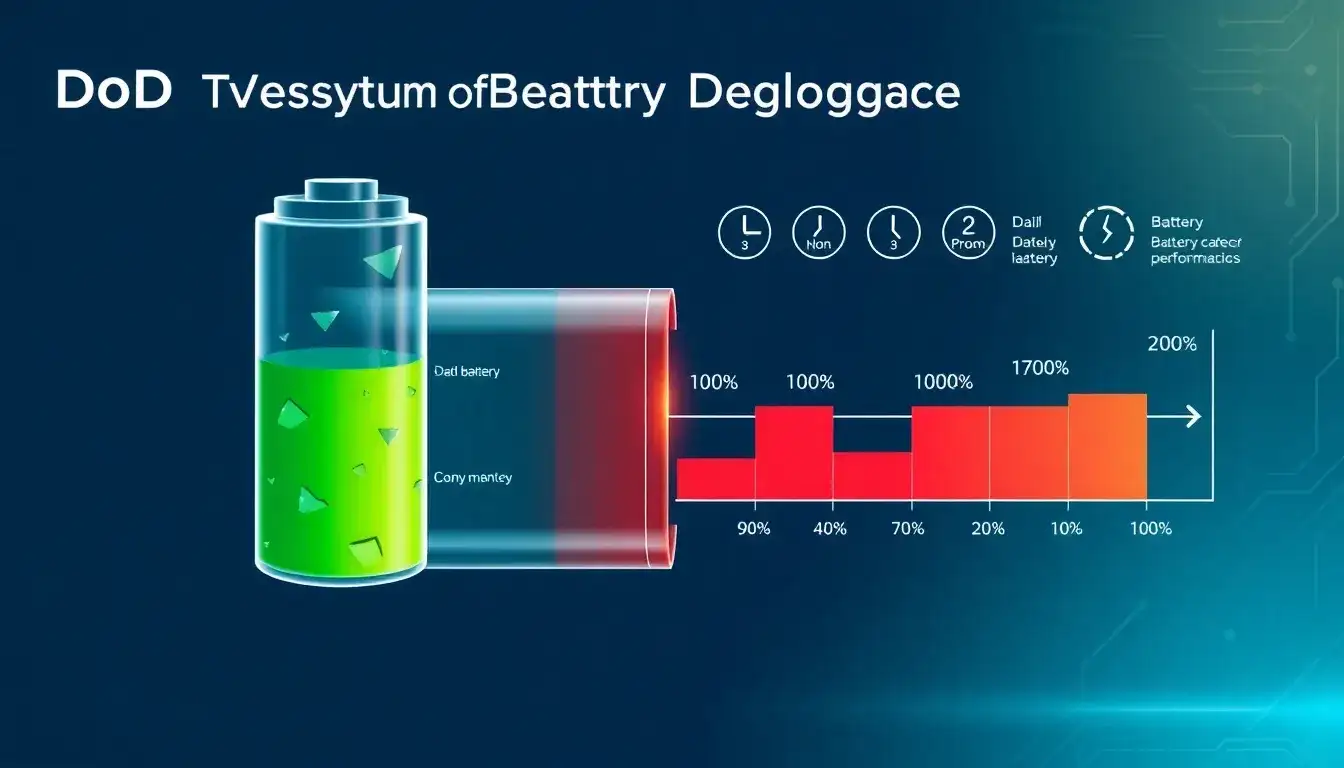
Understanding Depth of Discharge
Definition: DoD refers to the percentage of a battery’s total capacity that has been used before recharging. For instance, discharging a 100 kWh battery down to 20 kWh means a DoD of 80%. It is the complement of the state of charge (SoC), where a higher DoD indicates a more significant amount of energy drawn from the battery.
The Impact of Depth of Discharge on Battery Degradation
- Stress and Wear: Each cycle of charging and discharging inherently wears the battery down. The deeper the discharge, the greater the stress on the battery components, leading to more rapid degradation. Research indicates that high DoD can shorten the battery’s effective life as it increases the number of cycles that contribute to capacity loss.
- Cycle Life Correlation: The relationship between DoD and cycle life is significant. Batteries discharged to lower depths generally have higher cycle lives. For example, limiting DoD between 40-60% can lead to only a 12% capacity reduction after 700 full cycles, whereas cycling from 100% to 5% results in a 20% reduction over the same number of cycles. This demonstrates how a shallower discharge can greatly enhance lifespan.
- Battery Chemistry Sensitivity: Different battery chemistries react differently to DoD. Lithium iron phosphate (LFP) batteries, for instance, show less sensitivity to DoD changes compared to other types. This characteristic allows them to be routinely charged to 100% without significant degradation impacts, contrasted with lithium-ion batteries, which should ideally be maintained at lower states of charge to prolong life.
- Manufacturer Recommendations: Many manufacturers provide specifications on maximum recommended DoD to optimize performance and lifespan. For example, traditional lead-acid batteries perform best when discharged only up to 50-80% of their capacity. In contrast, lithium batteries may allow deeper discharges (up to 80-95%) without as severe consequences, but full discharges should still be avoided.
Practical Recommendations
To maximize battery lifespan, consider adopting practices that involve shallower discharges:
- Recharge Early: Instead of depleting the battery to a very low level, recharging when at around 20-30% can significantly enhance its longevity.
- Monitor Usage: Tailor your usage patterns to keep the DoD moderate. For instance, if driving shorter distances, aim to charge more frequently at the midpoint of your battery’s capacity.
By managing depth of discharge strategically, users can help mitigate degradation and enhance the overall lifecycle of their batteries. This approach not only supports performance but also economic viability, particularly in applications like EVs and renewable energy storage systems.
Original article by NenPower, If reposted, please credit the source: https://nenpower.com/blog/what-role-does-the-depth-of-discharge-play-in-battery-degradation/

