

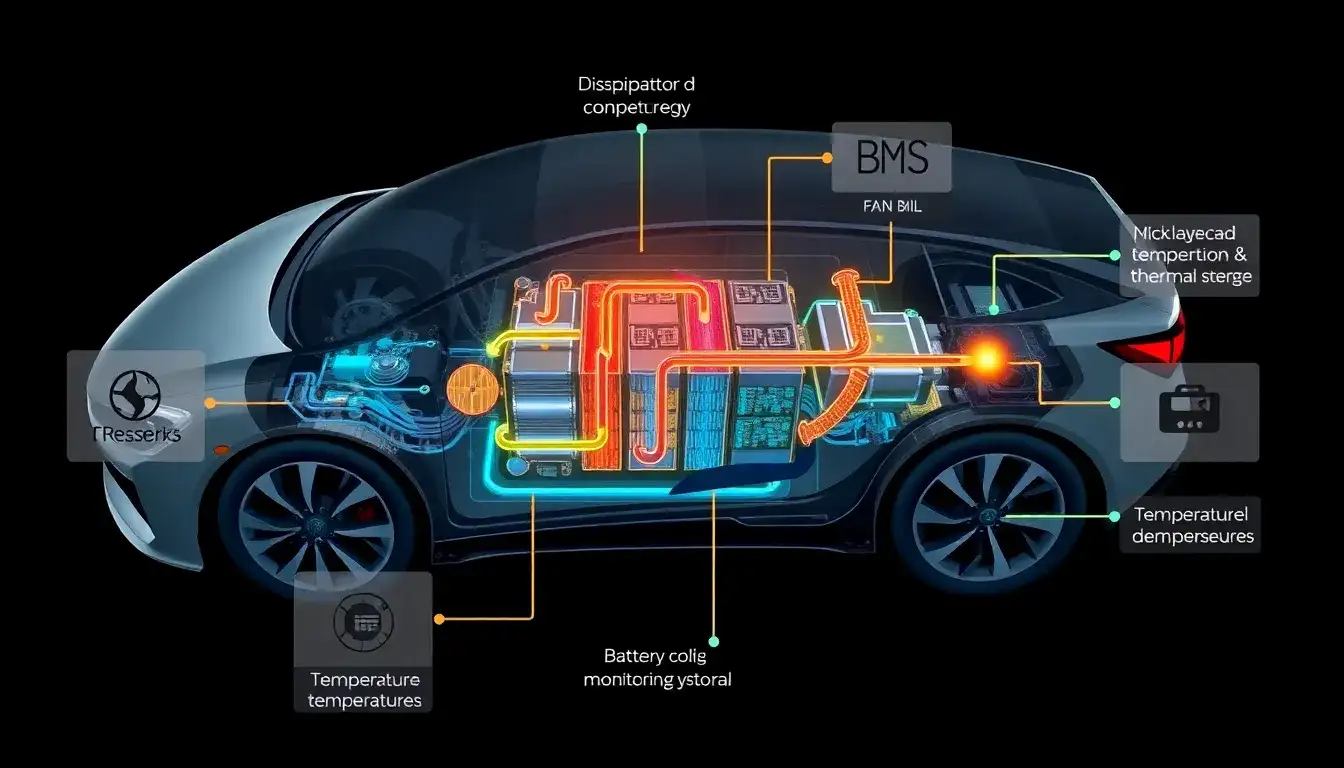
The Battery Management System (BMS) plays a critical role in the thermal management of batteries, particularly in electric vehicles and energy storage systems, by monitoring and controlling the battery’s temperature to ensure optimal performance, safety, and longevity.
Role of the BMS in Thermal Management
- Temperature Monitoring and Regulation:
The BMS continuously monitors the temperature of individual cells within the battery pack to maintain them within the manufacturer’s recommended operating range, typically between 15°C and 35°C. It avoids excessive temperature variations between cells (ideally less than 5°C difference) to prevent uneven aging and performance issues. - Preventing Overheating and Thermal Runaway:
By managing heat generation and dissipation, the BMS helps prevent battery temperatures from rising to dangerous levels (above 80°C), which can lead to thermal runaway—a hazardous condition that can cause fires or explosions. - Activation of Heating or Cooling Systems:
The BMS controls the battery thermal management system (BTMS), which employs heating elements or cooling loops as needed to maintain the optimal temperature range. In cold conditions, it activates heating to warm the battery for efficient operation and charging. In warm conditions, it manages passive cooling (using radiators and fans) or active cooling (using refrigerant cycles) to dissipate heat generated during battery use. - Integration with Cooling Loops:
For liquid-cooled battery packs, the BMS regulates the coolant flow through the battery cells to transfer heat effectively. It coordinates with the BTMS to ensure the coolant temperature is conditioned properly, either by heating or cooling before recirculation. - Optimization of Battery Performance and Lifespan:
By maintaining the battery within the ideal thermal window, the BMS minimizes accelerated battery degradation and maximizes energy efficiency, allowing for better charging speed, longer cycle life, and overall safer operation. - Use of Advanced Control Algorithms and Modeling:
The BMS may use thermal software models to simulate heat transfer and optimize control algorithms for thermal management, helping balance performance, safety, and energy consumption of the cooling/heating systems.
In summary, the Battery Management System is central to battery thermal management by continuously monitoring temperatures, activating heating or cooling processes, coordinating coolant flow, and preventing thermal hazards. This ensures batteries operate safely and efficiently within an optimal temperature range, thus enhancing performance, durability, and safety.
Original article by NenPower, If reposted, please credit the source: https://nenpower.com/blog/what-role-does-the-battery-management-system-play-in-thermal-management/

