

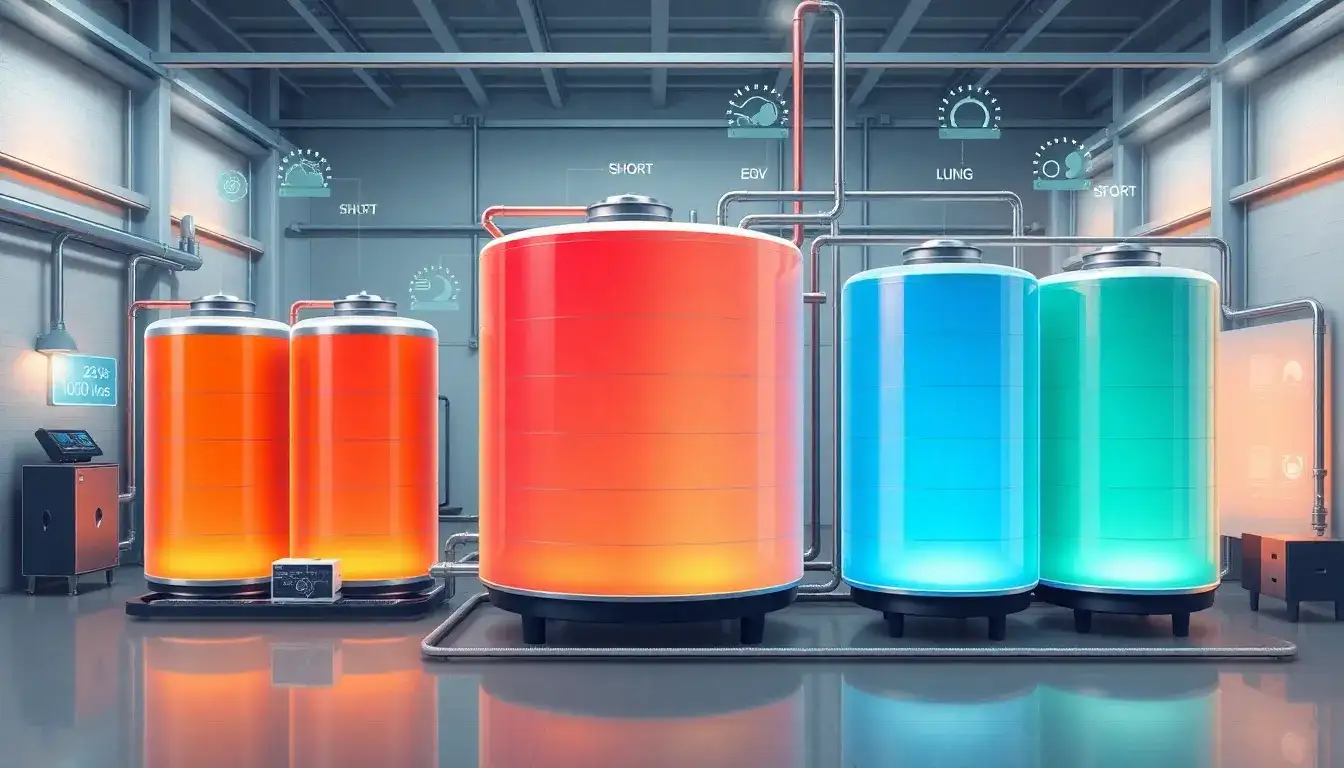
Storage duration plays a critical role in the efficiency and applicability of thermal energy storage (TES) systems. It essentially refers to how long the stored thermal energy can be retained with minimal losses before being utilized. Here’s how storage duration impacts TES efficiency:
Influence of Storage Duration on Thermal Energy Storage Efficiency
- Thermal Energy Retention and Losses: The longer thermal energy is stored, the more potential there is for heat losses due to imperfect insulation and thermal diffusion. Systems designed for short-duration storage (hours to a day) tend to have higher efficiencies because heat losses accumulate over time. Conversely, long-duration storage (days to months) must manage these losses carefully to maintain efficiency.
- Seasonal Storage Considerations: TES systems that enable seasonal storage require very low heat losses over months to be practical. Materials like dried salt and certain thermochemical storage options can store heat at high temperatures for extended periods with relatively low losses, suitable for seasonal use.
- Efficiency Metrics and Duration:
- Short to medium-duration TES systems typically show efficiency ranging from 50% to 90%, depending on technology and materials used.
- A recent demonstration of long-duration thermal storage in sand showed over 95% heat retention efficiency for multiple days, indicating that well-designed systems can achieve very high thermal storage efficiency over extended durations. However, when accounting for full round-trip efficiency (considering conversion to and from electricity), this lowers to about 50-52% for that specific system.
- Material and System Design Impact: The choice of storage medium (e.g., pebbles, copper slags, salts) and system design (such as flowing heat through pebble layers) deeply affects how well energy is preserved over time. Innovations that improve heat retention or minimize heat leaks directly improve the effective storage duration and thus the system’s overall efficiency.
Summary Table: Storage Duration vs Efficiency Considerations
| Storage Duration | Efficiency Impact | Suitable Technologies/Notes |
|---|---|---|
| Short (hours to days) | High efficiency (50-90%) due to lower heat losses | Hot air with pebbles, copper slags |
| Medium (~days) | Can achieve >90% heat retention with advanced insulation | Sand-based TES with 95% heat retention demonstrated |
| Long (seasonal/months) | Efficiency depends on minimizing heat loss; typically lower round-trip efficiency | Thermochemical storage, dried salt |
In essence, longer storage durations pose greater challenges to maintaining efficiency due to increased thermal losses, but advances in materials and system designs have significantly improved the performance of long-duration thermal energy storage systems.
Original article by NenPower, If reposted, please credit the source: https://nenpower.com/blog/what-role-does-storage-duration-play-in-the-efficiency-of-thermal-energy-storage-systems/

