

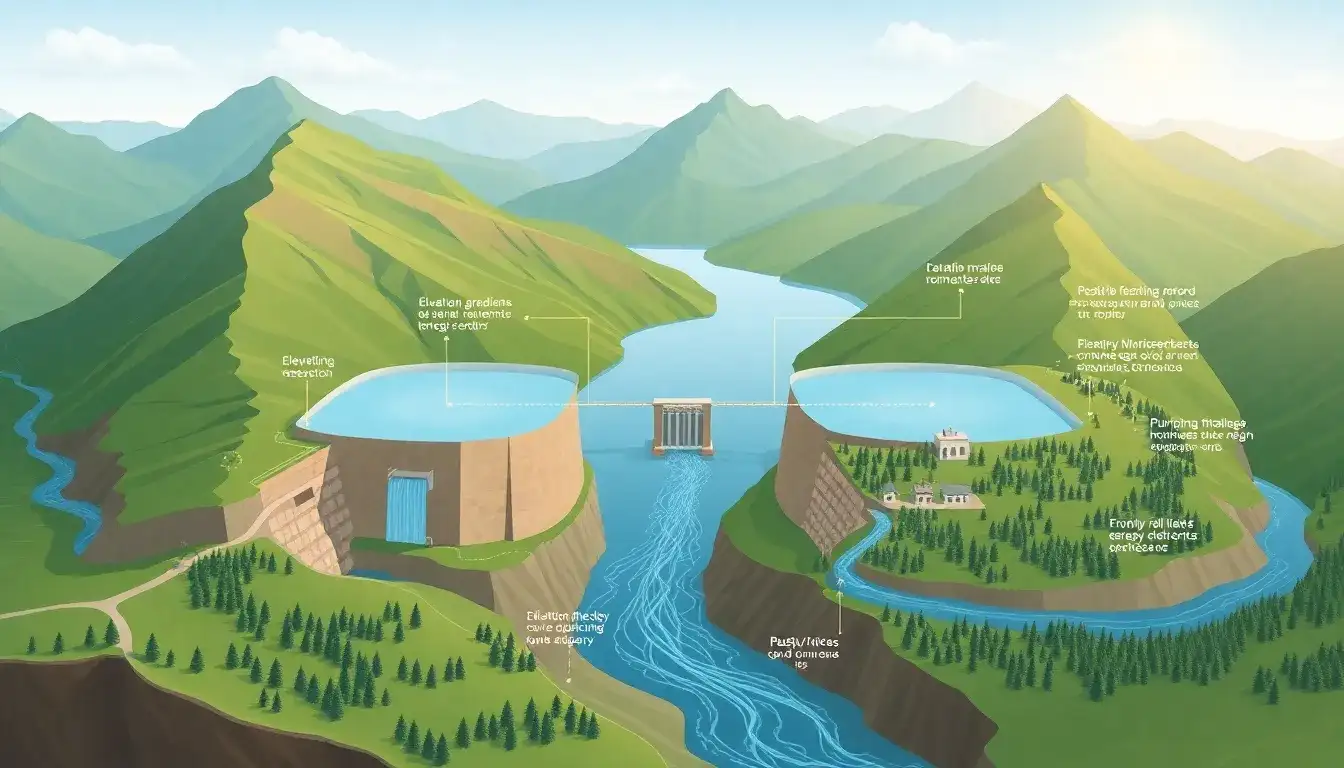
Geography plays a crucial role in the efficiency of pumped hydroelectric energy storage (PHES) by influencing several key factors:
- Suitable Topography: PHES requires locations with significant elevation differences to maximize efficiency. Hilly or mountainous regions are ideal as they offer the necessary height difference between the two reservoirs, allowing for efficient energy generation and storage. The global greenfield pumped hydro atlas lists over 800,000 potential sites primarily in hilly terrains, showcasing the extensive geographical scope for PHES.
- Spatial Constraints: While PHES can be built in various terrains, closed-loop systems away from rivers are often preferred due to easier planning and lower environmental impact. These systems can be constructed in areas not previously used for hydropower, reducing land and water requirements.
- Accessibility to Existing Infrastructure: Geography also affects the feasibility of integrating PHES with existing hydroelectric dams or infrastructure. Projects like Snowy 2.0 in Australia utilize existing reservoirs, while others repurpose old mines or “brownfield” locations, highlighting the adaptability of PHES to different geographical contexts.
- Environmental Considerations: The geographical location can impact environmental effects, such as altering natural water courses and affecting local ecosystems when built near rivers. However, closed-loop systems minimize these impacts by cycling water between small, isolated reservoirs.
- Land and Water Usage: Despite requiring specific geographical conditions, PHES has relatively low land and water requirements compared to other renewable energy storage methods like solar and wind farms. About 10 hectares per gigawatt-hour of storage are needed, and only a small amount of initial fill water, which is recycled over decades.
In summary, geography is pivotal in determining the efficiency, feasibility, and environmental impact of pumped hydroelectric energy storage by dictating suitable locations, spatial requirements, and potential integration with existing infrastructure.
Original article by NenPower, If reposted, please credit the source: https://nenpower.com/blog/what-role-does-geography-play-in-the-efficiency-of-pumped-hydroelectric-energy-storage/

