

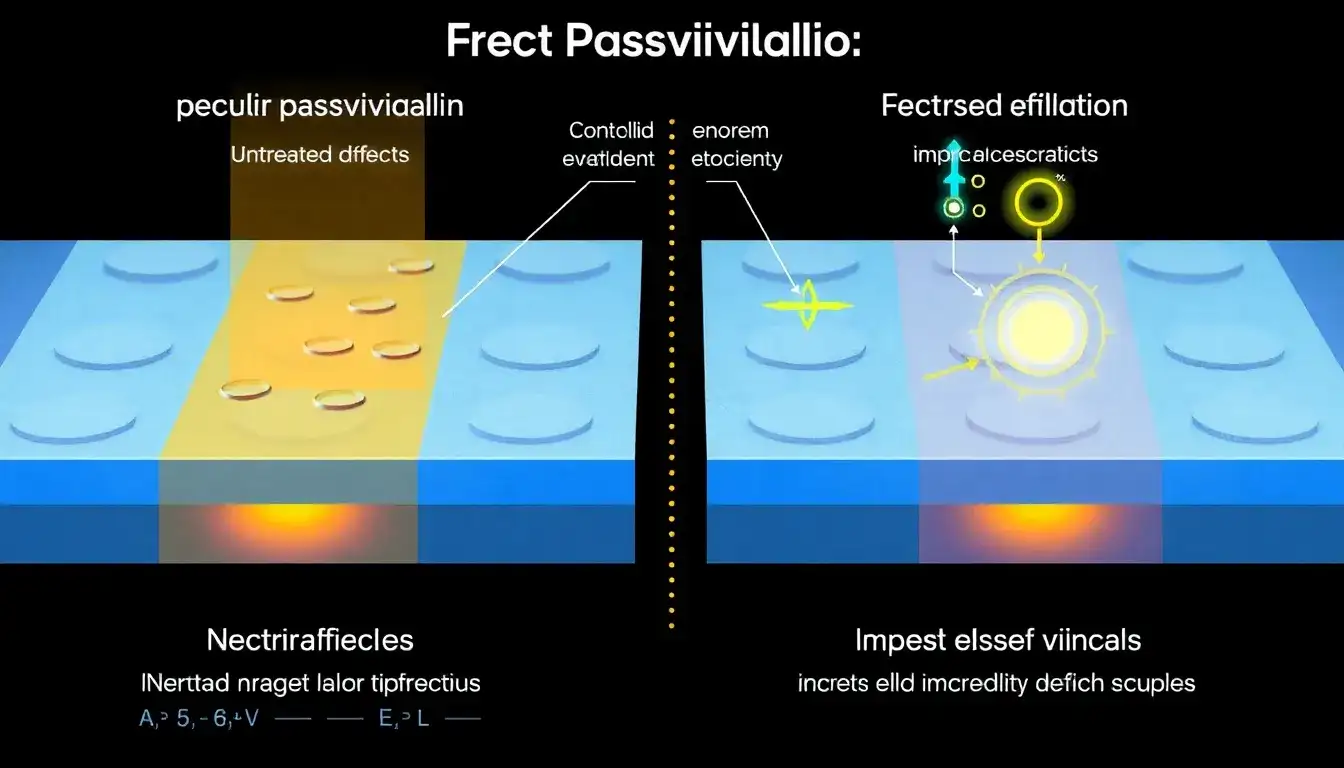
Defect passivation plays a crucial role in improving both the efficiency and stability of perovskite solar cells (PSCs) during ambient storage by reducing defect-induced charge recombination and structural degradation.
Role of Defect Passivation in Efficiency Improvement During Ambient Storage
Reduction of Trap States and Charge Recombination
Defects in perovskite films, especially trap states at surfaces and grain boundaries, act as centers for charge recombination, which severely limits the device performance. Passivation reduces these trap states, enabling more efficient charge transfer and minimizing photogenerated charge recombination. This leads to enhancements in key photovoltaic parameters, such as open-circuit voltage (Voc) and power conversion efficiency (PCE).
Improvement in Power Conversion Efficiency (PCE)
Studies show that passivation using specific additives or engineered molecules (e.g., carboxylic acid-functionalized aromatic molecules or metformin halides) can significantly increase the PCE. For instance, the incorporation of benzene-1,3,5-tricarboxylic acid (BTCA) resulted in an improvement of Voc by approximately 80 mV and a PCE increase up to 18.3%. Similarly, metformin halides raised PCE from 19.36% to 22.17% while improving the short-circuit current and Voc.
Enhancement of Stability During Ambient Storage
Defect passivation not only boosts initial efficiency but also stabilizes the perovskite films against environmental factors like moisture and oxygen, which typically cause degradation over time in ambient conditions. Passivated devices maintain a high percentage of their initial PCE after storage under air for extended periods (e.g., 95% of initial efficiency after over 1000 hours). This improved stability is linked to the reduced density of defects and the suppression of pathways for degradation.
Synergistic Bulk and Surface Passivation
Effective passivation strategies often involve simultaneous treatment of both bulk and surface defects to maximize efficiency and stability. This dual approach addresses defects throughout the perovskite layer and at interfaces, resulting in better crystal orientation, fewer residual defects, and enhanced structural integrity.
Summary
Defect passivation during ambient storage improves solar cell efficiency primarily by:
- Minimizing trap states that serve as recombination centers
- Enhancing charge carrier dynamics, leading to higher Voc and PCE
- Increasing long-term stability by protecting against environmental degradation
- Employing synergistic bulk and interfacial passivation for comprehensive defect reduction
Thus, defect passivation is a key method to both improve initial device performance and preserve efficiency over time in perovskite solar cells.
Original article by NenPower, If reposted, please credit the source: https://nenpower.com/blog/what-role-does-defect-passivation-play-in-the-efficiency-improvement-during-ambient-storage/

