

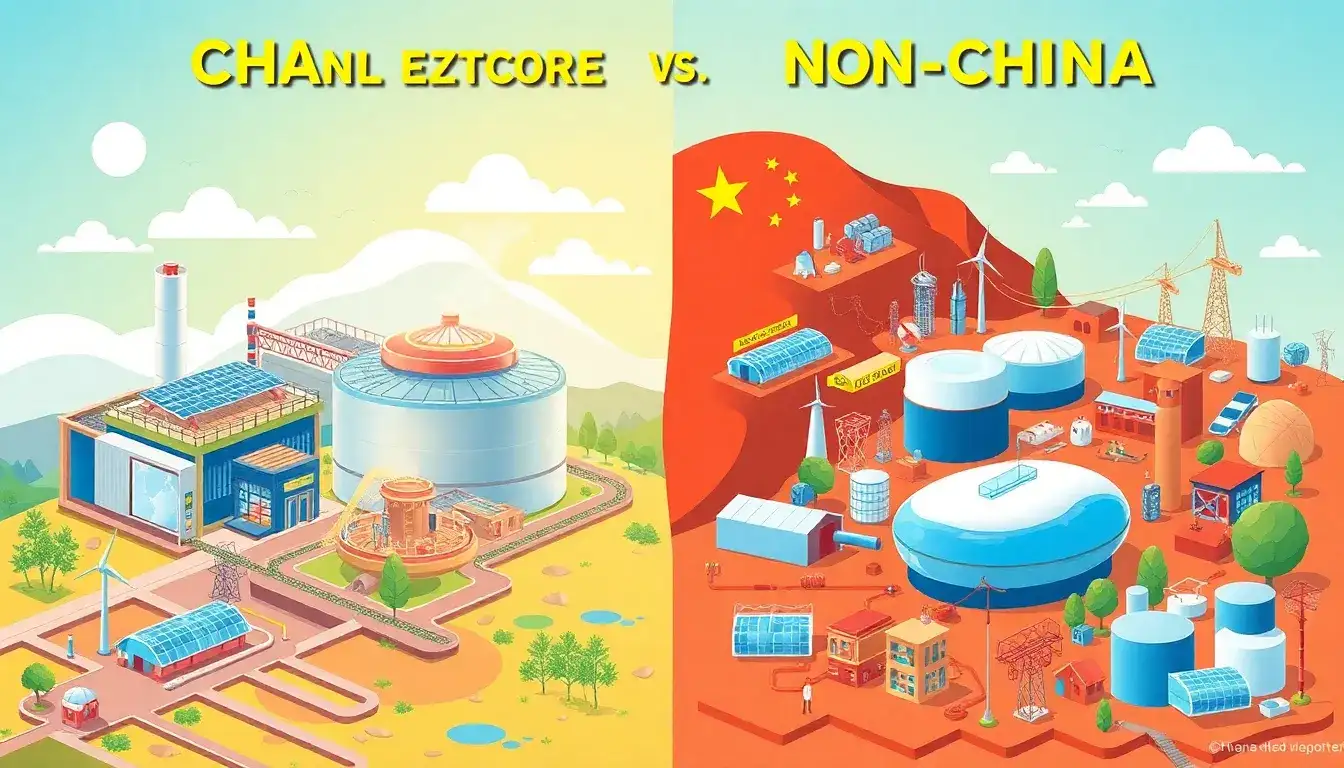
Competition in China’s energy storage market, driven by policy incentives and scaling effects, contributes significantly to cost differences in thermal energy storage compared to non-China markets. Here’s how:
Domestic Manufacturing and Supply Chain Advantages
China dominates lithium-ion battery production, and this industrialization extends to emerging technologies like thermal storage. The scale of domestic manufacturing reduces costs through concentrated supply chains, vertical integration, and declining unit prices as deployment accelerates. For instance, CATL, BYD, and other Chinese firms leverage massive production capacity to drive down storage technology costs, including ancillary components used in thermal systems.
Policy-Driven Market Expansion
The 14th Five-Year Plan explicitly prioritizes energy storage, creating a policy-defined competitive landscape. Government targets and incentives (e.g., subsidies, grid-access guarantees) compel utilities and private entities to invest in storage projects, fostering rapid innovation and cost reductions. In contrast, non-China markets often rely on fragmented regulatory frameworks, leading to higher risk premiums and slower adoption.
Technology Diversification and Scale
China’s aggressive deployment of large-scale pilot projects (like the 100MW molten salt storage in Xinjiang) provides economies of scale and operational data unavailable elsewhere. This reduces the levelized cost of storage (LCOS) for thermal systems, which developers claim undercuts lithium-ion alternatives in grid applications. Non-China markets, lacking comparable project sizes or policy urgency, face higher per-unit costs.
Supply Chain and Ecosystem Maturity
China’s energy storage ecosystem integrates upstream material suppliers, midstream integrators, and grid operators, reducing logistics costs and enabling standardized solutions. For example, projects often include bespoke infrastructure like 220kV substations, funded through centralized planning. In contrast, non-China markets may face fragmented supply chains and siloed project development, increasing overheads.
Key Cost Differentiators
| Factor | China Market | Non-China Markets |
|---|---|---|
| Policy Support | Centralized targets, subsidies, and mandates | Variable, region-specific incentives |
| Project Scale | 100MW+ thermal storage systems | Smaller pilot projects |
| Manufacturing | Integrated supply chains (e.g., CATL, BYD) | Reliance on imported components |
| LCOS Reduction | Faster iteration via state-backed pilots | Slower due to regulatory/commercial hurdles |
Original article by NenPower, If reposted, please credit the source: https://nenpower.com/blog/what-role-does-competition-play-in-the-cost-differences-of-thermal-energy-storage-between-china-and-non-china-markets/

