

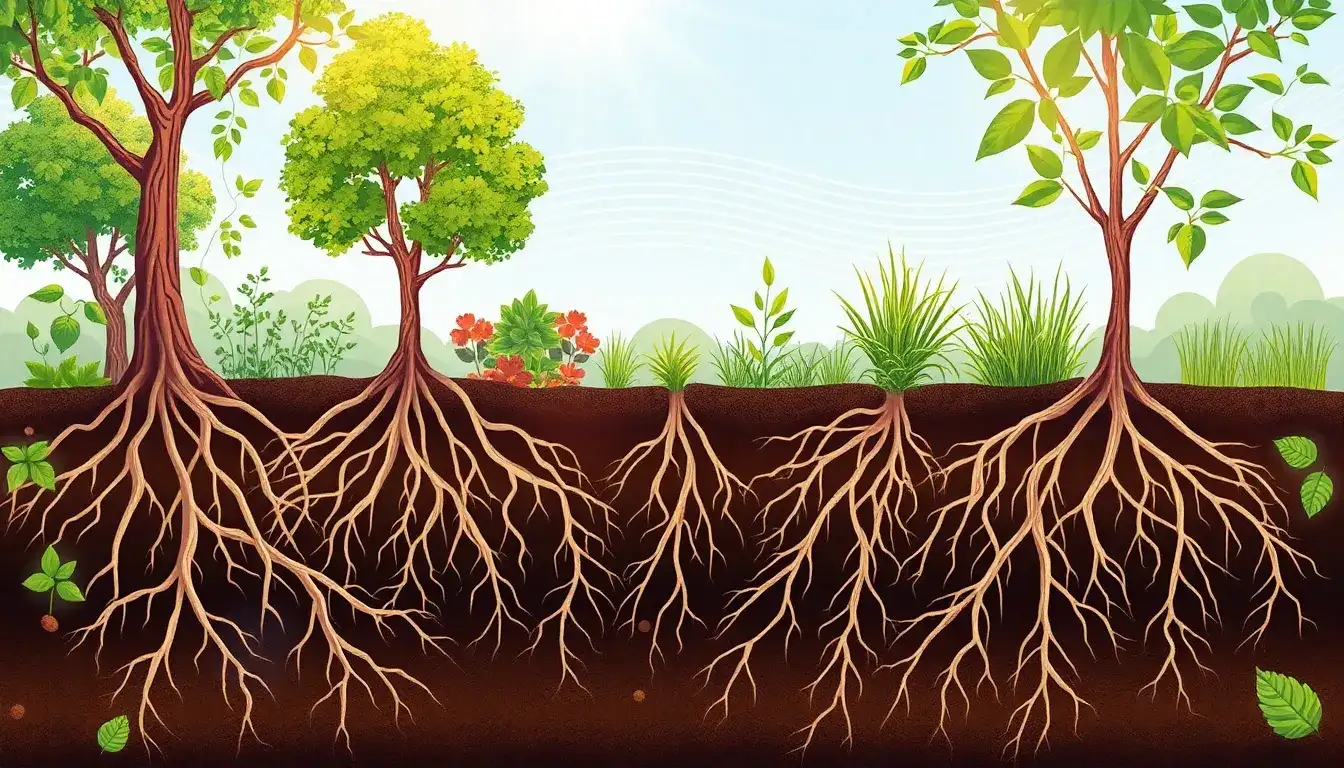
The root systems of plants contribute to noise reduction primarily by stabilizing soil and providing additional sound-dampening properties. While most noise reduction is achieved by parts of the plant above ground—like leaves, branches, and trunks that absorb, deflect, and scatter sound waves—the roots enhance this effect indirectly by maintaining the integrity and density of the soil and understory vegetation. This stable soil environment supports healthy vegetation growth, which collectively absorbs and reduces sound transmission, especially low-frequency noise that might otherwise travel through loose soil or bare ground.
More specifically, root systems:
- Stabilize soil to prevent erosion, ensuring that the sound-absorbing ground cover remains intact.
- Help maintain dense understory vegetation (grasses, shrubs) that complements trees in absorbing sound waves.
- Contribute to the overall mass and density of the vegetation-soil system, which aids in dampening sound vibrations traveling through the ground.
In sum, roots support the structural and ecological foundation that enables vegetation to act as an effective natural noise barrier, complementing the sound absorption of leaves, branches, and trunks.
Thus, the roots’ role in noise reduction is both structural—by stabilizing soil and supporting dense plant growth—and functional—by enhancing the ground’s capacity to absorb and dampen sound waves. This contributes to a multilayered approach to noise control in natural vegetation barriers.
Original article by NenPower, If reposted, please credit the source: https://nenpower.com/blog/what-role-do-the-root-systems-of-plants-play-in-noise-reduction/

