

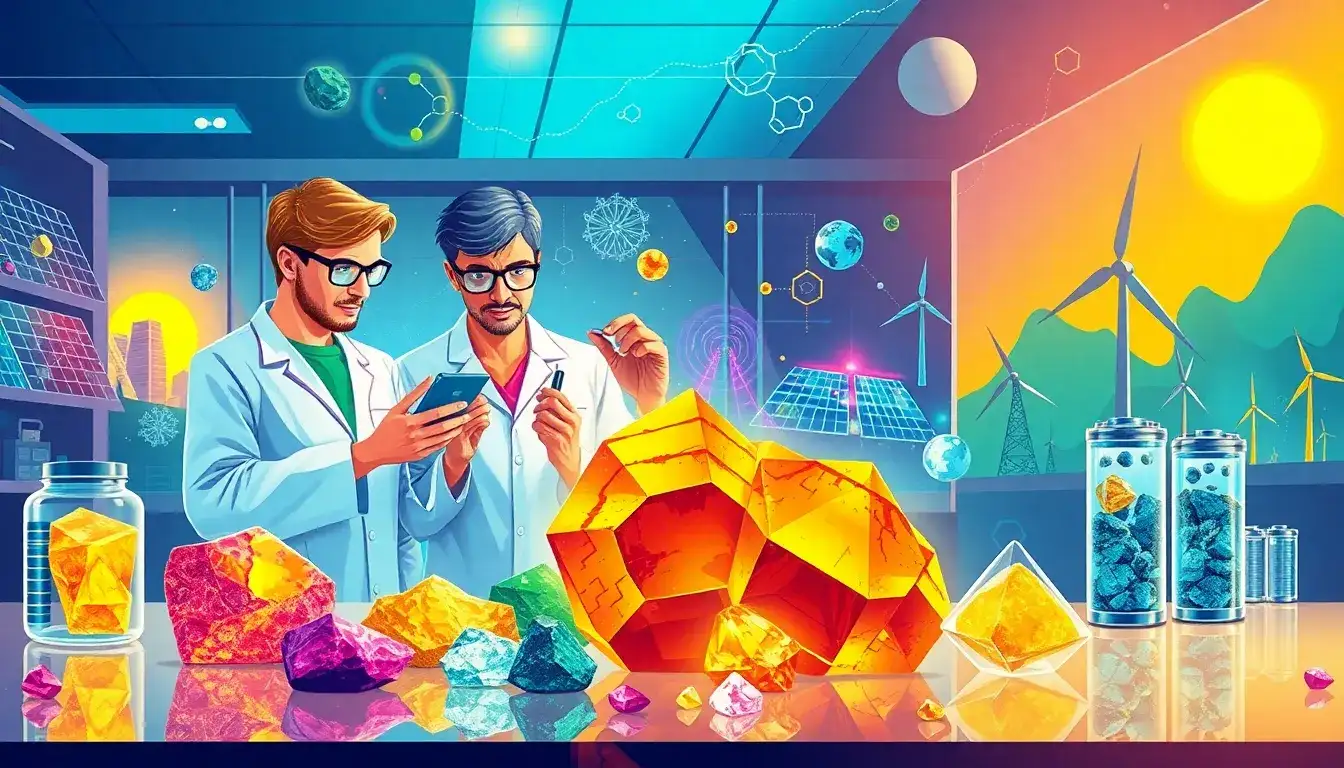
Rare earth minerals play a crucial and multifaceted role in the challenges of energy storage within the broader energy transition to low-carbon technologies. Their significance stems from their essential use in key components of renewable energy systems and electric vehicles, as well as the complexities involved in their supply and sustainability.
Role of Rare Earth Minerals in Energy Storage and the Energy Transition
- Critical Components in Renewable Technologies: Rare earth elements (REEs) such as neodymium, praseodymium, dysprosium, and terbium are fundamental to manufacturing permanent magnets used in wind turbines and electric vehicle (EV) motors. These magnets enhance performance and efficiency, enabling stronger magnetic fields that improve energy conversion and storage capabilities.
- Demand Growth: The demand for rare earth minerals is expected to soar due to the increasing deployment of wind turbines, solar panels, EVs, and storage batteries required for decarbonizing the energy sector and meeting climate targets like limiting global warming to 1.5°C. For example, global demand for neodymium is projected to grow 48% by 2050, with supply expected to fall short by as much as 250% by 2030. Similarly, praseodymium and terbium demand will also outstrip supply significantly, indicating serious future resource constraints.
Challenges Related to Rare Earth Minerals in Energy Storage
- Supply Chain Concentration and Vulnerability: The production, refining, and processing of rare earth elements are heavily concentrated in a few regions, notably China, which controls 70-90% of global REE refining capacity. This geographic concentration creates risks of supply disruptions due to trade restrictions, political instability, or geopolitical tensions. Such vulnerabilities can impact the availability and cost of critical materials essential for energy storage technologies.
- Environmental and Economic Costs: Extracting and processing rare earth minerals is energy-intensive and generates significant hazardous waste and environmental pollution, posing challenges for sustainable production. These factors complicate efforts to transition to clean energy while minimizing ecological harm.
- Recycling and Reuse Limitations: Recycling existing rare earth magnets from end-of-life products could reduce new demand, but current infrastructure for REE recycling is underdeveloped. Challenges include inefficient collection systems, the low concentration of REEs in products, shipping constraints, and long product lifetimes, which delay recycling benefits. Thus, the lifecycle management of REEs remains a bottleneck for sustainable energy storage solutions.
- Rapid Increase in Mining Demand: Besides rare earth elements, critical minerals such as lithium, cobalt, nickel, and graphite—essential for battery storage—are also expected to see demand increases as high as 4,000%. Meeting this demand may require the creation of hundreds of new mines globally, raising additional environmental, social, and supply chain concerns.
Summary
Rare earth minerals are indispensable for the magnets and components that enable efficient energy storage and generation in renewable technologies and electric vehicles. However, the growing global demand, supply chain concentration, environmental impacts of mining, and recycling challenges make these minerals a significant bottleneck in the clean energy transition. Addressing these issues requires innovations in sustainable sourcing, more efficient recycling systems, diversification of supply chains, and technological advances that reduce dependence on scarce REEs.
This complex interplay underscores the role of rare earth minerals as both critical enablers and limiting factors in scaling energy storage solutions necessary for a sustainable energy future.
Original article by NenPower, If reposted, please credit the source: https://nenpower.com/blog/what-role-do-rare-earth-minerals-play-in-the-challenges-of-energy-storage/

