

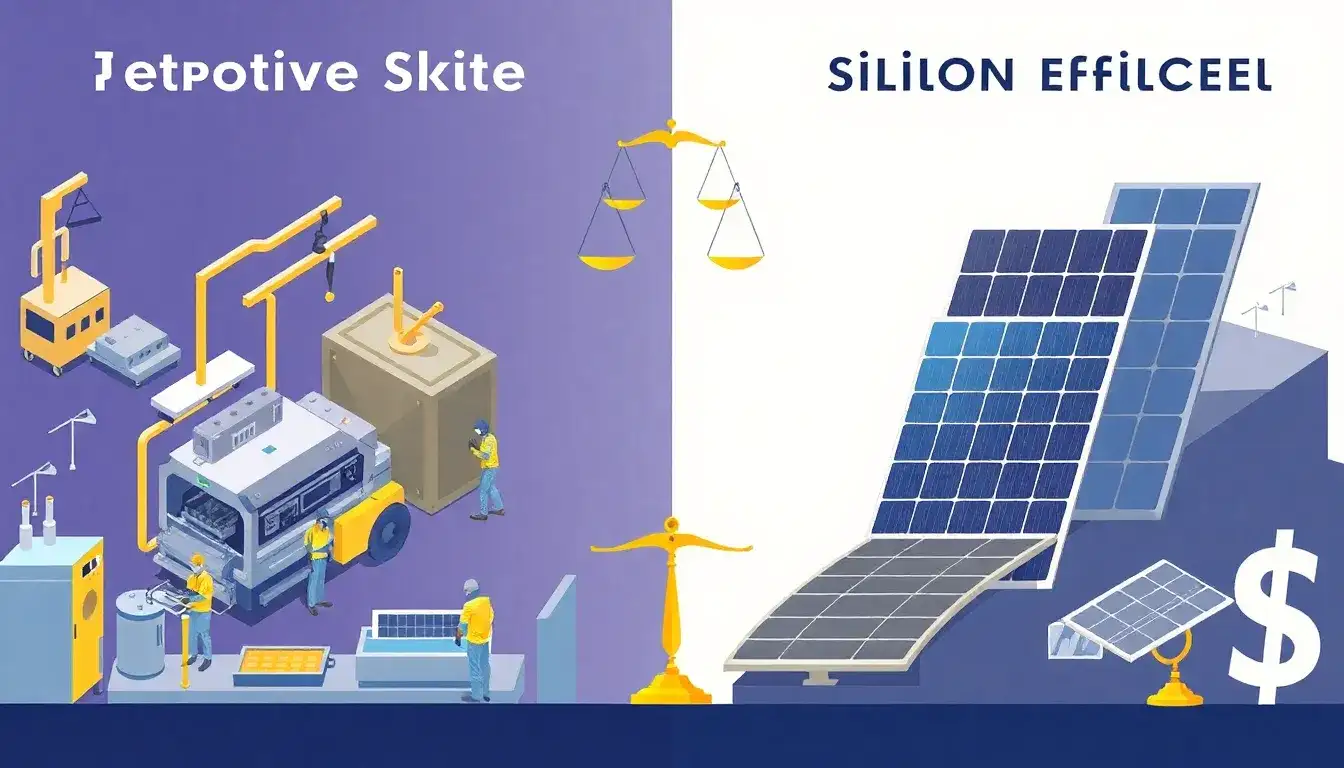
Production efficiencies play a significant role in the cost difference between perovskite and silicon solar panels, impacting both the manufacturing cost per watt and the overall competitiveness of each technology.
Impact of Production Efficiencies on Cost
- Perovskite-Silicon Tandem Modules
According to a techno-economic analysis by NREL, current production costs for U.S.-made perovskite-silicon tandem solar modules range approximately from $0.29/W to $0.42/W. These costs are higher compared to traditional silicon panels largely due to materials like solar glass, backsheets, encapsulation, and electron transport layer precursors required in the perovskite sub-cell, which add to manufacturing complexity and cost. However, increasing the module efficiency significantly reduces the cost per watt. For instance, a 32.5% efficient 4-terminal (4T) tandem module could reach costs below $0.285/W, which is competitive with 22%-efficient PERC silicon modules. At 35% efficiency, costs can drop further between $0.257/W and $0.306/W. Thus, higher production efficiencies directly reduce the cost gap by lowering the cost per watt through better energy output per module area despite higher material and processing costs. - Silicon Solar Panels
Silicon modules currently enjoy lower production costs largely due to their mature manufacturing processes and economies of scale, with prices ranging roughly from $0.34/W (China) to $0.54/W (Germany). However, as silicon technology matures further, their production costs are expected to continue declining. - Perovskite Solar Cells
While still emerging, perovskite solar cell manufacturing has potential for very low costs due to inexpensive precursor materials and simpler, potentially lower-temperature fabrication methods. Estimated future costs could be as low as $0.10/W, making perovskites one of the cheapest PV technologies if mass production and longevity challenges are addressed. This is partly because perovskite production efficiencies (material usage, processing speed) could be significantly improved with industrial standardization, which would further reduce costs.
Summary
| Factor | Silicon Panels | Perovskite Panels | Effect of Production Efficiency |
|---|---|---|---|
| Current Cost per Watt | $0.34 – $0.54 | $0.29 – $0.42 (tandem, current) | Higher efficiencies reduce $/W significantly |
| Efficiency Range | ~20-22% (typical PERC) | 25% – 35% (perovskite-silicon tandem) | Higher efficiency directly lowers $/W |
| Material Complexity | Mature, optimized silicon processing | Additional layers/materials for tandem | Material and process efficiency key to cost |
| Production Scale & Maturity | Large-scale, mature industry | Emerging, scale-up & standardization needed | Industrial standardization will improve efficiencies and reduce costs |
| Future Potential Cost | Continues to decline modestly | Could reach ~$0.10/W with improved efficiencies and longevity | Efficiency gains critical for cost breakthrough |
In conclusion, the cost difference between perovskite and silicon solar panels is strongly influenced by production efficiencies. Although perovskite materials and processing currently add cost complexity, their higher potential module efficiencies and simpler, lower-cost precursor materials promise significant cost reductions. Improvements in production scale, standardization, and efficiency will be crucial for perovskite technologies to outcompete silicon on a cost basis.
Original article by NenPower, If reposted, please credit the source: https://nenpower.com/blog/what-role-do-production-efficiencies-play-in-the-cost-difference-between-perovskite-and-silicon-solar-panels/

