

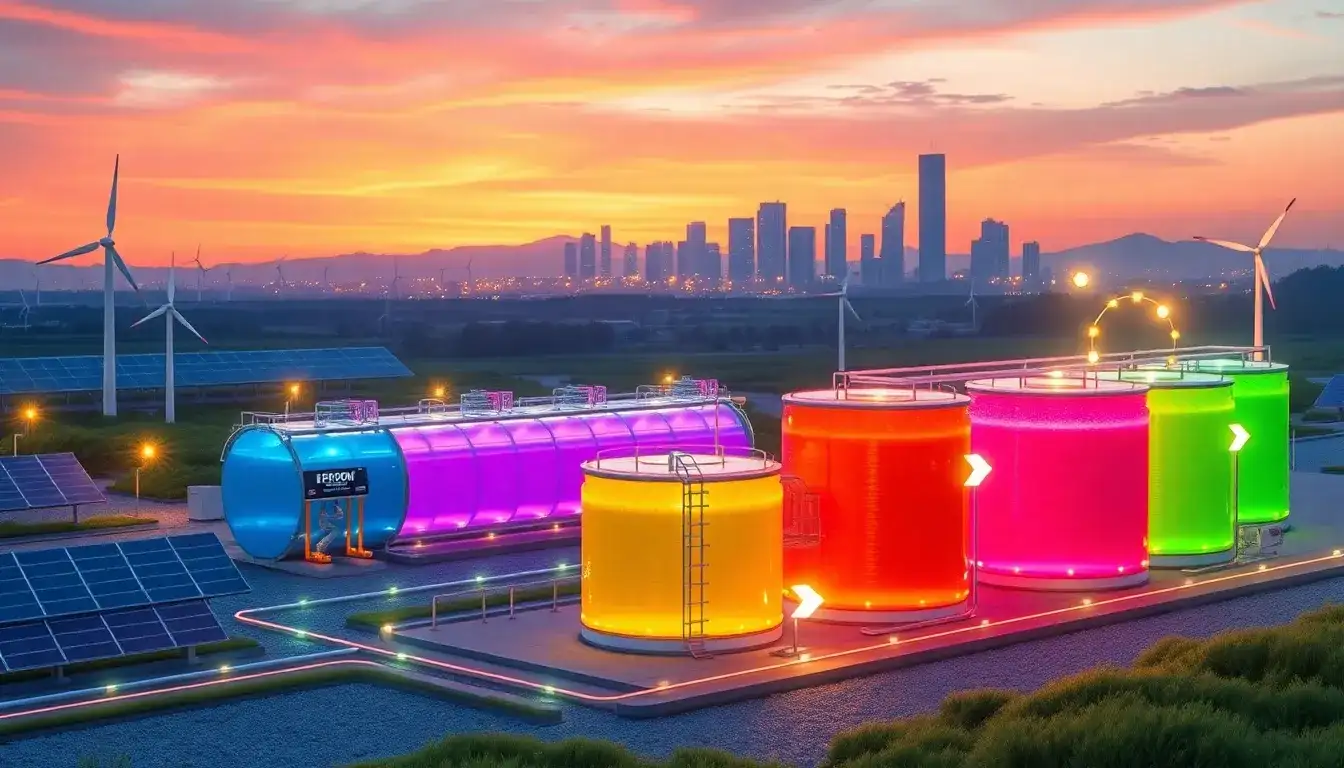
Flow batteries are emerging as a critical solution for long-duration energy storage (LDES), particularly for grid-scale applications requiring 4–36+ hours of discharge capacity. Their unique design and chemistry offer scalability, longevity, and safety advantages over lithium-ion batteries, making them ideal for stabilizing renewable energy grids.
Key Advantages
- Scalability: Flow batteries separate energy storage (tanks) from power generation (reactor), allowing independent scaling. Larger electrolyte tanks increase capacity, while larger reactors boost charge/discharge rates.
- Longevity: Vanadium flow batteries achieve 20,000+ cycles (15–25 years) with minimal degradation, compared to lithium-ion’s ~10,000 cycles. Their active species (e.g., vanadium ions) do not degrade over time, even after decades.
- Safety: Non-flammable electrolytes (e.g., vanadium sulfate or iron salts in water) eliminate fire risks associated with lithium-ion batteries.
Chemistries and Use Cases
- Vanadium: Dominates commercial deployments (e.g., Invinity Energy Systems) due to high energy density and indefinite electrolyte lifespan. Ideal for 10–36-hour discharge scenarios, especially paired with wind farms.
- Iron: Offers lower environmental impact during production and disposal. ESS Inc.’s iron flow batteries use earth-abundant materials (iron, salt, water) and last 20+ years, making them cost-effective for 4–10+ hour storage.
- Emerging Chemistries: Zinc-bromine and organic electrolytes are under development to reduce costs further.
Market Position
Flow batteries are most cost-effective for interday storage, bridging gaps during low solar/wind output. While lithium-ion remains cheaper for <4-hour storage, flow batteries become competitive for longer durations due to:
- Declining Costs: Scaling electrolyte tanks is cheaper than adding lithium-ion modules.
- Grid Resilience: Utilities like Enel Green Power use them to reduce reliance on fossil-fuel peaker plants and transmission infrastructure.
Challenges
- Efficiency: Typically 50–80%, lower than lithium-ion’s 85–95% but sufficient for long-duration roles.
- Crossover: Membrane imperfections allow electrolyte mixing, reducing capacity. Vanadium’s single-element chemistry inherently avoids this issue.
- Complexity: Pump systems and membranes increase maintenance needs compared to solid-state batteries.
Outlook
Flow batteries are gaining traction as renewable energy penetration grows, with companies like Form Energy and ESS Inc. advancing LDES solutions. Their ability to decarbonize grids by storing excess solar/wind power positions them as essential for achieving net-zero targets.
Original article by NenPower, If reposted, please credit the source: https://nenpower.com/blog/what-role-do-flow-batteries-play-in-long-duration-energy-storage/

