

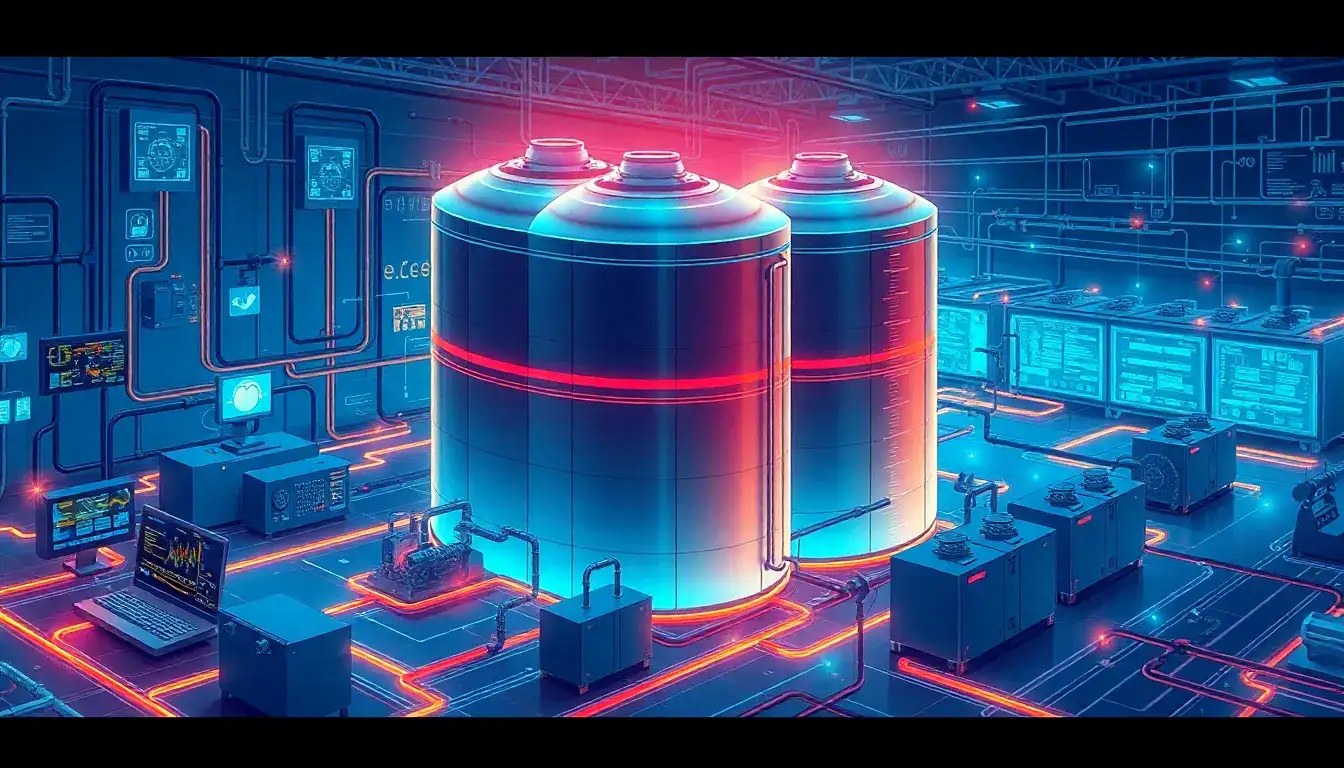
Control Systems in Thermal Energy Storage (TES)
Control systems are crucial for optimizing the efficiency and scalability of thermal energy storage (TES) systems by managing how thermal energy is charged, stored, and discharged within the system. Their role can be detailed as follows:
Role of Control Systems in TES Efficiency
- Stable Thermal Source Management: Control systems enable TES to work effectively with components like heat pumps by providing a stable thermal source, which improves the overall system efficiency. This stability allows heat pumps to operate under optimal conditions, reducing energy consumption and enhancing thermodynamic performance.
- Load Leveling and Peak Shaving: By intelligently controlling when the TES system stores and releases thermal energy, control systems help reduce peak demand on the energy grid. They store energy during periods of low demand or when renewable energy is abundant and release it during peak usage, improving load balancing and reducing energy costs and CO2 emissions.
- Integration with Variable Energy Inputs: TES systems often rely on intermittent renewable energy sources such as solar or wind. Control systems regulate the input (e.g., via heat transfer fluids or electrical heaters) to store excess thermal energy efficiently and prevent losses, ensuring high thermal storage capacity and better utilization of renewable energy.
Role of Control Systems in TES Scalability
- Modular and Adaptive Operation: Advanced control systems can manage multiple TES units or scales of storage in an integrated fashion, allowing TES solutions to be scaled up or down depending on demand and energy availability. This adaptability supports wider deployment across industrial, commercial, and residential applications.
- Optimization of Storage Media Usage: By monitoring and adjusting how heat is delivered and extracted—from sensible heat media like pebbles or latent heat materials such as phase change materials—control systems maximize the efficiency and capacity utilization, which is critical for scaling TES technologies in diverse contexts.
- Cost-effective and Reliable Operation: Control systems improve the cost-efficiency of TES by optimizing the operation of heat pumps or resistance heaters, which are used to charge the TES media. They ensure that the system uses the most economical method available at a given time, enhancing the economic viability as the system scales.
Summary
Control systems are essential in TES systems for:
- Ensuring efficient heat exchange and stable operation of associated components like heat pumps.
- Managing energy storage and release to reduce peak demand and improve energy cost savings.
- Integrating intermittent renewable energy sources effectively.
- Enabling scalable TES deployment by optimizing operation across units and storage media.
These roles collectively increase the overall energy efficiency, reduce emissions, and improve the practicality of TES systems for both small and large-scale energy applications.
Original article by NenPower, If reposted, please credit the source: https://nenpower.com/blog/what-role-do-control-systems-play-in-the-efficiency-and-scalability-of-thermal-energy-storage-systems/

