

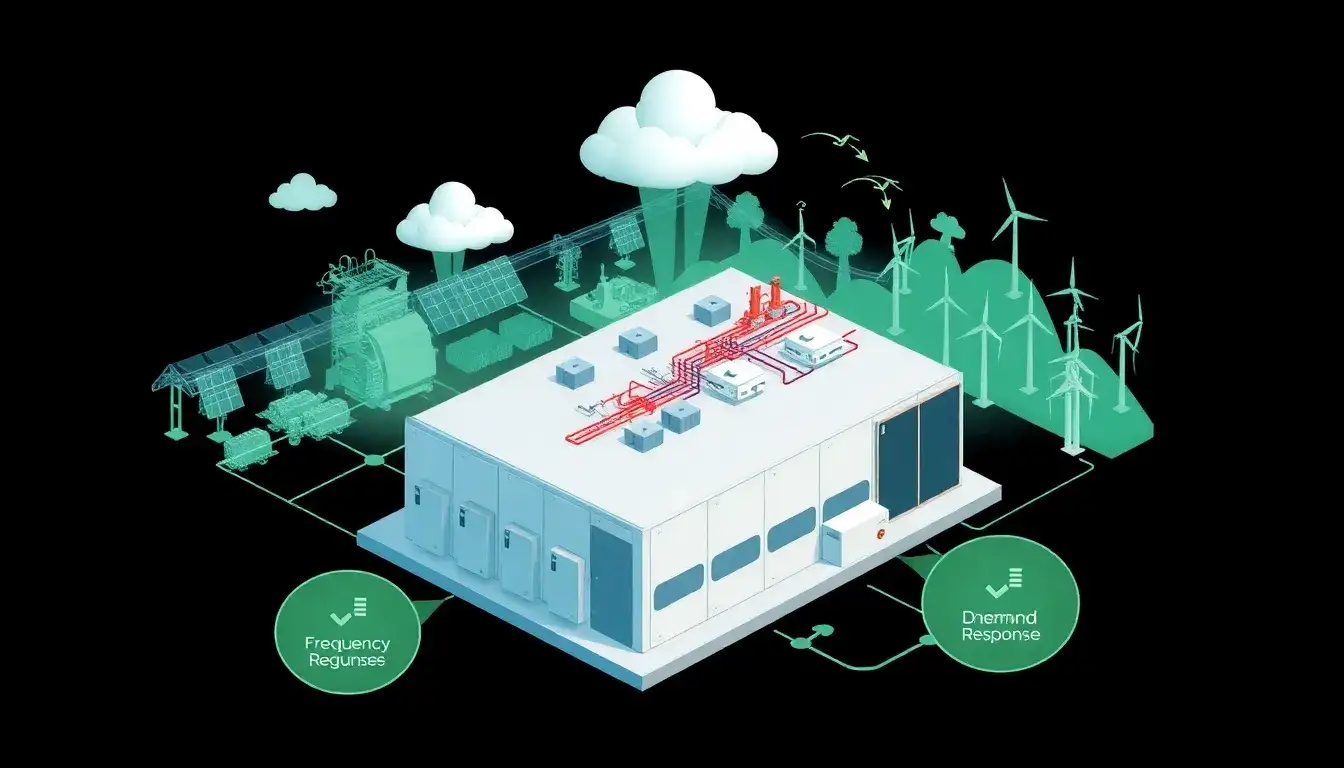
Role of Ancillary Services in Emissions of Utility-Scale Batteries
Ancillary services are crucial grid support functions that help maintain reliability and stability of the electric system. These services include frequency regulation, reserves, and fast response to fluctuations in supply and demand. Utility-scale batteries are well-suited to provide these services because they can rapidly charge and discharge, offering fast frequency response and regulating reserves typically needed to keep the grid stable.
However, these ancillary services come with a tradeoff in terms of emissions:
- Round-trip energy losses: Lithium-ion batteries typically lose about 10-15% of electricity during charging and discharging cycles, and for long-duration storage, losses can exceed 50%. These losses mean that batteries always consume more electricity than they deliver, which incurs a carbon footprint if the grid electricity used for charging is not fully renewable.
- Mismatch between emissions and prices: Batteries often operate based on market price signals rather than actual emissions intensity. Since market prices and emissions are only weakly correlated (e.g., about 0.46 correlation in ERCOT), batteries providing ancillary services do not necessarily charge during low-emission periods. This causes batteries to sometimes charge when fossil-fuel generation is high, increasing net emissions.
- Charging during higher price periods: To maintain state of charge for ancillary services, batteries might be obligated to charge during periods when electricity prices are relatively high, which often coincide with higher emissions from fossil generators. This can lead to “spillover effects” where fossil plants ramp up to meet battery charging demand, paradoxically raising emissions overall.
- Limited renewable energy shifting: In some markets such as Texas, almost none of the utility-scale batteries perform renewable energy shifting (charging when renewables produce excess power and discharging later), which is more effective in reducing emissions. Instead, each battery tends to focus on ancillary services or grid reserves, which by themselves do not guarantee emissions reductions.
- Potential emissions benefits: In some cases, batteries can reduce emissions by displacing less efficient or more polluting generators providing ancillary services such as black-start capability or fast frequency response, but this depends on the grid’s generation mix and whether batteries primarily charge from renewable sources.
Summary
| Aspect | Impact on Emissions |
|---|---|
| Battery round-trip losses | Increase emissions due to inherent energy losses |
| Ancillary services focus | Operations driven by grid reliability, not emissions |
| Market signals vs emissions | Weak correlation causes charging at high-emission times |
| Charging during high-price hours | Often leads to increased reliance on fossil fuels |
| Renewable energy shifting | Limited in many grids, reducing emissions benefits |
| Potential emissions offset | Possible when batteries replace inefficient generators |
In short, ancillary services provided by utility-scale batteries can inadvertently increase emissions when batteries charge from fossil-fueled electricity during non-optimal times, especially because their operation prioritizes grid stability and market opportunities over emissions minimization. Only with a higher penetration of renewables and improved coordination between battery operation and emissions signals can ancillary services from batteries reliably reduce emissions.
Original article by NenPower, If reposted, please credit the source: https://nenpower.com/blog/what-role-do-ancillary-services-play-in-the-emissions-of-utility-scale-batteries/

