

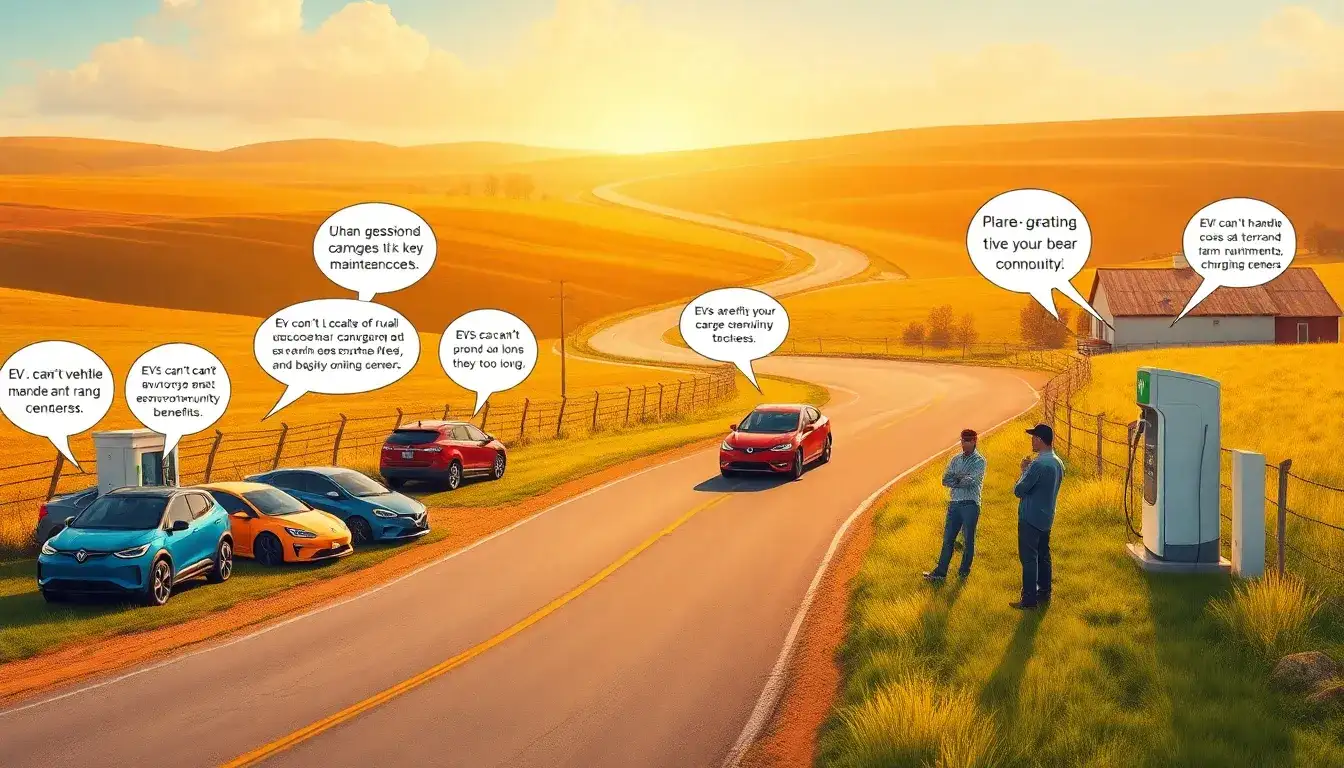
Common misconceptions about electric vehicles (EVs) among rural drivers often center on concerns about demand, reliability, performance, range, and charging infrastructure, which contribute to slower adoption rates in rural areas compared to urban ones.
Key Misconceptions Among Rural Drivers
- EVs Are Not Suitable for Rural Driving
A widespread belief holds that rural drivers, who typically drive longer distances and have less access to public transit, are not good candidates for EVs due to range limitations and charging availability. However, this is a myth. Despite driving longer distances, many rural drivers can charge their EVs at home or work, avoiding gasoline purchases entirely and reducing overall costs significantly. - Concerns About Limited Range and Charging Infrastructure
Rural residents worry that EVs do not offer sufficient range for long trips typical in rural life and that there are too few charging stations available nearby. While charging infrastructure is less dense in rural areas, improvements in battery technology have increased EV ranges substantially, with many models now achieving median ranges around 270 miles, and some exceeding 500 miles on a single charge. Rural EV owners interviewed report confidence in driving in various conditions, including cold weather. - EVs Are Less Reliable or Perform Poorly in Rural Conditions
There is skepticism about EV reliability and their ability to cope with harsh rural conditions such as freezing weather. However, ongoing advancements in battery and vehicle technology have improved reliability and reduced maintenance needs. Rural EV owners with experience attest to their vehicles’ dependable performance even in winter climates. - EVs Are Too Expensive or Not Economical for Rural Users
Some rural drivers believe EVs are too costly or not financially beneficial given their driving habits. In contrast, rural drivers actually spend a larger share of their income on gasoline due to high mileage. Transitioning to EVs can provide significant cost savings since electricity is generally cheaper than gasoline, and rural “superusers” could reduce their transportation expenses substantially with EVs. - Low EV Demand Means They Are Not Viable in Rural Areas
The lag in rural EV adoption partly stems from disinformation suggesting low demand reflects unsuitability. In reality, demand for EVs is increasing nationwide, with more affordable and diverse models becoming available, including pickup trucks favored by rural drivers. The challenge lies more with misinformation and uncertainty about the electric future rather than inherent limitations of EVs themselves.
In summary, misconceptions about EV range, charging availability, reliability in harsh conditions, costs, and demand contribute to a slower EV uptake among rural drivers. These myths are contradicted by advances in EV technology, positive rural EV owner experiences, and the economic benefits EVs can bring to rural households.
Original article by NenPower, If reposted, please credit the source: https://nenpower.com/blog/what-misconceptions-about-evs-are-common-among-rural-drivers/

