

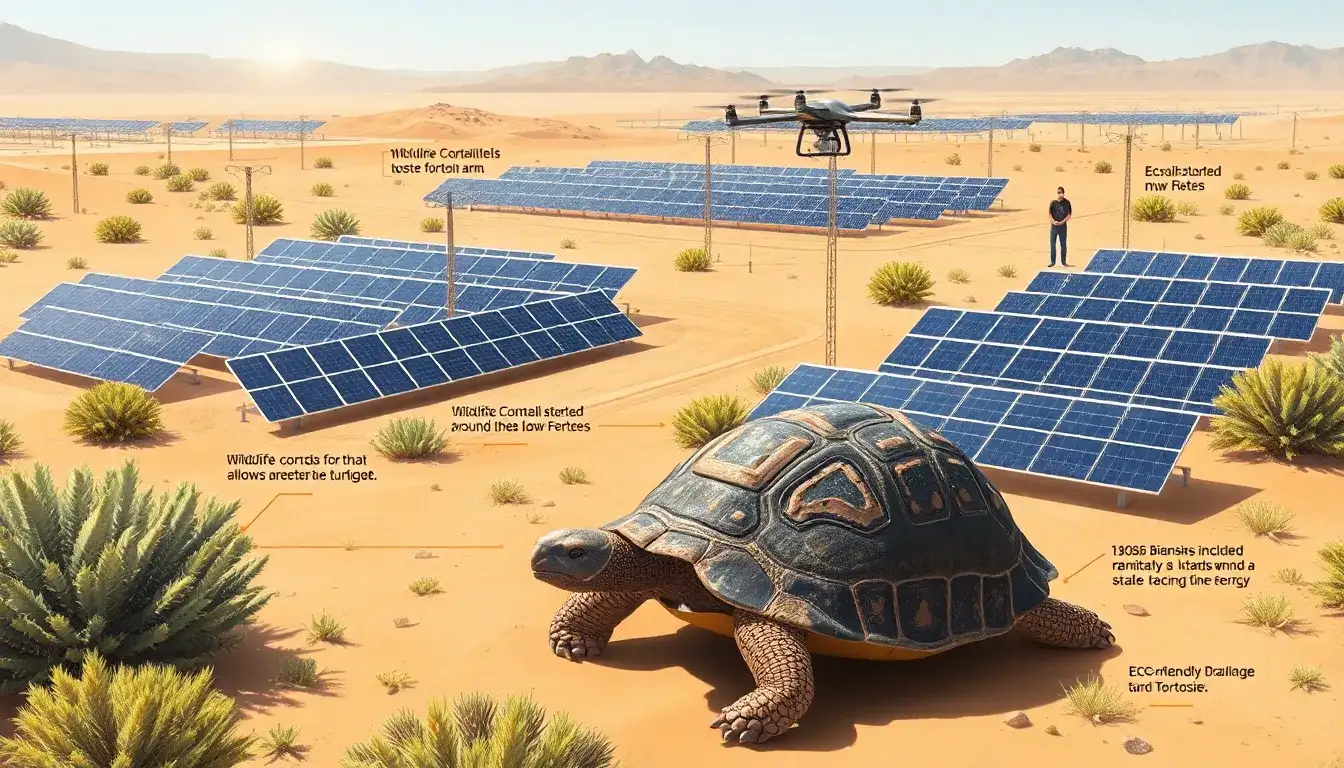
Measures taken to protect desert tortoises in solar energy projects include a combination of habitat preservation, construction adjustments, wildlife monitoring, and personnel training to minimize impacts on tortoise populations:
- Habitat-sensitive site design and construction: Instead of clearing vegetation entirely, solar developers clip only necessary plants to preserve natural topography and habitat structure. Solar panels are mounted higher than industry standards (42 inches above ground instead of 24 inches) to allow light penetration and vegetation growth underneath. Panel spacing is increased from 14 feet to 20 feet and varied spatially to reduce the “lake effect” illusion that could disorient tortoises.
- Maintaining habitat connectivity for wildlife movement: Fencing around solar sites includes regularly spaced openings (10 inches wide by 7 inches tall, about every 260 feet) to allow desert tortoises and other wildlife to pass through the site, maintaining access to surrounding habitats.
- Temporary relocation and monitoring of tortoises before construction: Biologists capture desert tortoises within the project footprint and temporarily relocate them to holding pens during construction phases. Selected tortoises are fitted with radio transmitters to track their movement and evaluate long-term residency and habitat use after release.
- Limiting vehicle impacts and staff training: Maintenance vehicles are restricted to small utility vehicles with speed limits (maximum 15 mph) to reduce risk of tortoise injury. Staff receive desert tortoise awareness training to identify and protect tortoises during operations.
- Collaborative partnerships and pilot projects: The U.S. Fish and Wildlife Service works with solar developers to implement and monitor wildlife-friendly solar projects as pilots. These partnerships help improve mitigation strategies based on collected data and ensure recovery goals for Mojave desert tortoises are integrated with renewable energy development.
- Ensuring adequate food, shelter, and thermoregulation resources: Project designs aim to maintain or mimic natural conditions that provide tortoises with sufficient forage, cover from predators, drinking sites, and thermal protection even within modified landscapes.
These comprehensive measures seek to balance the benefits of developing solar energy with conserving the critical habitat and survival of desert tortoises in the Mojave Desert and surrounding regions.
Original article by NenPower, If reposted, please credit the source: https://nenpower.com/blog/what-measures-are-taken-to-protect-desert-tortoises-in-solar-energy-projects/

