

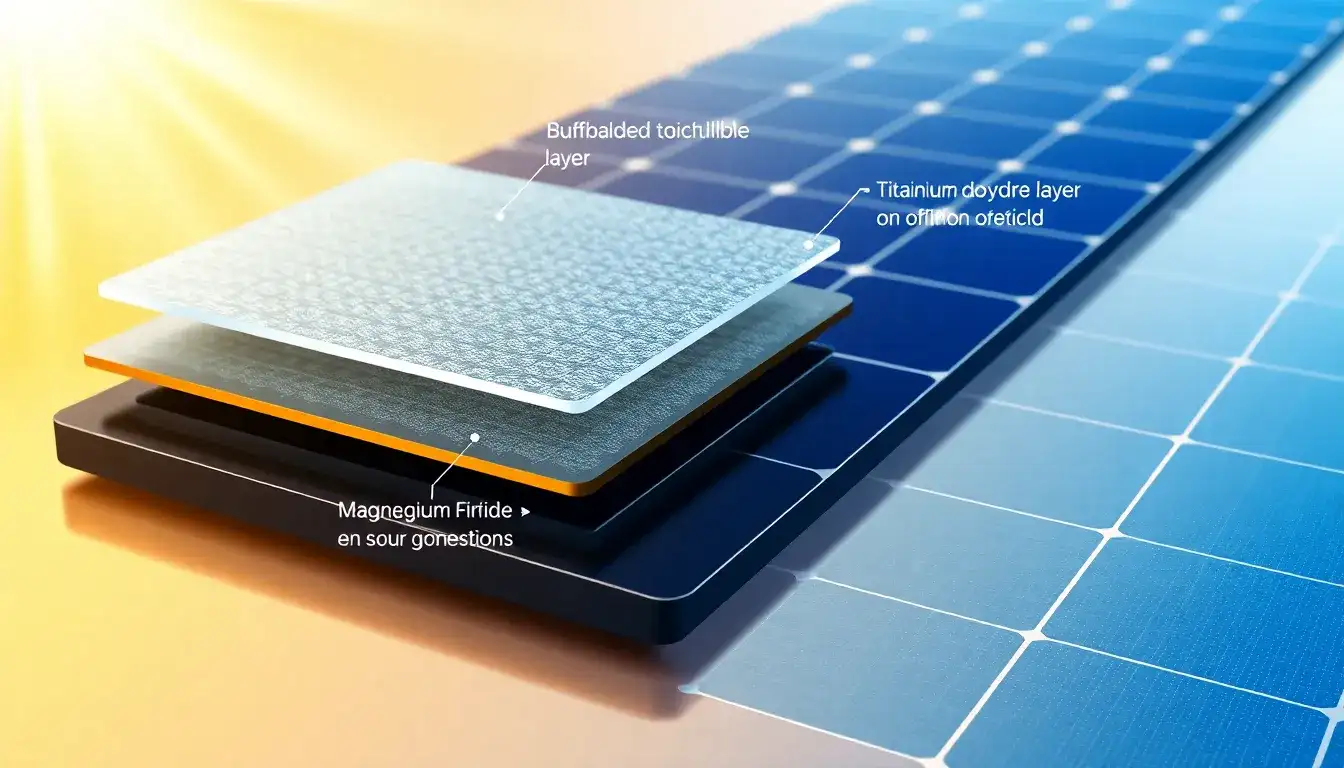
Common materials used in anti-reflective coatings (ARCs) for solar panels primarily include:
- Silicon nitride (Si3N4): This is one of the most widely used materials for anti-reflective coatings on silicon solar cells. It forms a thin dielectric layer that significantly reduces reflection and increases light absorption into the cell.
- Titanium dioxide (TiO2): Also commonly used, titanium dioxide serves as an effective anti-reflective coating material for solar panels, providing similar benefits in reducing surface reflection and enhancing light transmission.
- Silicon dioxide (SiO2) and zirconium dioxide (ZrO2): Recent research has shown that coatings combining silicon dioxide and zirconium dioxide can further improve anti-reflective performance. A mixed SiO2-ZrO2 layer applied by RF sputtering increased solar cell efficiency beyond that of single-material coatings, likely due to enhanced surface roughness and optical transmittance.
Role and Characteristics of Anti-Reflective Coatings
- These coatings reduce the natural reflectance of bare silicon solar cells, which can be over 30%, thus allowing more sunlight to be absorbed by the photovoltaic material.
- The coatings are designed with a precise thickness, often a quarter wavelength of the light in the material, so that reflected waves interfere destructively and reflection is minimized at wavelengths near the peak solar spectrum (~0.6 µm).
- AR coatings are applied not only on the silicon cell surface but also on the external glass surface of solar panels to increase light transmittance and reduce glare.
- These coatings are typically transparent or semi-transparent, making them invisible to the naked eye but critical for enhancing panel efficiency.
Summary Table of Common AR Coating Materials for Solar Panels
| Material | Description/Use | Notes |
|---|---|---|
| Silicon nitride (Si3N4) | Thin dielectric layer on silicon cells | Most common, improves absorption, durable |
| Titanium dioxide (TiO2) | Anti-reflective coating on cells and glass | Enhances light transmission and durability |
| Silicon dioxide (SiO2) | Used alone or combined for advanced coatings | Often combined with ZrO2 for better effect |
| Zirconium dioxide (ZrO2) | Used in combination with SiO2 | Improves efficiency via surface roughness |
In conclusion, silicon nitride and titanium dioxide remain the standard materials for anti-reflective coatings on solar panels, while innovative combinations like silicon dioxide and zirconium dioxide are emerging to further enhance solar cell efficiency by minimizing reflection and maximizing light absorption.
Original article by NenPower, If reposted, please credit the source: https://nenpower.com/blog/what-materials-are-commonly-used-in-anti-reflective-coatings-for-solar-panels/

