

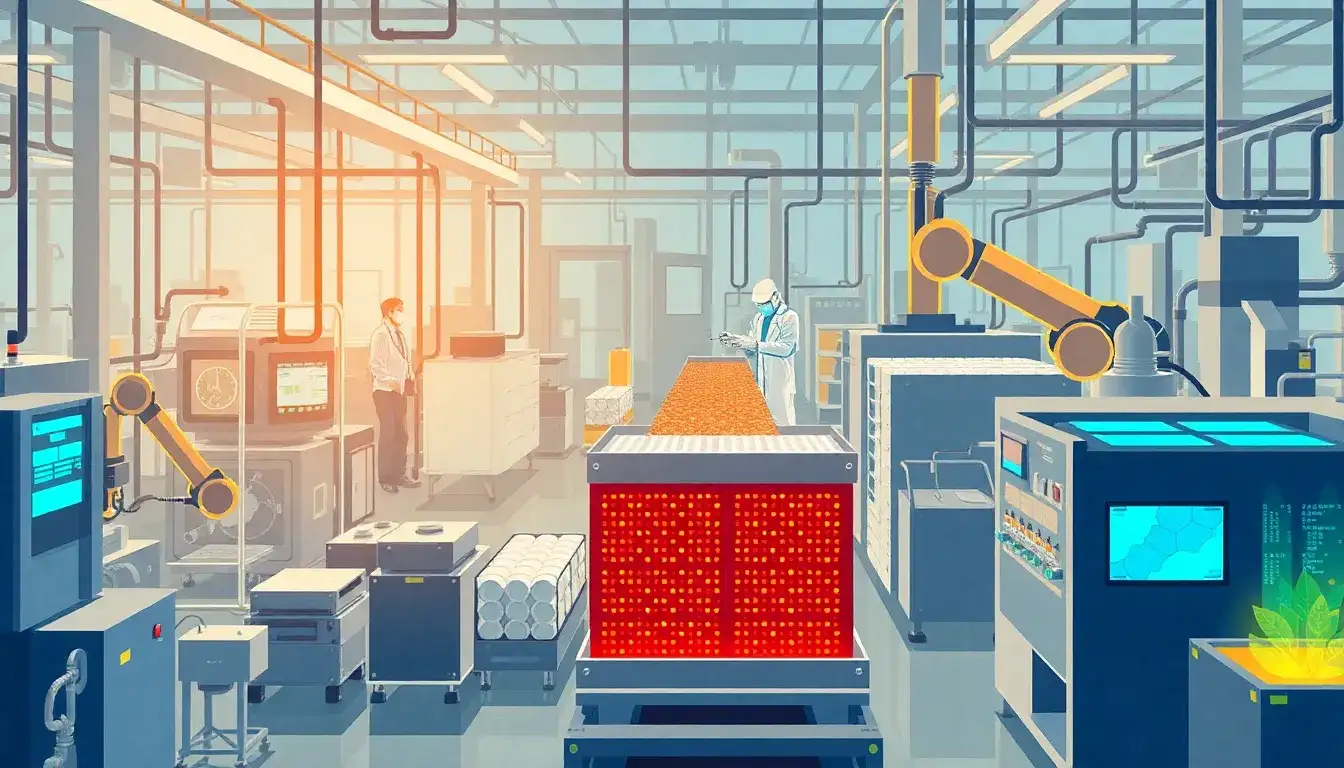
Manufacturing solid electrolytes more cost-effectively involves several advanced processes that improve scalability, reduce production time, and enhance material utilization while maintaining high performance. Key manufacturing processes identified for cost-effective solid electrolyte production include:
Main Manufacturing Processes for Solid Electrolytes
- Melt-Quenching
A traditional method to form glassy electrolytes by melting raw materials and rapidly cooling them. It tends to be simpler but can have limitations in controlling microstructure and scalability. - Mechanical Milling
Uses mechanical energy to grind and mix powders to form electrolytes. It is relatively low cost and scalable, but may introduce impurities and requires careful control of particle size. - Sol-Gel Synthesis and Wet Chemical Reactions
These chemical routes allow precise control over electrolyte composition and microstructure, enhancing ionic conductivity. However, wet chemical processes require drying steps, adding complexity and cost due to solvent use. - Additive Manufacturing (3D Printing) Techniques like Digital Light Processing (DLP)
This can produce patterned ceramic electrolytes with high precision and improved electrode-electrolyte interfaces, enhancing battery performance. DLP offers high resolution and reduced build time compared to traditional methods, but challenges include the cost of photosensitive resins and the need for manual support removal.
Process Innovations for Cost Efficiency
- Twin-Screw Extrusion
Used to compound cathode and electrolyte materials into homogeneous melts or slurries. This process is highly scalable, applicable to granules or powders, and enables continuous production, which lowers costs. The extrusion process can incorporate binders and additives that improve interface compatibility and reduce resistance between layers. - Wet Process Coating and Calendering
Large-scale wet coating techniques similar to lithium-ion battery cathode fabrication apply electrolyte and cathode layers onto a current collector film. This is well-established and scalable, though it requires solvent drying steps that add cost and time. - Vacuum Deposition
Electrolyte materials can be deposited in a vacuum environment via carrier gas. While this method yields high purity layers, it is currently slow and not yet commercially scalable. - Dry Film Formation Methods
Dry processes for electrolyte film formation are being developed to avoid the drying step inherent to wet processes, potentially reducing cost and processing time.
Summary Table of Cost-Effective Manufacturing Techniques
| Process | Advantages | Challenges |
|---|---|---|
| Melt-Quenching | Simple, established | Limited microstructure control |
| Mechanical Milling | Low cost, scalable | Potential impurities |
| Sol-Gel/Wet Chemical | Precise control, high performance | Solvent use, drying overhead |
| Digital Light Processing | High precision, improved interfaces | Expensive resins, manual supports |
| Twin-Screw Extrusion | Scalable, continuous, homogeneous mix | Process optimization required |
| Wet Coating & Calendering | Scalable, proven in Li-ion battery | Solvent drying step |
| Vacuum Deposition | High purity layers | Slow, low throughput |
| Dry Film Formation | Avoids drying, faster | Under development |
By integrating extrusion with wet coating and calendering, and exploring additive manufacturing for specific structured electrolytes, manufacturers can significantly reduce costs while enhancing performance. The shift from solvent-based wet processes to dry methods and the use of continuous extrusion techniques are key enablers for scalable, cost-effective solid electrolyte production.
Original article by NenPower, If reposted, please credit the source: https://nenpower.com/blog/what-manufacturing-processes-can-make-solid-electrolytes-more-cost-effective/

