

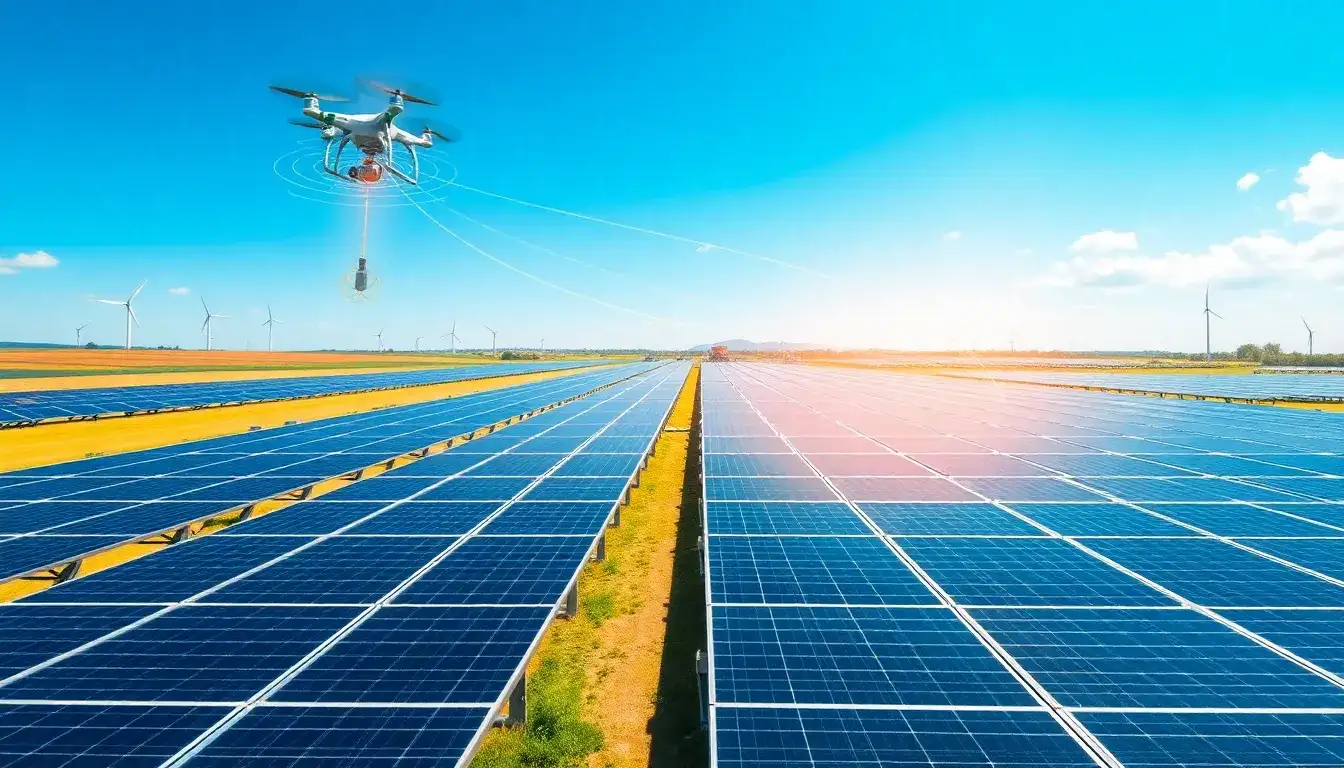
LoRaWAN is particularly suitable for large-scale solar farms due to several key features that address the unique challenges of these expansive installations:
Long-Range Communication
Solar farms often span extensive geographical areas, requiring communication technology that can transmit data over long distances without the need for dense infrastructure. LoRaWAN supports long-range data transmission, enabling effective monitoring and control across the entire solar farm with fewer gateways and less complex network deployment.
Low Power Consumption
Devices operating in solar farms frequently reside in remote locations where power availability can be limited. LoRaWAN devices consume very little power, enabling them to operate efficiently on battery or small solar power sources for extended periods. This low power requirement reduces maintenance needs and ensures continuous operation.
Cost-Effectiveness and Scalability
The infrastructure cost for LoRaWAN networks is relatively low compared to other communication technologies. This affordability is crucial when many devices such as solar trackers and sensors need to be interconnected over large areas. Furthermore, LoRaWAN networks are highly scalable, allowing solar farms to expand their monitoring systems without significant increases in operational complexity or cost.
Real-Time Monitoring and Predictive Maintenance
LoRaWAN enables real-time data transmission, allowing operators to monitor solar panel performance, environmental conditions, and energy generation remotely. The data collected supports predictive maintenance, helping to identify and address issues proactively before they impact system performance.
Robustness and Environmental Adaptability
LoRaWAN signals resist interference and have good penetration capabilities, including deep indoor and obstructed environments. This robustness is valuable for solar farm equipment spread over diverse terrain and environmental conditions, ensuring reliable communication.
Wireless and Plug-and-Play Solutions
Integration of LoRaWAN provides true wireless solutions that simplify deployment and management. For example, systems like Cloud Energy’s LoRaWAN-enabled solar power system demonstrate robust, stable data communication compatible with wide-area monitoring and management without extensive wiring or complex installations.
Summary Table: Why LoRaWAN is Suitable for Large-Scale Solar Farms
| Feature | Benefit for Solar Farms |
|---|---|
| Long-range communication | Covers large geographical areas with minimal gateways |
| Low power consumption | Enables operation on battery/solar power, lowering maintenance |
| Cost-effective | Affordable infrastructure for extensive deployments |
| Scalable network | Easy to add devices as the farm grows |
| Real-time monitoring | Supports predictive maintenance and performance tracking |
| Robust and adaptable | Reliable signal in varied environmental conditions |
| Wireless deployment | Simplifies installation and management |
These features collectively make LoRaWAN a logical and effective choice for managing large-scale solar farms, enabling efficient, low-cost, and reliable operation across wide and often remote areas.
Original article by NenPower, If reposted, please credit the source: https://nenpower.com/blog/what-makes-lorawan-suitable-for-large-scale-solar-farms/

