

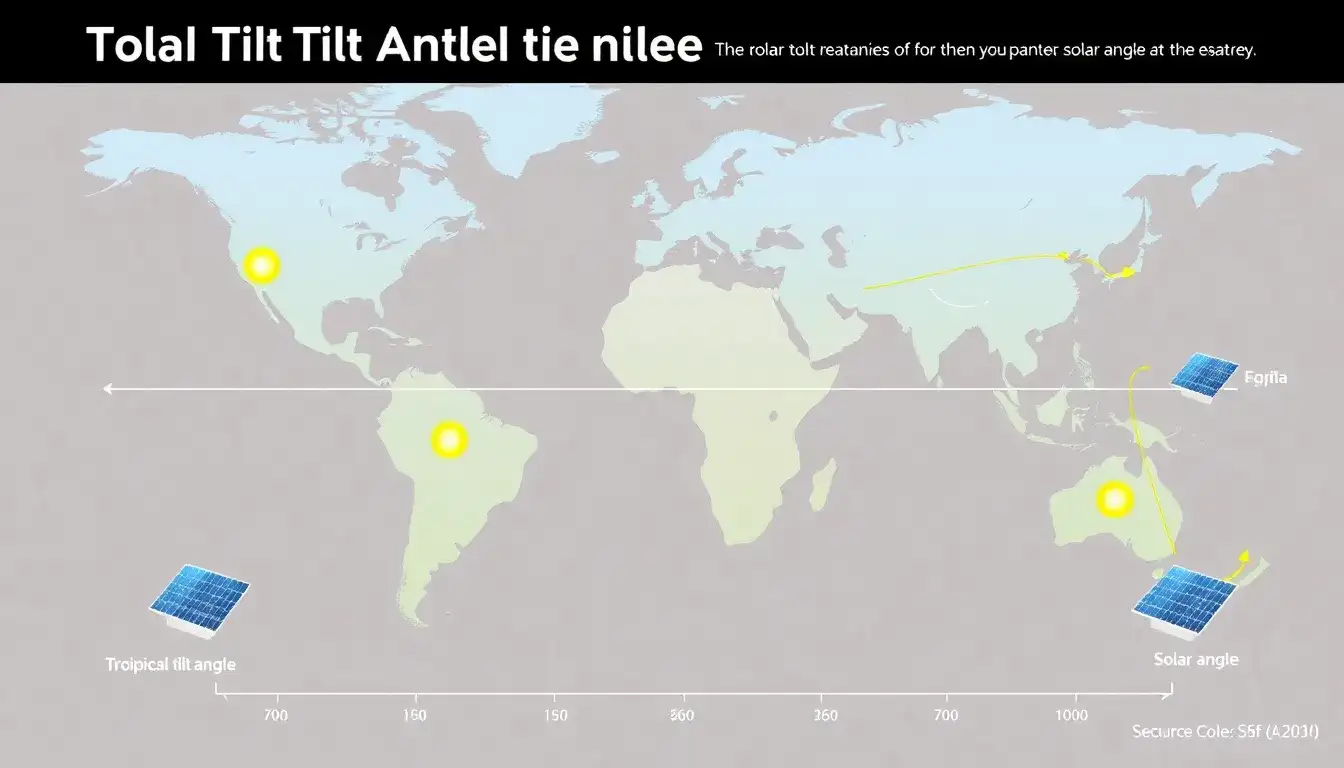
The ideal tilt angle for solar panels varies mainly with latitude and the season, aiming to maximize exposure to the sun:
General Rule of Thumb by Latitude and Season
- Annual Fixed Tilt: A good general fixed tilt angle for solar panels is to set them approximately equal to your latitude. For example, if your latitude is 34°, the fixed tilt would be around 34°.
- Seasonal Adjustment:
- Winter: Increase the tilt angle by about 15° (latitude + 15°) to capture the low winter sun better.
- Summer: Decrease the tilt by about 15° (latitude – 15°) to better catch the higher summer sun.
Improved Seasonal Calculation
- Some refined formulas suggest:
- Winter tilt = (latitude × 0.9) + 29°
- Summer tilt = (latitude × 0.9) – 23.5°
- Spring/Fall tilt = latitude – 2.5°.
For example, at 34° latitude:
- Winter tilt = (34 × 0.9) + 29 = 59.6°
- Summer tilt = (34 × 0.9) – 23.5 = 7.1°
This method results in steeper angles in winter and flatter in summer compared to the simple ±15° rule, optimizing midday sun capture especially in winter.
Latitude-Based Examples for Seasonal Angles (for latitudes 25° to 50°)
| Latitude | Summer Tilt (°) | Winter Tilt (°) |
|---|---|---|
| 25° | ~2.3 | ~41.1 |
| 30° | ~6.9 | ~45.5 |
| 35° | ~11.6 | ~49.8 |
| 40° | ~16.2 | ~54.2 |
| 45° | ~20.9 | ~58.6 |
| 50° | ~25.5 | ~63.0 |
Adjusting tilt angles 2 or 4 times per year around these values can improve annual energy harvest by a few percent.
Near the Equator and Special Cases
- Near the equator (e.g., latitudes close to 0°–10°), the sun is almost overhead year-round, so a low tilt angle (~10°) is preferred to avoid water pooling and optimize capture.
- Panels in the northern hemisphere should face true south, and in the southern hemisphere true north. Correct for magnetic declination if using a compass.
Other Practical Considerations
- Roof pitch often ranges between 18° to 37° in the US, which is close to many latitudes and provides near-optimal fixed tilt without adjustment.
- Orientation (facing south in the northern hemisphere) has a bigger impact (~30% efficiency gain) than fine-tuning the tilt by a few degrees (which may only yield 1–8% gain).
- For grid-connected systems, fixed tilt close to latitude is usually sufficient; for off-grid systems or winter-priority use, steeper tilt angles favoring winter sun may be better.
- Tracking systems that follow the sun can maximize output but are more expensive and complex, mostly practical for ground-mounted arrays.
Summary
| Location / Latitude | Fixed Tilt Angle | Seasonal Tilt Adjustments (Approx.) | Notes |
|---|---|---|---|
| General (latitude-based) | Equal to latitude | Winter = latitude + 15°, Summer = latitude – 15° | Simple and commonly used |
| Refined Seasonal Angles | Variable | Winter = 0.9×lat + 29°, Summer = 0.9×lat – 23.5° | Better captures midday sun, especially winter |
| Near Equator (<10°) | ~10° | Little seasonal variation | Sun overhead year-round |
| Latitude 25° to 50° | Approx. latitude | Summer tilt significantly flatter than winter tilt | Seasonal adjustment optimizes energy yield |
| Roof-mounted (typical US) | Roof pitch (~18°–37°) | Usually fixed tilt matching roof pitch | Close to optimal for many locations |
Use online calculators like PVWatts for precise angles considering local conditions, but the latitude-based rules provide very good approximations.
Original article by NenPower, If reposted, please credit the source: https://nenpower.com/blog/what-is-the-ideal-tilt-angle-for-solar-panels-in-different-latitudes/

