

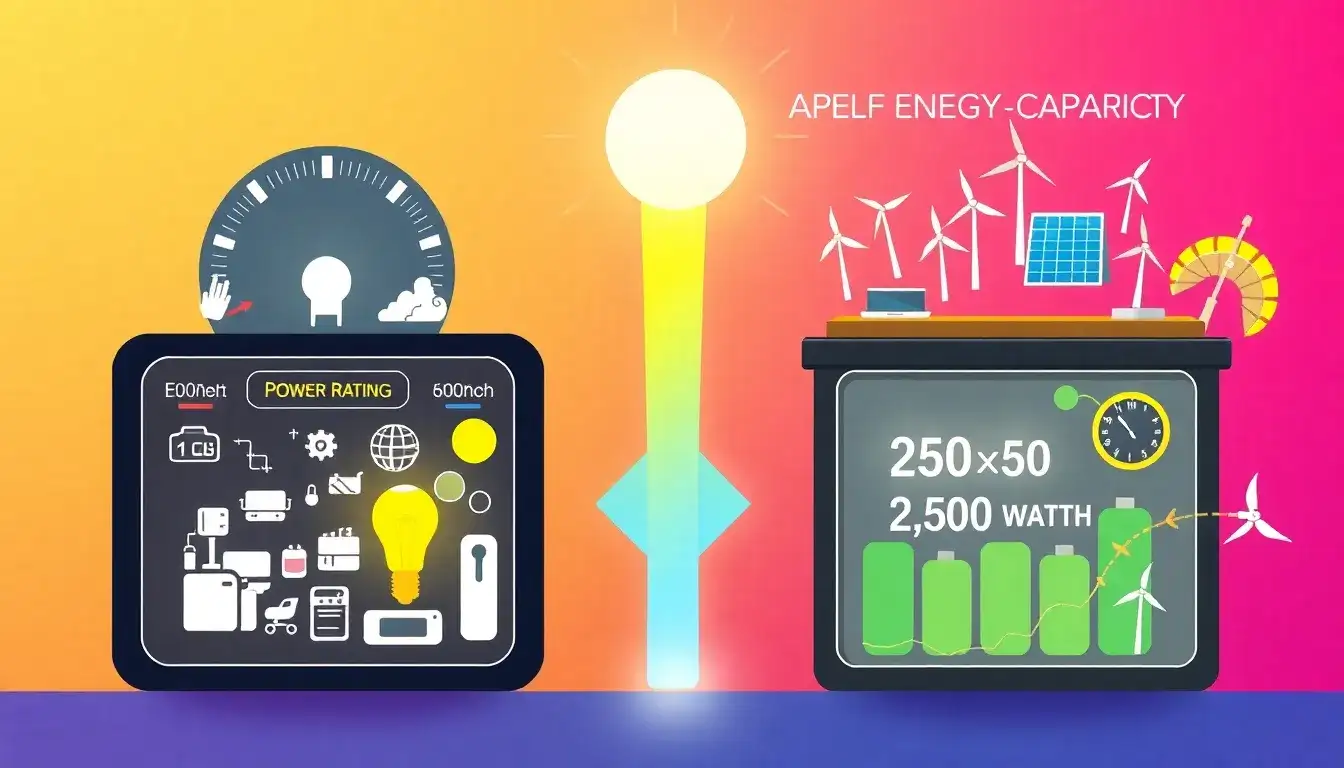
Power Rating vs. Energy Capacity
Power rating refers to the instantaneous output capability of a system, measured in kilowatts (kW) or megawatts (MW). It determines how much electricity can be delivered or consumed at any given moment. For example, a 500 kW system can instantly supply up to 500 kilowatts of power to meet sudden demand spikes.
Energy capacity represents the total amount of energy stored, measured in kilowatt-hours (kWh) or megawatt-hours (MWh). It defines how long the system can sustain power delivery at its rated output. For instance, a 2 MWh system paired with a 500 kW power rating can operate for 4 hours at full output (2 MWh ÷ 500 kW = 4 hours).
Key Differences
- Metric:
- Power = Rate of energy flow (kW/MW).
- Energy = Total stored energy (kWh/MWh).
- Application:
- High power rating is critical for rapid grid responses, such as frequency regulation.
- High energy capacity is essential for long-duration needs, like renewable energy backup during low generation periods.
- Relationship:
Duration = Energy Capacity ÷ Power Rating. A 40 MWh battery with a 10 MW power rating provides 4 hours of runtime at full load.
In practice, systems balance both to address specific use cases, such as peak shaving (high power to reduce grid strain) or load leveling (high energy to store excess generation).
Original article by NenPower, If reposted, please credit the source: https://nenpower.com/blog/what-is-the-difference-between-power-rating-and-energy-capacity/

