

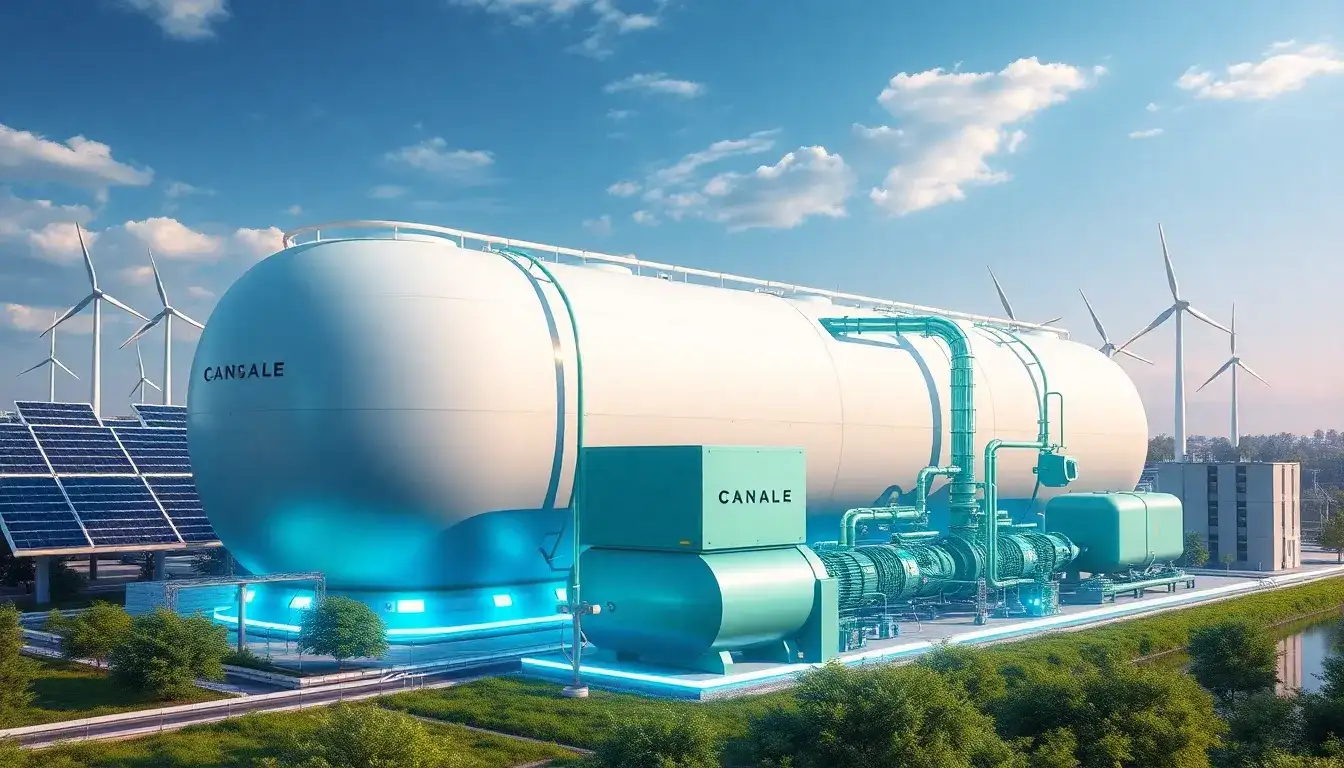
Several innovations could improve the efficiency of Compressed Air Energy Storage (CAES) systems by addressing key technical challenges such as heat management, system integration, and operational flexibility.
Innovations to Improve CAES Efficiency
1. Integration of Thermal Energy Management (Adiabatic CAES)
Traditional CAES systems lose significant energy as heat during the compression stage, lowering overall efficiency to around 40-50%. Adiabatic CAES systems improve efficiency by capturing and storing the heat generated during air compression and reusing it during the expansion phase. This approach can potentially raise efficiency to 70% or higher and reduces or eliminates the need for external fuel sources for heating, making the system more environmentally friendly.
2. Hybrid CAES Systems
Combining CAES with renewable energy sources such as wind or solar (Hybrid CAES or H-CAES) enhances system efficiency by storing excess renewable energy when generation exceeds demand. This integration also helps smooth out intermittencies in renewables, improving overall grid stability and maximizing the use of clean energy.
3. Advanced Compression and Expansion Technologies
Utilizing electrically powered turbo-compressors and turbo-expanders can improve compression and expansion efficiencies. Innovations in turbine and compressor design, including using technologies like multi-port power converters and advanced power distribution controls, allow the system to respond quickly to grid demands and operate efficiently across a wide range of power outputs.
4. Thermal Mechanical Long-Term Storage
New thermal mechanical storage methods use thermodynamics to store electrical energy as thermal energy, which can later be converted back efficiently. This approach enhances the ability to store energy over longer periods while retaining more of the initial energy input.
5. Isothermal Compression and Expansion
Implementations using multi-stage compression with inter-stage cooling, such as isothermal CAES, maintain air temperature closer to ambient during compression, reducing energy losses. Techniques like airblast venturi pumps with heat exchangers improve the heat management between stages and enhance overall efficiency.
6. Flexible Operation and Enhanced Control Systems
CAES plants designed to independently operate compression and expansion units provide flexible cycling options. This enables simultaneous load absorption and energy generation, quick response times (full compression or expansion available within minutes), and excellent part-load efficiency, which collectively optimize the system’s energy use.
Summary Table of Key Innovations
| Innovation | Efficiency Impact | Additional Benefits |
|---|---|---|
| Adiabatic CAES | Potentially ≥70%, reduces heat loss | Eliminates external fuel need, lowers emissions |
| Hybrid CAES | Improves energy use of renewables | Enhances grid stability, maximizes renewable integration |
| Advanced Turbines & Compressors | Improves mechanical efficiency | Rapid response, load-following, part-load efficiency |
| Thermal Mechanical Storage | Improves long-term energy retention | Enables days of storage, reduces losses |
| Isothermal Compression | Reduces compression heat loss | More efficient compression stages |
| Flexible Cycling & Control Systems | Enhances operational flexibility | Quick start-up, simultaneous charging/discharging |
These combined innovations target increasing overall energy conservation and efficiency, reducing reliance on fossil fuels, improving the scalability of CAES systems, and ensuring better performance to meet grid demands effectively.
Original article by NenPower, If reposted, please credit the source: https://nenpower.com/blog/what-innovations-could-improve-the-efficiency-of-caes-systems/

