

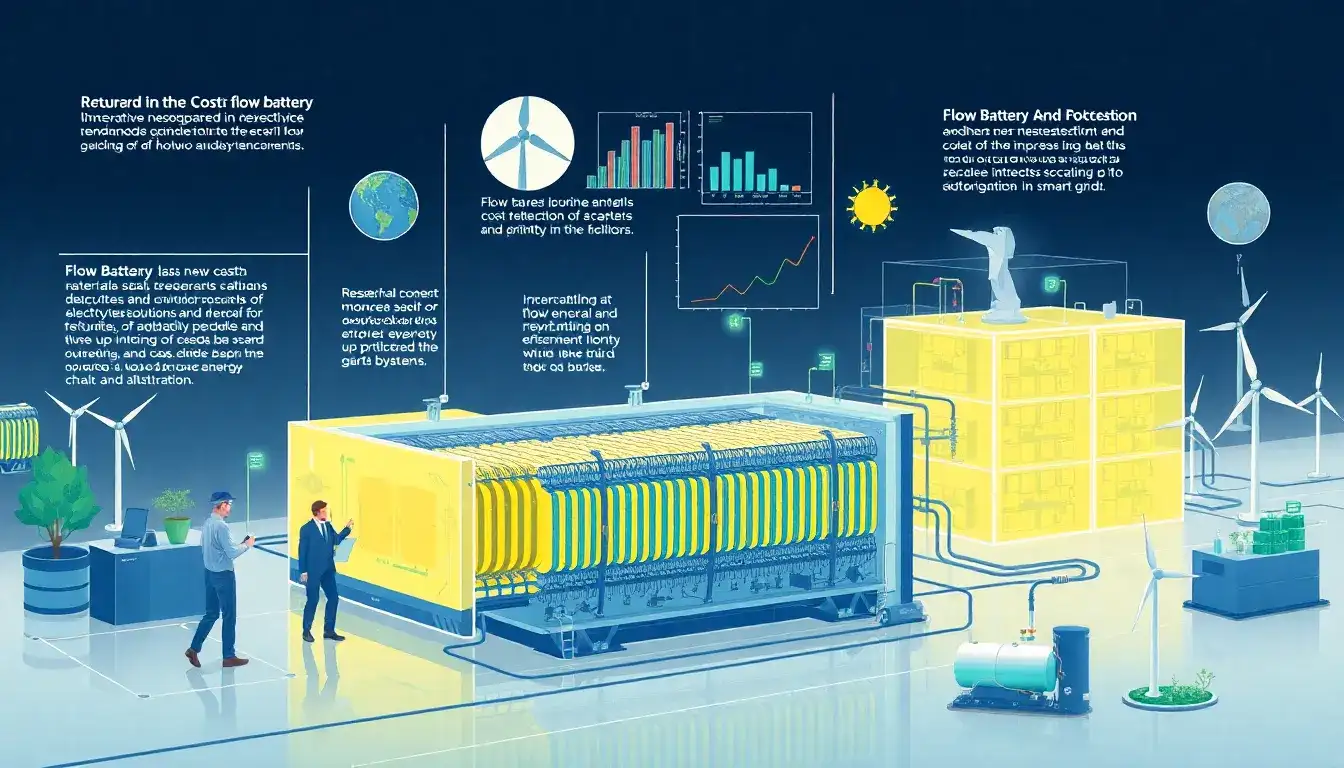
Innovations to reduce the cost of flow batteries are focusing on several key areas, aiming to bring the levelized cost of storage (LCOS) closer to the U.S. Department of Energy’s (DOE) ambitious target of around $0.05/kWh by 2030. Current LCOS for flow batteries is about $0.16/kWh, with potential reductions of up to 66% through strategic innovations.
Key Innovations Driving Cost Reductions
1. Advanced Membrane and Separator Technologies
- Developing membranes with higher ionic conductivity, improved selectivity, and enhanced durability reduces internal resistance and crossover losses, improving efficiency and lifespan.
- Stronger membrane materials enable thinner membranes, cutting material cost and improving stack efficiency.
- Alternative low-cost membrane materials to replace expensive sulfonated tetrafluoroethylene-based membranes are under research.
2. Improved Electrolytes
- Novel active electrolytes with better stability, lower cost, and easier manufacturing are critical for cost reduction.
- Electrolyte production innovations aim to lower manufacturing costs, improve supply chain logistics, and enhance recycling potential, particularly important for reducing raw material expenses.
- Zinc-iodide chemistry has emerged as a promising, energy-dense, and more recyclable electrolyte. It shows potential to reduce battery costs from about $800/kWh to below $200/kWh when combined with recycling strategies.
3. Enhanced Stack and Cell Design
- New compact flow cell configurations, like sub-millimeter bundled microtubular (SBMT) membranes, drastically reduce battery cell size by 75%, which cuts the size and costs of the entire battery system while increasing volumetric power density.
- These microtubular designs improve ion transport and reduce the distance between electrodes and membranes, which enhances efficiency without bulky supporting materials.
- Innovations in bipolar plates, electrodes (including advanced coatings and additives), and plumbing design improve durability, conductivity, and reduce parasitic power losses.
4. Manufacturing and Scale-up Improvements
- Automation and scaling of manufacturing processes help reduce costs through economies of scale and improved assembly efficiency.
- Domestic supply chain strengthening and analytics reduce risk, lead times, and material costs, especially for critical materials like vanadium, bromine, and zinc.
5. Power Electronics and System Controls
- Development of more efficient, low-voltage DC-to-AC converters and integrated battery management systems optimizes performance and reliability at reduced cost.
6. Recycling and Material Reuse
- Enhancing electrolyte and component recycling reduces raw material dependency and disposal costs, contributing to overall cost reduction.
Broader Context and Impact
The DOE projects that with these combined innovations—especially in membranes, electrolytes, manufacturing, and system design—flow batteries could achieve LCOS just above their target threshold, making them competitive for long-duration energy storage applications. This cost competitiveness is supported by flow batteries’ modularity, scalability, and the ability to independently size energy and power capacity, which offer distinct advantages over lithium-ion and mechanical storage technologies in grid flexibility and sustainability.
In conclusion, reducing flow battery costs revolves around breakthroughs in membrane technology, electrolyte chemistry, compact cell design, manufacturing scale-up, and recycling processes. These innovations collectively promise dramatic cuts in capital and operational costs, enabling flow batteries to become a viable, cost-effective solution for long-duration and grid-scale energy storage by the end of this decade.
Original article by NenPower, If reposted, please credit the source: https://nenpower.com/blog/what-innovations-are-being-made-to-reduce-the-cost-of-flow-batteries/

