

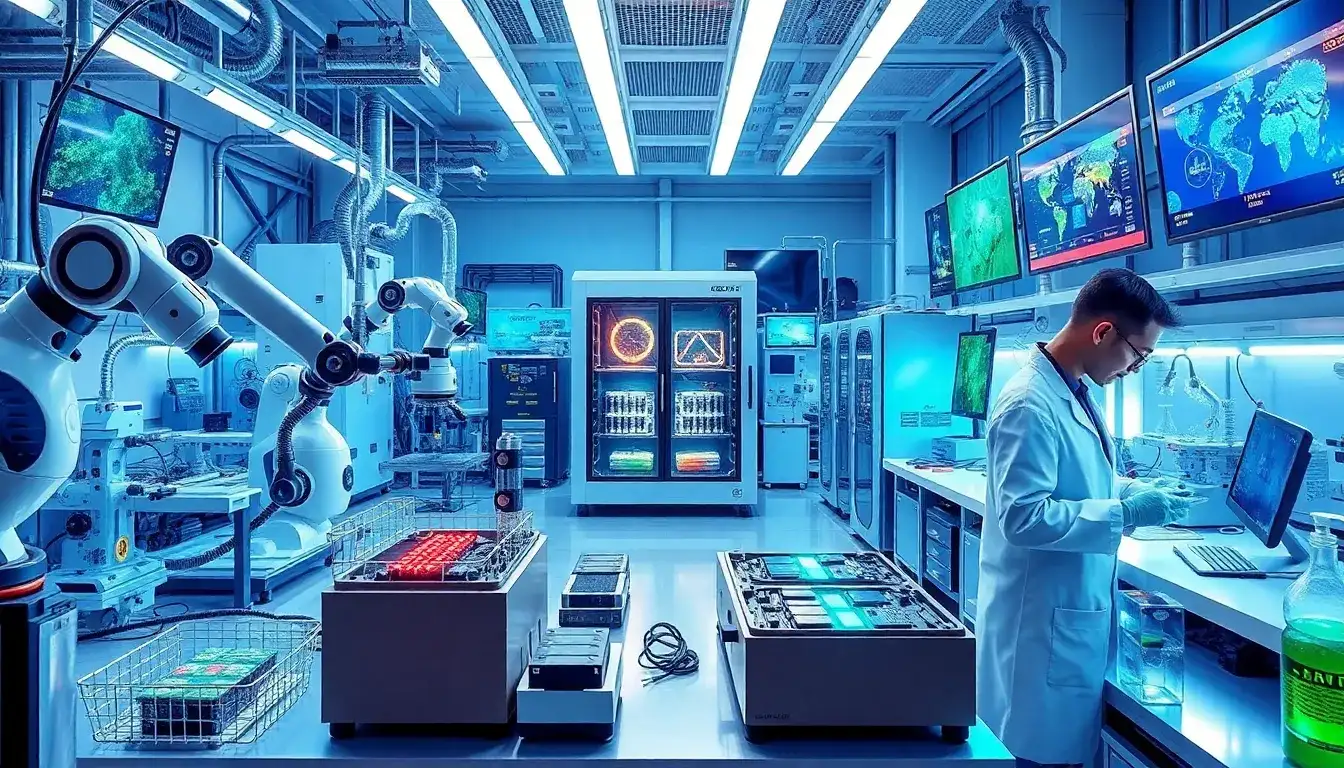
Innovations in lithium-ion battery (LIB) recycling are focused on improving efficiency, environmental friendliness, and material recovery rates. The main approaches and recent advancements include:
Established Recycling Techniques
- Pyrometallurgy: Uses high-temperature treatments to recover metals but often produces alloys requiring further chemical processing.
- Hydrometallurgy: Involves chemical dissolution to extract metals and is currently the most researched method, aiming for more cost-effective and environmentally friendly processes.
- Direct Recycling: Seeks to preserve the electrode’s chemical structure for reuse, but research and application remain less developed compared to the other methods.
Emerging Innovations
- Hybrid Recycling Approaches: Combining pyrometallurgical and hydrometallurgical steps for better metal recovery efficiency and purity.
- Focus on Cathode Recycling: Due to the high value of critical metals like cobalt, nickel, and lithium, there is prioritized innovation in recovering cathode materials.
- Eco-friendly Chemical Processes: Researchers are developing hydrometallurgical processes that reduce chemical use and environmental impact.
Breakthrough Technologies
- Battery Recycling and Water Splitting (BRAWS) Technology: Developed by the U.S. Department of Energy’s Ames National Laboratory, this method uses only water and carbon dioxide to recycle lithium-ion batteries without hazardous chemicals or high heat. Key benefits:
- Recovers nearly all lithium from spent batteries.
- Produces green hydrogen as a byproduct, which can be used as fuel.
- Consumes carbon dioxide, helping to clean the environment.
- Leaves other materials intact enough to be reused directly.
- Commercial Production of Lithium Carbonate from Recycled EV Batteries: Companies like Ascend Elements are pioneering processes that efficiently convert recycled battery materials back into lithium carbonate, a critical raw material for new batteries.
Industry and Digital Innovations
Incorporation of digital solutions and improved recycling technologies enhances operational efficiency and traceability in battery recycling, accelerating industry-wide adoption and scale.
In summary, the field of lithium-ion battery recycling is advancing through a mix of optimizing existing methods like hydrometallurgy, innovating with hybrid approaches, and pioneering truly green technologies like BRAWS that minimize chemical and energy inputs while maximizing lithium recovery and environmental benefits. Commercial entities are also developing scalable solutions that turn recycled materials back into usable battery components, closing the loop in the lithium-ion battery lifecycle.
Original article by NenPower, If reposted, please credit the source: https://nenpower.com/blog/what-innovations-are-being-made-to-improve-the-recycling-of-lithium-ion-batteries/

