

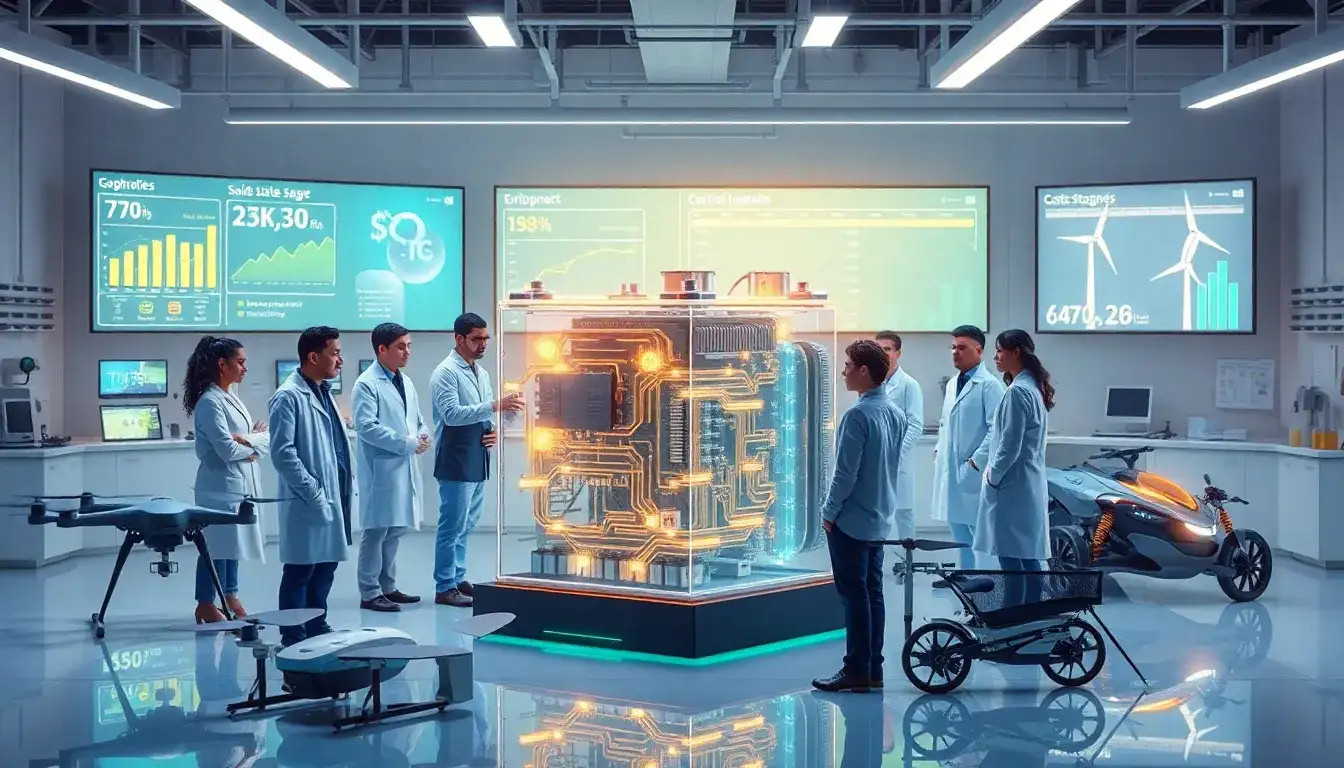
Innovations in battery storage technology are being developed to reduce costs and enhance performance. Here are some key advancements:
Recent Innovations
- Lithium-Sulfur Batteries: These batteries replace cobalt with sulfur, reducing production costs and environmental concerns associated with cobalt mining.
- Sodium-Ion Batteries: These use abundant, non-toxic materials and are less energy-dense than lithium-ion batteries but offer promise for cost reduction in stationary applications.
- Solid-State Batteries: These use solid electrolytes, increasing energy density, safety, and charging speeds compared to traditional lithium-ion batteries.
- Flow Batteries: While more expensive, they provide long-duration energy storage, making them suitable for stabilizing renewable energy sources.
Cost Reduction Strategies
- Technology Advancements: Improvements in manufacturing processes and materials are expected to lower the cost of lithium-ion batteries, with shifts away from expensive materials like cobalt.
- Scaling and Automation: Large-scale production and automation can significantly reduce the cost per unit of energy storage solutions.
- Diversification of Chemistries: Exploring alternatives like sodium and lithium-sulfur can lead to cheaper raw material costs.
- Supply Chain Optimization: Using AI for supply chain management can further reduce costs by optimizing inventory and production planning.
Future Projections
- Long-Duration Energy Storage: The U.S. Department of Energy aims to reduce long-duration storage costs to $0.05/kWh by 2030 through innovations in various technologies, including pumped hydropower and compressed air storage.
- Grid Integration: Batteries are becoming integral to modernizing the power grid, enhancing reliability and resilience by stabilizing supply and demand.
Original article by NenPower, If reposted, please credit the source: https://nenpower.com/blog/what-innovations-are-being-made-in-battery-storage-technology-to-reduce-costs/

