

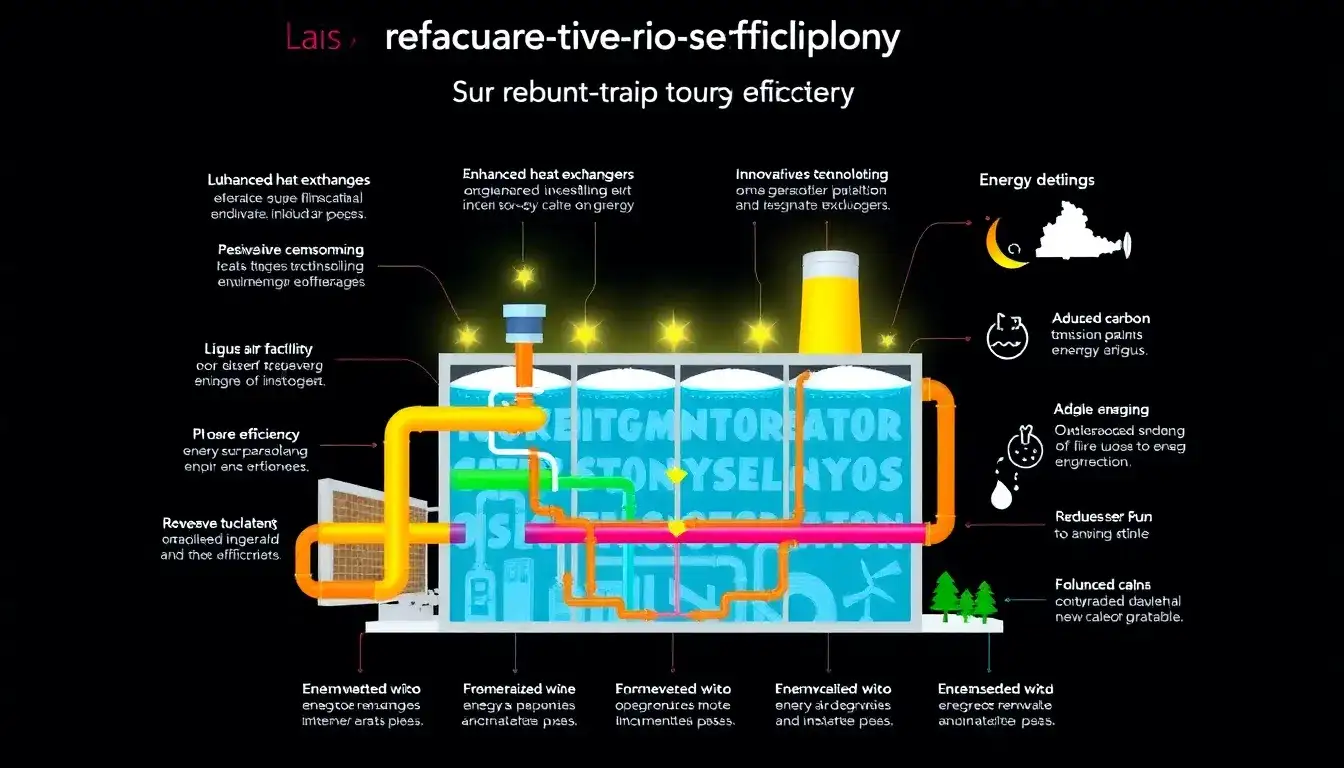
Improvements to the round-trip efficiency of Liquid Air Energy Storage (LAES) systems have primarily focused on enhancing system design, optimizing thermal energy management, and integrating external heat and cold sources.
Key Improvements in Round-Trip Efficiency of LAES Systems
- Enhanced system configuration and thermal energy optimization:
Research indicates that improving the overall system setup and maximizing thermal energy storage capabilities are critical to boosting round-trip efficiency. This involves optimising the thermodynamic cycle and employing cold recycle processes to improve efficiency beyond initial standalone levels. - Utilization of waste heat:
Injecting available waste heat during the expansion phase of the air substantially increases the work output of the generators, effectively improving round-trip efficiency. Higher-grade waste heat leads to better performance and reduces the need for internally generated heat during the recharge phase, which cuts operational costs.
Integrating LAES plants near industrial sources of waste heat, like steel mills or power plants, has demonstrated efficiency improvements from approximately 60% (standalone) to over 70%. - Utilization of waste cold:
During the recharge phase, applying waste cold—such as that produced during LNG regasification—reduces the workload on refrigeration systems, lowering power consumption and raising overall efficiency. - Standalone system innovations:
Researchers at Dongguk University developed a standalone LAES system that offers significant efficiency and economic performance gains without the need for integration with external thermal power plants or industrial heat sources. This preserves the key advantage of LAES systems’ geographical and operational independence, while overcoming some prior limitations of requiring adjacent thermal infrastructure or external fuels (which have associated CO2 emissions).
Summary Table of Efficiency Improvements
| LAES Configuration | Round-Trip Efficiency | Notes |
|---|---|---|
| Standalone, basic cycle | 50–60% | Based on early large-scale standalone systems |
| Standalone, improved design | ~60% | Optimized thermodynamic cycles and cold recycle |
| Integration with waste heat | >70% | Injection of industrial waste heat during discharge |
| Integration with waste cold | >70% | Use of cold from LNG regasification during recharge |
| New standalone system (Dongguk University) | Significant boost reported | Improved efficiency and economics without external system reliance |
These advancements illustrate a progression from standalone systems with efficiencies around 50–60% toward integrated approaches exceeding 70% efficiency, with ongoing research focused on balancing performance gains against system independence and environmental sustainability.
In conclusion, the round-trip efficiency of LAES systems has improved mainly through system optimization, recovery and reuse of waste heat and cold, and innovative standalone designs that reduce reliance on external infrastructure while maintaining or enhancing efficiency.
Original article by NenPower, If reposted, please credit the source: https://nenpower.com/blog/what-improvements-have-been-made-to-the-round-trip-efficiency-of-laes-systems/

